Graduation 2015

The following speech was delivered to the class of 2015 on June 9, 2015 in Seattle WA.

1 All students all alike in dignity

2 In dear Seattle where we lay our scene

3 from ancient text to music harmony

4 We study things we know and things unseen

5 From the communal mind of what we know

6 Each student now walks across this great stage

7 To celebrate all that they’ve done to grow

8 and now to walk onto histories page

9 their wondrous passage into their high school

10 is now for everyone to take in stride

11 just please remember Our one golden rule

12 respect is how you live your life with pride

13 and with today as in all of your dates

14 go forth and make us proud dear graduates

My speech tonight is filled with quotes. Words of people I admire. Listen closely for the quotes. There may be hidden wisdom in them. Friends, Romans, Graduates, lend me your ears. It is an honor to have been selected to speak. Thank you. I would like to reflect on the purpose and path of education and why all of you are in an excellent position to succeed beyond your imagination. First, the teachers, faculty and especially your families have helped you to get to this point – please be sure to personally thank them. Then, be sure to thank yourself. Your work, all your efforts, has gotten you here- sitting in the garb of a graduate. Graduates oh graduates, wherefore are thou graduates? That is to say, why are you graduates? Culminating in walking across the stage today your education has been formidable. I know there has been struggle and angst; yes there has been the predictable blood, sweat, and tears of learning in Middle School. But, there has also been great joy that details your memories of EW. I will guess that you will look back on your time here and recognize the achievement of completing middle school at EW. It is an excellent preparation for any of the schools that you are each attending next year. I think that once you get out of the metaphoric woods that EW lives in, and start comparing your experience to other ninth grade students, you will see how vast and deep your education has already been. As you move from middle to high school, remember this, to learn or not to learn that is the question; to tank and fail – perchance to be in the zone and succeed. Ay there is the rub. Yes, the difference between learning and tanking is the task of the student. Ultimately – and I am sure this may spark great debate – it is not about the grade. Your memory of each score will fade, but the lessons learned will last longer and always be there to support your future ambitions. One of my favorite Zen quotes is, “The expert in anything was once a beginner.” I am reminded of the learning process daily. Not only as I watch the students of EW grow, but as I watch my own children grow too. My daughter, almost six months old now, has recently learned how to belly crawl across the floor. She illuminates the idea that learning is failing and then trying again. That is how you stay away from tanking. She, regardless of her failure to get her knees involved in the process of crawling properly, is in the zone and continues to work on the task of moving across the floor. I believe that the EW graduates align with this idea and Bruce Lee when he said, “I either win or I learn.” I hope that each of you can take that mentality with you in your future years as life continues to present the challenges and rewards of being an engaged life long learner. “You don’t always need a plan” I saw this quote recently posted online and read on. “Sometimes you just need to breathe, trust, let go, and see what happens.” The powerful moment here is the potential of each one of you. Through the following years each of you will earn, win, face challenge, experience success. These events will continue to shape who you are: A Nobel Lauriat; A social worker eliminating homelessness; A politician fighting for equal rights; An artist that addresses the concerns of society? Doctors that work across boarders; lawyers that advocate for the rights of everyone; the next inventor of the next tech revolution; Loving Parents; Loyal friends; engaged people that care about the world around them and a sustainable future? I hope so. I have said for a long time, “The essence of life is not about being perfect. In fact, perfection exists so that we have something to strive for.” This is at the heart of education, for me. There will always be someone that knows more than you; someone that can run faster than you; someone that will outperform you in one-way or another. Yet, for every person better than you, there is someone looking at you with the same thoughts. And, today, we are looking at you with pride in our hearts. Your achievement today, makes us proud. Regardless of who is better than whom, what matters is that you each run your own race and “don’t let your perceived limitations ruin your creativity.” Creativity is one of the greatest assets that you all have acquired at EW. From Drama to every other subject, creative thought is required. Every vocation benefits from creativity. It is our imagination that spurs ingenuity. It is one of my favorite parts of this school: creativity is held in the same regard as responsibility, confidence, and integrity. When students arrive here, in my class and every other, one of the other great lessons they learn is self-confidence. And, this is important because self-doubt is one of the most crippling forces. Self-confidence is one of the most empowering. EW Graduates know that have a voice that both matters and will be heard, because they have self-confidence. Education Researchers, Fay and Funk put it this way, “A positive self concept comes from feeling capable.” EW graduates are highly capable: from challenge assignments to an immersive curriculum that spans many of the most essential subjects, EW Students are empowered to take on the world. EW Graduates, you amaze me with your self-confidence. You are empowered to speak you mind, engage in civil debate, solve problems with elegance, change the world and address the problems that have been handed to you. Gandhi was smart and can give us this guide, “You can be the change that you wish to see in the world.” Rumi would add, “You should first change yourself.” I hope that I have not been too dogmatic here. The best teachers show you where to look but not what to see. To turn this idea around here Graduates, I predict that you will be showing the world where to look. In just one short decade, you will be entering the workforce as informed impassioned leaders. I would like to credit you time at EW as partially responsible for that. Regardless of where you end up, no matter where you are, how educated you are, how rich, poor, or cool you are, what matters in the end is how you treat people. Ultimately, this tells everything about you. Act with integrity and respect in all things. I know you graduates will stand up for what matters and for what is right in the world. I know it is in good hands. Vince Lombardi gives me my final words for you, “Every job is a self portrait of the person who did it. Autograph you work with excellence.” Congratulations graduates. I am truly proud of each and every one of you.
Know Thy Students: Expect Diversity

“Our understanding of a group remains incomplete when the perspective of either the insider or the outsider is overlooked (Banks, C.A.M., 1996, p 52).” Knowing the group is essential for anyone in teaching because teaching is a two-way relationship. Students must understand their teacher and the teacher must teach to the student understanding. How does one get to know their students? Multicultural education requires a dynamic curriculum that is derived from the interests of the teacher and the interests of their students (Mvududu, 2015). It is true that teachers must continually adapt and change their instruction. Early in my teaching career I had a challenging experience.

I was hired as an after school tutor. Previously, I had worked for a very middle-class and white population of middle and elementary school aged students in a one-on-one environment. Now, I was hired to work in a low-income and racially diverse school. I was to implement after school programming such as yard games and arts activities in addition to homework help. On paper, I was a great fit. In reality, I was not ready to do the work to form a relationship with students that saw this after school program as a holding tank that they had to stay at because their parents could not pick them up. One student in particular expressed this opinion nearly every day. Both a Pacific Islander and a musician, he loved to play a ukulele. I would frequently stop him from playing. I would tell him to put the ukulele away so that he could participate in my activities. “You can’t keep me here,” he would say as he stormed off and ran down the hall away from the gym, where he was supposed to stay. Because it was an after school program and because the school was already understaffed, I could not leave the gym. I had to call for support when this happened. The student was frequently angry. While I tried to treat the student with respect, it became difficult for me to do when he attacked my own identity. “You’re not like me, you wouldn’t understand.” I wanted to understand. But, the barrier that was between us was too difficult to overcome. I gave up and left the position as soon as a replacement could be hired.

Both of us, the student and myself, constructed a meta-narrative about each other. We both had an alien voice for each other. We both made assumptions about whom the other of us was. If we could have challenged our instinctual notions and in turn challenged the metanarrative, just as early African American Scholars did with the story of the Westward Movement (Banks, C.A.M., 1996, p 52), there could have been change; we could have told the whole story, or at least have gotten closer to a full picture of each other. But, the damage of our mutually exclusive meta-narrative was done. We needed our stories to be unpacked. I wanted to help and he wanted to be heard. Sometimes we a set back because of the metanarrative that is given to us; this is the same story that we take as the truth about the world. We must question the metanarrative and ask to hear the voices that are put down just as the voices of the Native Americans were put down and adjusted in the footnotes of history. We, teachers, cannot sideline a student because we do not understand them. This of course crosses racial lines and includes any diversity that a student may bring to the classroom. We cannot make assumptions about the metanarrative they bring to the classroom. We must work to unpack and uncover the multiple narratives that talks about both the minority and majority experience of the student.

I understand from that experience that the job of a teacher is far more than instruction and organizing activities. The job of a teacher is to connect with their students. If I could do it again, I would. I would make more of an attempt to get to know this troubled student. I would ask him open-ended questions. I would share about my own ideas and try to find points of common connection. I would have let him play his ukulele and even lead the group in song. It would have been completely appropriate for the after school program. I bet he would have changed his mind about me. I bet I would have changed my mind about him.

If a teacher constructs a meta-narrative about a student they can become pinned down to that narrative. For me, that student will always be a troubled student that I was unable to reach. If I had implemented a dynamic curriculum that was responsive to the needs and identity of my students, I would have made a positive impact. “Multicultural education, as we’ve seen, supports just that dynamic, curriculum rising in part from the interests and backgrounds of diverse kids (Mvududu, 2015).” We must teach the students that show up in our class and use their cultural assets and interests to instruct them in the content.

Discussing my successes with culturally responsive teaching would be easy. I have now developed a program in my drama classes that demands that students talk about what they know and love. By making my curriculum implicitly responsive to the student interests (by having them create the content) I am forced into a culturally responsive stance. However, I must continually improve. Another recent challenge for me rests in a student that left the school before the year was completed. This student felt alienated; I can only assume the reasons. He is Middle Eastern with a very dark complexion. He looked black to many students and was often confused for African American. He is Muslim; this is a fact I did not learn until after his departure. He was incredibly short and believed that the NBA had a spot waiting for him. He was the last of seven children. Many teachers, including myself, believed that his parents had given up on him. We would have benefited from these wise words, “all families, no matter what their income, race, education, language, or culture, want their children to do well in school – and can make an important contribution to their children’s learning (Mvududu, 2015).” We tried to work with the family; but our work was far too late in the game. I tried, for about a year, to connect with this struggling student. He declined, often, to share details about his life

We cannot reach every student. As teachers, it is impossible to know every student as well as we should. It is an unfortunate numbers game. But, I still put the blame on my plate. I could have spent more time getting to know him and less time “supporting his academics.” I saw him as a struggling student and he stayed a struggling student.

Know THYSELF, linked here.

Know THY SUBJECT, linked here.

Back to Prologue and Epilogue, here.

References:

Banks, C.A.M. (1996). Intellectual Leadership and the Influence of Early African American Scholars on Multicultural Education. In J.A. Banks (Ed.), Multicultural Education: Transformative Knowledge and Action (pp. 46-63). New York, NY: Teachers College Press.

Mvududu, N. (Director) (2015, May 1). Class Lectures. Diversity in America, Spring Quarter. Lecture conducted from Seattle Pacific University, Seattle.

Equal Access to Academic Language and Classroom Content through Flipped Learning

Giving students the opportunity to access classroom content in multiple ways is an essential practice of an effective educator; learning content specific academic language can be difficult for both advanced English language speakers and English speakers that are still acquiring fluency, the effective educator will give students multiple opportunities to learn the same content in different ways so that students of different backgrounds can be served equally.

In theatre arts, learning the academic language associated with blocking (the physical movement on the stage that is comprised of entrances, exits, and moving about the stage) can be difficult to master. In my classroom, students are given multiple opportunities to interact with, process, and perform their understanding of the content. This can be especially effective for students that are English Language Learners, struggling readers, or struggling writers.

A primary strategy to instruction of blocking is through a flipped classroom model. First, blocking can be difficult to understand because it is comprised of a coded language that makes the process simpler if the user understands the code. Consequently, I put together a set of instructional videos that mirrored instructional lessons so that the students can take the time to comprehend the information at a pace that works for them. These videos both teach the code of blocking, the reasons for the codes, and how the student can use the blocking.

Further videos allow the students to document the blocking that will be used in the production. These videos have both auditory instructions and the blocking written out for students to copy down; most importantly, students can pause and rewind the video at any point so that they can catch all the information that they need. Students get to both see the code and listen to the fully spoken explanation of the blocking. Any questions that students have are answered in class.

The second strategy, now that students have a written record of the required blocking for the production is to process that information through performance and rehearsal. Students demonstrate their knowledge by actually doing the blocking on stage. This critical step takes the information away from the abstract representation and transforms it into a physical practice that anyone, regardless or reading or writing level, can perform.

Lastly, students explain in their own words why their character is completing the movement in the blocking. Allowing the student to personalize the information, this step makes the information memorable. Because, blocking is more than the set of codes that represent locations on the stage; blocking is the physical expression of the actor.

These multiple modalities represent three best practices in teaching content area language. Students get to learn through multiple forms of the text (recorded audio, recorded video, in person class time) at an understandable rate; students get to perform and demonstrate their understanding of the academic language; students get to personalize the information to finalize the memorization process and relevance.

This was the first year that I presented theatrical blocking through a flipped classroom. The approach is unconventional. Some of my more experienced theatre students resisted the concept. They wanted to quick coded language (ex. Bob X DSL, R O Sam, EX USR instead of Bob crosses down stage left to the right of Sam and then exits up stage right) that they could pick up on the spot. However, students that took more time to learn this content (my sixth grade class for the most part) really enjoyed the process of learning blocking through the flipped classroom because it gave them time to both understand the blocking and process their understanding in class.

The implications for student learning are significant. Presenting the blocking and academic language associated with it through an online format allows students to go back to the information at any time that they choose. I had many students comment that they enjoyed being able to reference both the primary instructional video and the actual blocking videos.

Further iterations of this project may include multiple videos of the blocking. One video would be the quick coded message version, so that more experienced students could sort through the content quickly and a second version for students that needed a more thorough explanation. This would address the concerns that my more advanced students had with the approach while maintaining the online resource for my students.

Cross Content Collaboration

Collaboration within the school community can be an effective way to reach students across content areas and to help create new and renewed engagement for students and teachers; to do this teachers must collaborate across content areas and use appropriate communication to do so.

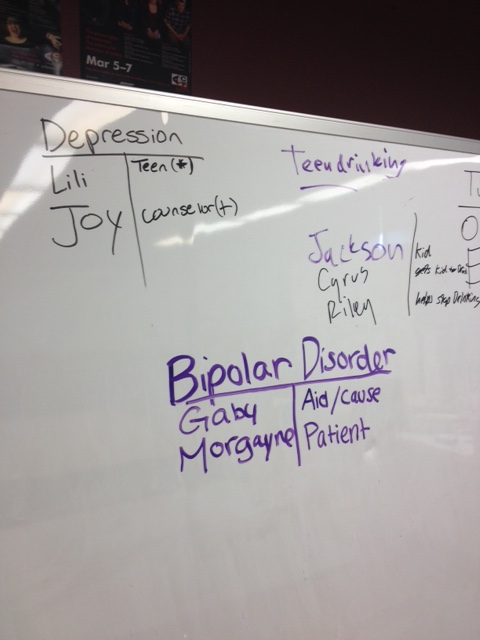
My most recent collaboration with a teacher outside of my subject area is an improvisation and health project. In the project, students must investigate and research health issues that are relevant to their lives and then use that research to build a character in drama. The characters then come together for a “community meeting” and discuss the issues of relevance in their improvised lives.

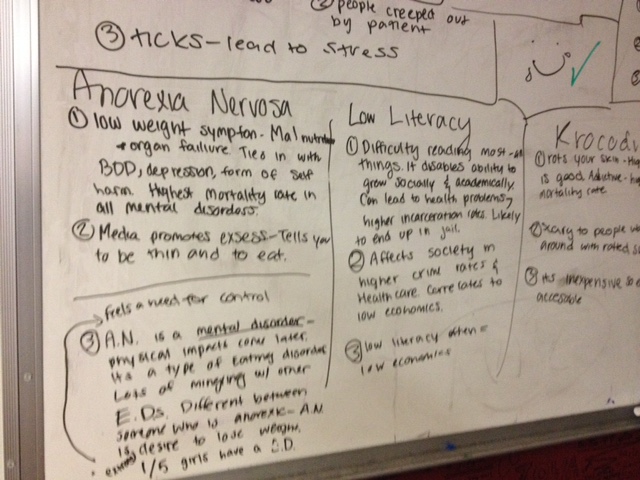
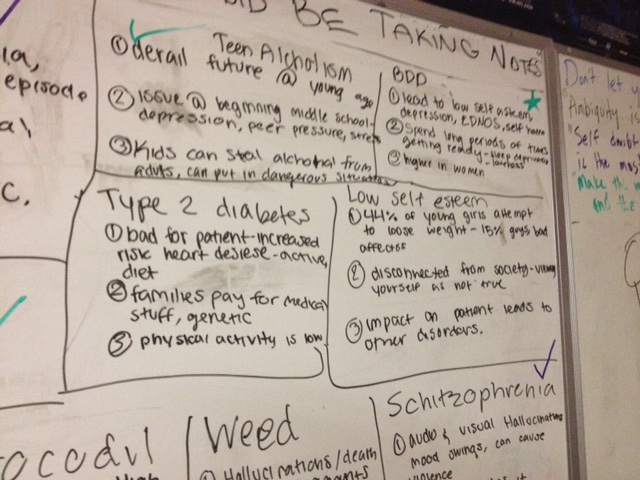
This project started with student research; this research was summed up in a inter-disciplinary meeting that shared the outcomes across content areas between drama and health. These pictures represent the research compiled by the students.

IMG_3616

IMG_3617

This information, generated by the students, was then summed up and shared with all the participating teachers so that it could be used in three ways. First, by using the foundational knowledge the health teacher is able to bring additional resources to the students so that their information that they use in drama can be more substantial.

Second, the students generate characters in an improvisational-based format that utilizes all of the research and gathered information. Based on the content from health class, students must create a back-story for their characters, character objectives and relationships, and character traits such as vocal and physical patterns.

IMG_3619

Lastly, this information, in addition to the work in class and the additional research in health class, is used to create a joint rubric. Students will receive a single summative evaluation that addresses their learning in both classes.

Every piece of written information is shared via Google drive so that both of the associated teachers can easily add and adjust content as the unit progresses.

This project exemplifies collaboration within the school because it is a unit that has and will continue to grow together. It allows students to combine their knowledge across content areas; this project further demonstrates this standard because it requires both of the collaborating teachers to communicate professionally in both written and verbal forms.

In summary, this project created a powerful effect on my students. They reported that the best aspect of the project was the integration of multiple subjects. Placing the health content in an improvisational format allowed them to explore the issues in both meaningful and personal ways. Further, this project created an excellent template (in both communication and lesson planning) for collaborations that I am sure will follow between the health teacher, other teachers, and myself.

In future iterations of this project, I will be sure to communicate with other teachers earlier in the year. While we had ample time to complete the project, the planning late in the year gave us undesirable timing when it came to the shared class time for the initial collaboration and the community meeting that the students jointly participated in.

Personal Performances that are Developmentally Logical and Abstract, Reflection

Teachers should plan for and adapt a curriculum with a learner-centered strategy that engages students in a culturally responsive and developmentally appropriate way.

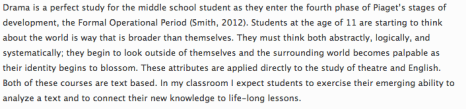
When it comes to developmentally appropriate instruction, planning can be informed by the study of the fourth phase of Piaget’s stages of development, the Formal Operational Period. As a part of this study I researched the importance of this important stage of development. As a part of coursework, I wrote, “students at the age of 11 are starting to think about the world in a way this is broader than themselves.”

Screen Shot 2015-04-28 at 10.59.23 AM
Course Research into Student Development: Piaget (https://davidoracekelly.com/2014/07/16/learning-drama-in-the-face-of-the-learner-paradox/#more-87)

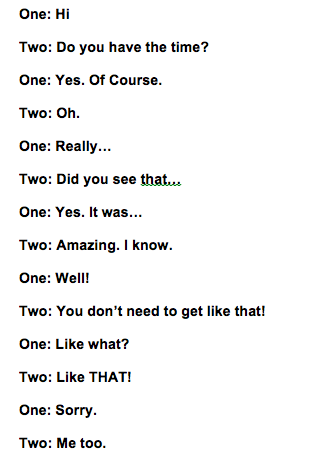
As Piaget’s fourth stage of development suggests, drama can help students to think both abstractly and logically. By studying a script they must both analyze the meaning of the text and interpret the meaning that is personally relevant. One example of this is a lesson I completed in the eighth grade. Students had to study a neutral scene and interpret the text by adding personal meaning in the performance. Students created a range of performances. By identifying the who, what, and where of the scene, students created a unique world from the abstract idea that was logically created. Student work included a daughter (One) and a mother (Two) after the daughter came home late from a party; another performance had a boyfriend (One) getting dumped by a girlfriend (Two); lastly, the most memorable performance was a rock-star (One) meeting a fan (Two) as the rock-star left a performance and unfortunately the rock-star disappoints the fan by not being everything the fan thought they were.

Picture of Neutral Scene

In this lesson, students had to imagine a situation that both logically fit the text and fit their own personal interpretation of the text. This exercise met both conditions found in Piaget’s fourth stage.

In summary, I have presented this lesson in the past. What changed this time was the insertion of personal meaning into the text. Students had to place themselves into the concepts that they were creating. The resulting performances were filled with significantly more meaning and emotional impact than I had previously seen.

Student learning in drama must include personal meaning. It is through this concept that students can personalize the work and create authentic performances. While this is typically a high-level skill that college students pursue, it is achievable in the middle school classroom through this tactic.

I propose that more of my work with text include personal meaning in performance. I will even add it to my evaluation rubric as a self-assessment component for all performances. I often talk about the symbiotic relationship between text and performer. This will bring that idea into reality; the performer must put their opinion into the text and bring it to life in a way that only they can. This key idea brought out new talent that was previously un-tapped by the students. These changes will both increase the artistry that the students produce and, more importantly, increase the student ownership of the work in drama.

You Should Champion the English Language and not Rant about Change

Every generation has cried out about the writing degradation of the next generation. Test scores are lower than ever, a critic may cry. But tests are biased ad are discriminatory to different populations depending on the content that the test asks about (Daniels, Steineke, and Zemelman, 2007).

The critic may try to expose the monumental outbreak that is assassinating the English language. “OMG” “LOL” and “BRB” are tearing apart our language. But, are they really? Language evolves with the people that use it.

What about “OK?” Historians cannot agree on the origination of the word. However, one dominant origination is from the phrase “orl korrekt” an alternate spelling of “all correct,” that was used in the U.S. during the 1830’s (for more explanation see http://www.oxforddictionaries.com/us/words/what-is-the-origin-of-the-word-ok).

From the birthplace of the English language, one of the greatest geniuses of all time, Shakespeare, made up more than 1700 words used in the common English of today (Mabillard, 2000). These words include, “exposure,” “birthplace,” “rant,” “dishearten,” “critic,” “monumental,” “outbreak,” “assassination,” and “champion.” There would not be a champion for the English language to rant about the disheartened critics, without Shakespeare.

The English language has been changing with every generation because of the way that people communicate. Perhaps today, the change is even more rapid. A teacher may say that their students hate to write; in reality the student may simply hate to write what the teacher wants (Daniels, Steineke, and Zemelman, 2007). However, students are not writing well for academic purposes (Daniels, Steineke, and Zemelman, 2007). This impacts the path of the student throughout life as they may struggle to learn advanced content in any given subject matter, as they work to meet state standards, as they seek out advanced education and take high-stakes testing such as the SAT and ACT, and as they seek out employment.

How should a teacher go about teaching writing? One strategy is Writing to Learn so that the teacher is not simply teaching “how to write;” the teacher should teach students how to learn through writing. Therefore, teachers should use writing in the following formats so that writing becomes part of the learning process: short, spontaneous, exploratory, informal, personal, one draft, unedited, and ungraded. These writing styles exist in every subject. From the quick notes that a science student makes about an experiment to the brainstorm “word cloud” that goes into writing an essay in English. The idea of ungraded work may be a novel approach in a school. But, a comprehensive correction of student writing does not and never has worked to teach writing (Daniels, Steineke, and Zemelman, 2007). Writing can be used instead to start discussions, feed small-group work, and review key ideas. From this point, the teacher can help the student act upon their writing impulses and guide the students to an academic voice in their writing.

Writing will always evolve and inform culture; if writing is also informed with an academic voice, it will change society in a way that is powerful and lasting (just as Shakespeare has done). As Gandhi said, “you must be the change you wish to see in the world.” Teachers take note and champion the change in the English Language because change will happen with or without your influence.

References:

Daniels, H., Steineke, N., & Zemelman, S. (2007). Content-area writing: Every teacher’s guide. Portsmouth, NH: Heinemann.

Mabillard, Amanda. Words Shakespeare Invented. Shakespeare Online. 20 Aug. 2000. http://www.shakespeare-online.com/biography/wordsinvented.html .

Content Area Reading Strategy: Academic Lanugage Focus

Secondary students struggle with content area reading because they do not understand the words on the page. What should a teacher do about this? One strategy is to focus on academic vocabulary. Students need to make personal connections to what they read and cannot do this if they are stuck on phonetic decoding. By breaking out the vocabulary acquisition into three tiers (Daniels and Zemelman, 2014) both teachers and students can strategically approach the instruction. Tier One includes vocabulary that the student already knows; teaching these words will help the student activate their prior knowledge. Tier Two words are important over many years in many disciplines both your own and others; examples include parallel, theme, and base; teaching these words will help students make connections to ideas outside of the content and reinforce the meaning in the content. Tier Three words are technical with narrow definition; these words should be taught for the lesson and looked up for further clarity; a student will engage the text at an analytical level. Teaching with vocabulary in mind will help with pre-reading, accessing previous knowledge, connecting to personal experiences, and reading for deeper meaning in the text; these are all proven reading strategies.

Reference:

Daniels, H., & Zemelman, S. (2014). Subjects matter: Exceeding standards through powerful content-area reading (Second ed.).

What’s the problem with American textbooks and how can this problem be overcome?

THE PROBLEM: The problem with American Textbooks is that they are often bland and outdated. The textbook replaces the standards that the teacher should use to derive original and refreshing lessons that are relevant to the student population. A textbook is a homogenous text that is made for universal appeal. With a mandated textbook, teachers are left to either follow the textbook in full (which is hardly teaching) or assemble their lessons around the required components. A textbook, when used as a primary or exclusive teaching device, is equivalent to letting another teacher (the author of the textbook) into the classroom and puts the primary teacher into a position of student management monitor.

THE SOLUTION FROM THEATRE AND ENGLISH LANGUAGE ARTS: Fortunately, both of these subjects have a broader range of choices than the average science or math class. These highly structured fields contain a set sequence of information that the student must master from one year to the next (Daniels and Zemelman, 2014). However, with English Language and Theatre Arts, the instruction has a spiral structure (Daniels and Zemelman, 2014). Students are required to build on past (and similar) learning experiences with the same structure and processes from one year to the next. In English Language Arts, students read texts (ideally in a wide array of genre) and respond to those texts through writing and other interactive activities (such as group discussions). In Theatre Arts, students study a new play each time they go through the process of performance; the text is always changing and the skills build upon the past experience of the student. Both of the subjects are focused on the personalized application and interpretation of the content.

THE QUESTION FOR EDUCATORS: Where does the information for your field live? Suggestion, take a cue from the humanities. Knowledge lives in the student; by capturing the student experience as they interact with the primary source of information, knowledge is formed. A textbook in science can be a reference tool for an educator because it contains the “required information” for the grade level. However, a textbook in Theatre Arts does not exist and a textbook for English Language Arts is seldom used. Further, students will learn and retain more information when the teaching is not exclusive to information processing (a.k.a. regurgitation). Information is retained through a personalization of the information – that is how it turns into knowledge. Lastly, this is how literacy can be build, across the subjects. Literacy must include the ability for one to personally translate, utilize, and generate information within the content. That cannot happen if the information is merely being read, memorized, tested, and forgotten.

Reference:

Daniels, H., & Zemelman, S. (2014). Subjects matter: Exceeding standards through powerful content-area reading (Second ed.).

Meta-Reflection: Teaching With Technology

Technology is becoming ubiquitous with everyday life. Students and teachers should use technology in a way that is effectively integrated into the classroom so that learners and teachers are technologically proficient.

Through an investigation of the ISTE standards I have brought multiple avenues of potential development to my classroom. Integrating the arts and technology together in education is a difficult thing to do. Many other subjects have pre-loaded content, websites, and platforms that are dedicated to the education of students through technology. However, the arts do not have parody with these resources.

My existing work with technology in teaching supersedes the work that many of my colleagues are doing. One example of this is my development of a flipped classroom. This approach allows me to deliver lecture, collect survey/test data, and support class content through a use of my website, screen casts, and the Google Platform (including Google Docs, Google Forms, and other associated Google Apps).

Screen Shot 2015-03-14 at 2.22.55 PM
Linked to ISTE1 Blog Post

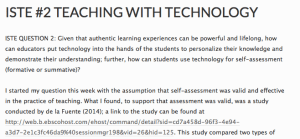
Given that I already deliver tests and assessments online, I wanted to verify the validity of self-administered testing and self-assessments through technology. I found that testing through technology provided valid and reliable data; surprisingly I also found that self-assessment through technology provided increased learning. I intend to engaged this approach in my future teaching be integrating more self-assessments through my web site.

Screen Shot 2015-03-14 at 2.27.13 PM
Linked to ISTE 2 Blog Post

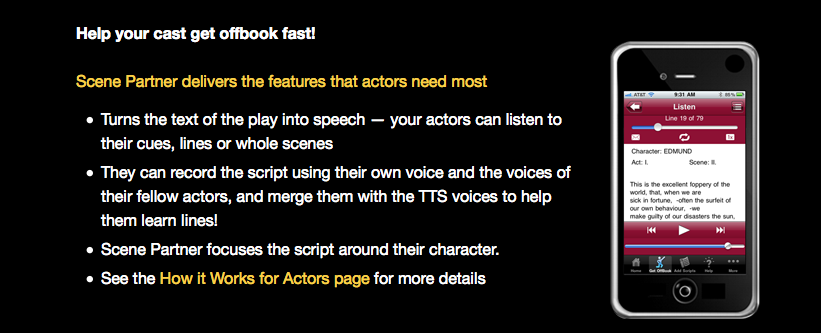
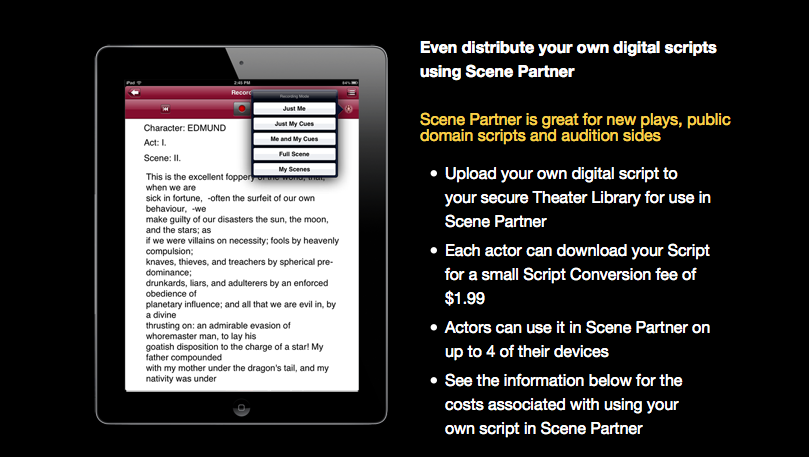
For ISTE 3 I was able to find an app, ScenePartnerApp, that would assist me in modeling digital age learning in my classroom and content area. Students using this app will be able to upload their script and use the text reader as a scene partner when memorizing their lines. This technology provided the discipline specific resource I needed to teach with technology.

Screen Shot 2015-02-14 at 1.46.16 PM
Linked to Blog Post on ISTE 3

Given the lack of resources that I found that are discipline specific I leave my research with two action points that I intend to pursue. First, I will continue to integrate screen casts and self-produced material in my classroom. It has proven to be, and I believe will continue to be, an effective pedagogical tool. One new aspect of this will be teaching students about digital citizenship.

Screen Shot 2015-03-14 at 2.15.29 PM
Linked to Digital Citizen Post

Second, I will use online communities (such as LinkedIn) to connect with teachers from across the globe. I have already started to do this through LinkedIn; the results of this outreach have been effective. Not only have I been able to ask questions of teachers in multiple disciplines, including theatre, but I have been able to present my research to these groups and offer my expertise to other teachers.

Screen Shot 2015-03-01 at 10.10.46 AM
Linked to ISTE5 Post

By using technology in my classroom I am providing the needed tools to my students so that they can participate in a digital future. Teaching digital literacy and citizenship is the civics class of today and a needed part of every classroom.

Lastly, I plan to create a theatre curriculum that is entirely supported online. I would like to pilot a remote learning theatre program that will allow students from across the globe to connect through theatre performance. This would go a long way towards providing the resources – to other educators – that I struggled to find for myself.

Modeling Digital-Age Learning in a Participation Arts Based Classroom (ISTE 3)

ISTE Standard 3 states that teachers should exhibit knowledge, skills, and work processes that are representative of an innovative professional. My content area, theatre arts, is based in human interaction; these interactions must occur in the moment and in person. An actor must learn to act and re-act. Taking the content of theatre arts into the technological realm is equivalent to making painting class into a digital photography class. However, there is a great deal of content that can be delivered in a flipped classroom format; there are digital tools for teachers, students, and actors that are becoming increasingly common place.

Because the world is increasingly tech-enabled and tech-enhanced, how can I as a teacher of theatre arts, demonstrate technological processes that both enhance my curriculum, increase productivity, and build technological capacity in my students?

Kennedy (2009) speaks to the need for educators to rethink education and align learning environments with real world demands so that learning is flexible and can be utilized anytime and anywhere. One of the most tedious tasks of the actor is to memorize lines. One digital innovation seeks to change that. ScenePartnerApp (https://www.scenepartnerapp.com/) is one of many emerging tools for actors to use when the need to memorize their lines. Any student with an iDevice can download existing scripts or upload their own. This makes the program highly adaptable to any classroom, especially mine because much of the theatre work that my students engage with is written by the students in my classes. However, when we do get to the published works (such as Shakespeare), we can simply download the text.

Screen Shot 2015-02-14 at 1.45.46 PM Screen Shot 2015-02-14 at 1.46.16 PM Screen Shot 2015-02-14 at 1.46.38 PM

One of the greatest highlights of this app is that it allows the user to hear only their lines or only the lines of their scene partner. This ability to repeat the text and use a digital scene partner is invaluable. Without this, the technique of memorization with a partner would need to happen in class. By using this app many of my students, those with iPods and iPads, have a highly effective solution that not only saves time for my classroom, it adds digital flexibility for my students. This app is one clear example of how I can integrate emerging digital technology into a classroom based on human interaction. In fact, because of the time I save (due to students memorizing their lines outside of class) I can increase the amount of human interaction in my class.

Theatre arts is not alone when it comes to time saving digital tools. Now because of the Google Institute (shared by Lida Enche in Google+) students can save travel time and virtually visit art across the world. This too increases the human interaction because in the classroom, teachers and students can talk as much as they want. Google Institute can be found at, https://www.google.com/culturalinstitute/project/art-project. I encourage everyone to check out both of these new digital tools that help arts classes.

References:

Kennedy, K. (2009). Volume 7, Issue 2 Distance Learning 21 Cross-Reference of Online Teaching Standards and the Development of Quality Teachers for 21st Century Learning Environments. Distance Learning, 7(2), 21-28.