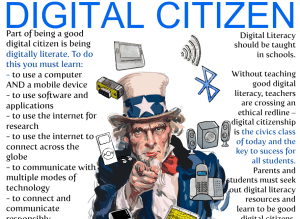
Digital Literacy is an essential skill for the students of today. It will enable them to achieve academically as more and more content is delivered through technology and it will enable them to succeed in the workplace of the future.
Being digitally literate means understanding the technology of today in both how to use it and the best practices surrounding it. Digital Literacy also means adapting to the technology of the future.
Every teacher, regardless of subject, should integrate technology into their classroom for these very basic reasons. Teaching digital literacy and citizenship is the essential class of today – equivalent to the civics class of the past.
ISTE Standard 3 states that teachers should exhibit knowledge, skills, and work processes that are representative of an innovative professional. My content area, theatre arts, is based in human interaction; these interactions must occur in the moment and in person. An actor must learn to act and re-act. Taking the content of theatre arts into the technological realm is equivalent to making painting class into a digital photography class. However, there is a great deal of content that can be delivered in a flipped classroom format; there are digital tools for teachers, students, and actors that are becoming increasingly common place.
Because the world is increasingly tech-enabled and tech-enhanced, how can I as a teacher of theatre arts, demonstrate technological processes that both enhance my curriculum, increase productivity, and build technological capacity in my students?
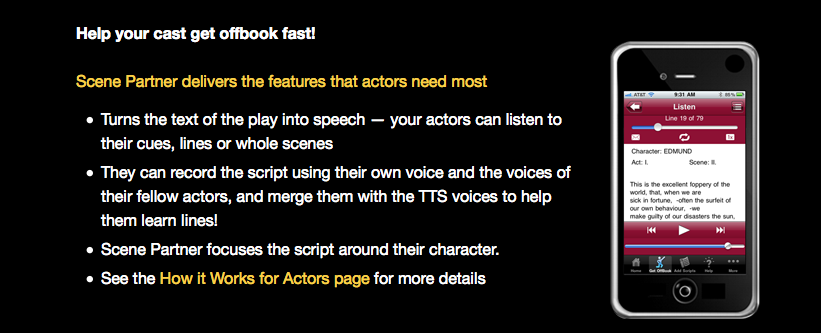
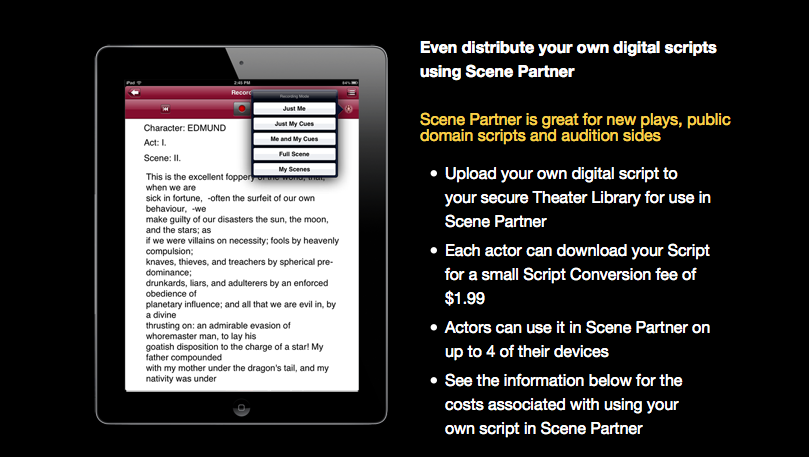
Kennedy (2009) speaks to the need for educators to rethink education and align learning environments with real world demands so that learning is flexible and can be utilized anytime and anywhere. One of the most tedious tasks of the actor is to memorize lines. One digital innovation seeks to change that. ScenePartnerApp (https://www.scenepartnerapp.com/) is one of many emerging tools for actors to use when the need to memorize their lines. Any student with an iDevice can download existing scripts or upload their own. This makes the program highly adaptable to any classroom, especially mine because much of the theatre work that my students engage with is written by the students in my classes. However, when we do get to the published works (such as Shakespeare), we can simply download the text.
One of the greatest highlights of this app is that it allows the user to hear only their lines or only the lines of their scene partner. This ability to repeat the text and use a digital scene partner is invaluable. Without this, the technique of memorization with a partner would need to happen in class. By using this app many of my students, those with iPods and iPads, have a highly effective solution that not only saves time for my classroom, it adds digital flexibility for my students. This app is one clear example of how I can integrate emerging digital technology into a classroom based on human interaction. In fact, because of the time I save (due to students memorizing their lines outside of class) I can increase the amount of human interaction in my class.
Theatre arts is not alone when it comes to time saving digital tools. Now because of the Google Institute (shared by Lida Enche in Google+) students can save travel time and virtually visit art across the world. This too increases the human interaction because in the classroom, teachers and students can talk as much as they want. Google Institute can be found at, https://www.google.com/culturalinstitute/project/art-project. I encourage everyone to check out both of these new digital tools that help arts classes.
References:
Kennedy, K. (2009). Volume 7, Issue 2 Distance Learning 21 Cross-Reference of Online Teaching Standards and the Development of Quality Teachers for 21st Century Learning Environments. Distance Learning,7(2), 21-28.
ISTE QUESTION 2: Given that authentic learning experiences can be powerful and lifelong, how can educators put technology into the hands of the students to personalize their knowledge and demonstrate their understanding; further, how can students use technology for self-assessment (formative or summative)?
I started my question this week with the assumption that self-assessment was valid and effective in the practice of teaching. What I found, to support that assessment was valid, was a study conducted by de la Fuente (2014); a link to the study can be found at http://web.b.ebscohost.com/ehost/command/detail?sid=cd7a458d-96f3-4e94-a3d7-2e1c3fc46da9%40sessionmgr198&vid=26&hid=125. This study compared two types of student assessment in a secondary language classroom. The scenario of students working independently to memorize words and phrases is not too different from a common scenario in the theatre arts classroom. In my work, I often give students time to work on memorizing their lines. The study placed one group of students in a position of control over their self-assessment with mobile assisted language learning (MALL). The second group surrendered all power to the instructor with an assessment that was instructor manipulated language learning (IMLL). The study observed the comprehension of the students following the assessments. Students in the MALL group demonstrated significantly higher levels of comprehension in multiple categories (de la Furente, 2014). When comprehension is the central task, self-assessment is more effective than instructor directed assessment.
Second, I attempted to answer the more difficult question of how to implement self-assessment through technology. A second study was found to answer this question (Mordis and Economides, 2012); the link is provided here http://web.b.ebscohost.com/ehost/pdfviewer/pdfviewer?vid=24&sid=cd7a458d-96f3-4e94-a3d7-2e1c3fc46da9%40sessionmgr198&hid=125. Mordis and Economides (2012) found that during a self assessment test the learner was able to reach an optimal emotional state in relationship to the learning content by giving students the reward of applause after correct responses.
Students took a multiple choice question test and the levels of anxiety were observed and measured. Results showed that male students not receiving applause have a significantly high state of anxiety after the test than female students not receiving the applause (Mordis and Economides, 2012). Further, males that received applause after correct responses were significantly less anxious than females in the same category. In other words, males need more external positive motivation to reduce their anxiety.
Mordis and Economides (2012) conclude that affective feedback during self-assessment is only one tool that can be used; this supportive feedback can have positive or negative outcomes that may fall along gender lines. Lastly, affective teaching must embed self-assessment within the educational context (Mordis and Economides, 2012).
In my classroom, I have students give a “clap of respect” to performers. The clap does not signal success or failure (as the second study did for success). However, this did highlight renewed awareness that every student reacts differently to praise.
What really interested me this week was the idea of self-assessment through technology in an arts classroom. Lida Enche, provided a reference to the tool that could combine my public presentations with technology. By utilizing a document camera, I could have students highlight their own work (e.g. notes they made on their script) and evaluate their progress for the class. The resource provided by Enche (http://www.theartofed.com/2014/09/01/15-fabulous-ways-to-utilize-a-document-camera-in-the-art-room) does not address the concept of self-assessment, however it does lead one to extend ones thinking about how to use the document camera.
References:
de la Fuente, M. J. (2014). Learners' Attention to Input during Focus on Form Listening Tasks: The Role of Mobile Technology in the Second Language Classroom. Computer Assisted Language Learning, 27(3), 261-276.
Moridis, C. N., & Economides, A. A. (2012). Applause as an Achievement-Based Reward during a Computerised Self-Assessment Test. British Journal Of Educational Technology, 43(3), 489-504.
The integration of technology in a classroom can be an effective means to instruction because it can generate creativity along side developing proficiency with technology .
In consideration of ISTE 1 and the practice of drama instruction, learning can happen online – in a flipped classroom setting. The online portion of the learning can deliver content and allow for the classroom time to be focused on the creative aspects of drama. The technology can then also be used to capture the creative expressions of the students.
For example, I can deliver a lecture online about the play format and style.
Journal Entry from October 20, 2014 for Theatre Methods
What is…
At this point I have a decade of experience under my belt in youth theatre. I have a firm grasp on “what is” in my program. This grasp has been continually transforming over the years and has certainly shifted from a more idealistic to a more realistic perspective on what is possible and achievable. Some of the most cumbersome constraints include administrative oversight and school policy, student interests, and limited instructional time.
In my class, as I often describe, I try to create an atmosphere of respect. One benefit of this is that it serves as a backbone for socially responsible actions. We, society, must respect the identities of the people we interact with. We, each individual, must also respect our own history and identity. Too often in theatre, we take licenses to transgress boundaries that are present…
Teachers should exemplify an understanding of the professional responsibilities of teaching and the policies of the school they teach in.
In my recent work as a teacher I have developed a nuanced understanding of effective relationships with parents. Recently I researched into the best practices of parent and teacher relationships and identified five key points for a relationship between a teacher and a parent to be effective for the education of the student in question; the relationship must be partnership based, include shared goals, be based in mutual respect, provide for accommodations on both sides of the relationship, and have regular communication that is both formal and informal.
It is a professional responsibility and best practice of any educator to create an ongoing relationship with the parents of each student.
The first reason relationship building is important is that with the relationship the teacher develops an advocate and resource that will enhance the student’s understanding and learning outside of the classroom. An educator, at best, gets one-third of the day with each student. The parents of the students, at best, get the remaining two-thirds of the time; the parents are in an equal or better position to be influential in the academic outcomes of their student.
Secondly, each parent is a stakeholder in the community and a taxpayer (or tuition funder) that supports the development and continuation of the school. By involving parents into the process of education, teachers are acting with due diligence to their constituents, the community. Schools exist for the public good and those that fund and participate in schools deserve to know what is happening in the schools.
In completing the research, and in spite of my eight years as a teacher, I was impressed by the literature that presented educators as figures that are feared. There are parents that have little respect or appreciation for educators, or purposefully distance themselves from educators, because of their own experience with education. This increases the importance of building a positive partnership that is team-based, rather than a model of opposition or submission.
When an educator and a parent team-up with shared goals and values the student has a significantly increased chance for academic growth. Just this year I have seen an ELL student advance beyond his peers because of an intensive parental involvement in this student’s education. This involvement would not have been possible without an ongoing, weekly often and daily at times, relationship with the parents of this student.
While there are limitations on my time, I would like to increase my competency with parent-teacher relationships. One way I can do this is to focus on early and frequent positive communication about the students that I teach; this is one clear area that I can improve in. While phone calls and emails home along with ad hoc meetings after school and formal conferences have been productive, a method that I have not employed in the past has been through a message in the school bulletin. A brief statement that informs parents what we are working on in class and invites parents to contribute in ways they are comfortable would be an excellent way to establish a relationship that would allow parents to make the initial contact rather than myself making the first contact to the individual. This would also bring parents into the classroom and increase their buy-in to the program as a whole because their voices would be heard.
References:
Gregory A. Cheatham & Michaelene M. Ostrosky (2013). Goal Setting During Early Childhood Parent-Teacher Conferences: A Comparison of Three Groups of Parents, Journal of Research in Childhood Education, 27:2, 166-189
Guo, Y. (2010). Meetings Without Dialogue: A Study of ESL Parent-Teacher Interactions at Secondary School Parents’ Nights. (Undetermined). School Community Journal, 20(1), 121 – 140.
Jordan, L., Reyes-Blanes, M. E. Peel, B. B., Peel, H. A., & Lane, H. B. (1998). Developing teacher-parent partnerships across cultures:.. Intervention in School & Clinic, 33(3), 141.
Juniewicz, K. (2003). Student Portfolios with a Purpose, Clearing House, 77(2), 73-77.
Learning should be broken into time periods that are manageable for teachers and students. Medina (2008) recommends breaking learning segments into 10-minutes periods.
Increased surveillance over each student as they are engaging in the content is an effective method of maintaining positive behaviors in each student (Wright, 2014).
Offer choice to students. When students have the opportunity to choose between multiple routes of completion their engagement will increase (Wright, 2014).
Misbehavior may be a sign of a learning challenge. The teacher should offer to help students with their learning and adjust to approach the content from a new perspective (Wright, 2014).
Pre-view the rules and expectations of the class and rehearse the procedures (Wong and Wong, 2009).
Set up the classroom for success. The student seating should facilitate the learning process and allow the teacher to observe every student in learning (Wong and Wong, 2009).
General Principles of Interventions:
Teachers should aim to maintain positive relationships with each of their students. Creating a positive relationship includes being fair, especially as the consequences for poor behavior are given to the student (Fay and Funk, 2009).
Teachers can shift the responsibility for productive and appropriate behavior onto the students. Using statements such as, “tell me what would be an appropriate response to your behavior” or “consider the impact you have made on the other students” will allow the student to reflect and respond in a personal way (Fay and Funk, 2009).
As a master of subject specific content, teachers should be prepared to shift the focus of the class (Banner and Cannon, 1997). Using a statement such as “this doesn’t seem to be working for us today” or “Let’s come back to this after we have remembered how to show respect for each other” can lead the students to reflect on their behavior and the natural consequences that are in place.
Teacher Intervention Responses: Verbal
The teacher should use student names, to indicate that they are recognized in class and their behavior is expected to be engaged and appropriate. By recognizing students, by name, the teacher is inviting their students to learn (Wong and Wong, 2009).
The teacher should give clear directions to the students that leave no-room for interpretation so that students can follow the directions the first time they are given (Wong and Wong, 2009).
The teacher should use enforceable statements that are clear and descriptive. Students should understand that their behavior has both positive and negative consequences (Fay and Funk, 1995).
The teacher should offer choices that are both acceptable. Students will follow class expectations when they have a say in their behavior (Fay and Funk, 1995).
Teachers should focus on the positive behavior. Saying, “Don’t run” is less effective than “Please walk.” Students will hear the verb in the instruction and adjust their behavior accordingly (Wong and Wong, 2009).
Teachers can ask clarifying questions that lead the student to consider their behavior as it relates to their learning and the learning of other students (Fay and Funk, 1995).
Teacher Intervention Responses: Non-Verbal:
The teacher should know what is happening in their room at all times. To do this the teacher should walk to all areas of their room while teaching, make eye contact with as many students as possible to keep them engaged in the lesson, and anticipate behavior problems before they happen, and intervene with a verbal statement (Wong and Wong, 2009).
The teacher can use facial expressions to indicate acceptable behavior or unacceptable behavior for students; the teacher can use facial expressions such as a raised eyebrow, a smile, or a shake of the head (indicating yes or no) to tell the student that their behavior is acceptable (or not) and they can signal to students through eye contact (saying to the student “I see what you are doing”).
The teacher can establish classroom specific gestures or use commonly understood gestures to communicate to their students about the desired behavior. These gestures may include a wave of goodbye (to send the student out of the room), pointing with ones hand (to indicate a direction of travel or a location in the room), a hand raised high (to signal for student attention), and a single finger placed on their lips (to indicate the need for quiet) (Wong and Wong, 2009).
Regarding student behavior, the classroom should be configured for two purposes, so that the teacher can move around the room with brevity and so that students can be moved as a potential behavior intervention (Wong and Wong, 2009).
References:
Banner Jr., J., & Cannon, H. (1997). The Elements of Teaching. New Haven: Yale University.
Fay, J. and Funk, D. (1995). TEACHING With Love & Logic: Taking Control of the Classroom. Glendale, CA: The Love and Logic Press, Inc.
Marzano, R. (2007). The art and science of teaching a comprehensive framework for effective instruction. Alexandria, Va.: Association for Supervision and Curriculum Development.
Medina, J. (2008). Brain rules: 12 principles for surviving and thriving at work, home, and school. Seattle, WA: Pear Press.
Wong, H. & Wong, R. (2009). The First Days of School; How to be an Effective Teacher. Mountain View, CA: Harry K. Wong Publications, Inc.
Many people have experienced the ability to learn in different modalities. For instance, I memorize information best while I am walking. Many students in my class have demonstrated a visual preference for learning; they write and draw information to retain it. Other students in my class have shown their best growth when they talk to each other about their learning. Empirically, teachers and laypeople alike, understand that there are multiple modalities for learning. Why is it that student evaluation does not encompass the modality of learning?
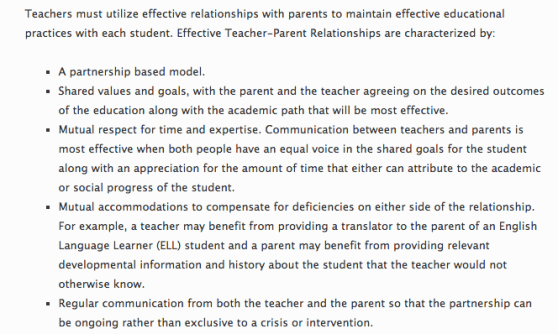
Teachers must utilize effective relationships with parents to maintain effective educational practices with each student. Effective Teacher-Parent Relationships are characterized by:
A partnership based model.
Shared values and goals, with the parent and the teacher agreeing on the desired outcomes of the education along with the academic path that will be most effective.
Mutual respect for time and expertise. Communication between teachers and parents is most effective when both people have an equal voice in the shared goals for the student along with an appreciation for the amount of time that either can attribute to the academic or social progress of the student.
Mutual accommodations to compensate for deficiencies on either side of the relationship. For example, a teacher may benefit from providing a translator to the parent of an English Language Learner (ELL) student and a parent may benefit from providing relevant developmental information and history about the student that the teacher would not otherwise know.
Regular communication from both the teacher and the parent so that the partnership can be ongoing rather than exclusive to a crisis or intervention.
Conferences with parents are an essential tool for effective communication between parents and teachers. These conferences happen in a variety of formats and are essential to developing positive relationships that are focused on the academic and social growth of the student in question. Conferences may or may not include the student. However, it is a best practice to bring the element of student voice to the conference, regardless of the student being in attendance. The two most common formats of a conference are casual and formal.
Casual Conferences occur spontaneously. Characterized by informal meetings, these conferences may occur at school, on the phone, or even in the broader community setting (Jordan, Reyes-Blanes, et. al. 1998). Research shows that frequent, early, and positive communication from teachers to parents is a consistently effective way to build productive partnerships between parents and teachers (Gregory and Ostrosky, 2013).
Formal Scheduled Conferences typically have an intended purpose. These purposes can include, but are not limited to, an academic check-in to evaluate student strengths and challenges, an academic intervention to address specific student challenges, and academic assessment of learning abilities to develop an Individualized Education Program (IEP). All three types can occur commonly. Addressing general academic strengths and challenges is a good practice for every student. Interventions are more effective when both the parents and the teachers agree on the purpose, plan, and goals of the intervention; which is why a conference can be valuable. Also, developing an IEP must include input from the parent of the student so that, like an intervention, the purpose, plan, and goals of the IEP are clear and agreed upon (Jordan, Reyes-Blanes, et. al. 1998).
When preparing for a conference the teacher must allow for ample time for the conference to occur. At a minimum conferences last 30 minutes when everyone involved has time to participate in the discussion. However, the teacher must also respect time restraints so that the conference does not last too long and create a scheduling conflict for any of the participants.
Parents can feel uncomfortable and vulnerable around teachers and other education professionals due to their own experiences in education (Jordan, Reyes-Blanes, et. al. 1998). Teachers should be advised to create a family centered environment so that families are comfortable at the school (Gregory and Ostrosky, 2013).
Parents may have their own concerns about their relationships with a teacher, in addition to the experiences of their child (Jordan, Reyes-Blanes, et. al. 1998) and may have either a positive or negative impression of teachers because teachers can be seen as self-appointed “experts” (Gregory and Ostrosky, 2013); when this occurs communication becomes a teacher monologue, rather than a dialogue between teachers and parents (Guo, 2010). One way to avoid this is to approach the meeting from a team-building perspective.
In part because of this perceived monologue effect, teachers must be aware of their potential attitudes toward parents; this is especially important when the parent comes from a different demographic (cultural, economic, geographic, etc.) than the teacher (Jordan, Reyes-Blanes, et. al. 1998).
Some of the issues that teachers may encounter, when addressing demographic differences, are:
The concept of family and family roles.
Expectations for student behavior.
Expectations of teacher behavior.
Expectations of parent involvement.
Socio-economic resources, especially as they apply to schoolwork that occurs outside of the home.
Of particular note are parents that speak little or no English. One of the greatest under-represented cultural demographics in school communities is that of ELL parents (Guo, 2010). These parents need to have a translator present at the meetings; the school should provide a translator as a part of creating an accessible and fair education for every student. The translator can provide a comfortable and welcoming element to the meeting in addition to explaining school specific content that is culturally contained, such as what Social Studies or Science may courses include (Guo, 2010). Without a translator the teacher risks alienating the parent and consequently eliminating any potential supports that could occur outside of school.
In a formal conference setting, the teacher must also work to ensure the physical comfort of all participants. The physical arrangement of the conference can facilitate or inhibit the progress made in addition to the relationship between parent and teacher (Jordan, Reyes-Blanes, et. al. 1998). The area must be comfortable for adult sized bodies, maintain privacy and confidentiality, include a seating arrangement that is non-hierarchical, and a seating arrangement that is focused on eye contact without physical barriers between participants (Jordan, Reyes-Blanes, et. al. 1998). One common seating arrangement is with adult sized chairs placed in a circle.
Student Portfolios in Conferences are an excellent way to exhibit student work, academic progress, and engage student voice. By integrating a student portfolio into the conference the conversation can be targeted to a qualitative and quantitative discussion (Juniewicz, 2003). Avoiding the litany of summative assessment scores, a qualitative discussion can highlight student achievement and student weaknesses in a non-confrontational way. While it does require teachers to assist in the creation of the portfolios, it can be student-centered. If implemented early in the school year, students can be held accountable for maintaining a student portfolio that is kept in the classroom. The student should be instructed to include work that features their strengths, academic growth, and academic challenges. It should be noted that parent reactions to a portfolio-based conference will vary. Some parents will assert that the qualitative description from their child is extremely helpful for their understanding of their child’s academic abilities. Other parents will complain that the conference does not allow for private communication between teacher and parent (Juniewicz, 2003).
While teacher and parent schedules are busy, it is a best practice to utilize multiple conferences throughout the year, in both formal and informal formats. In doing so, the lines of communication will not be limited to a single meeting and the relative accumulation of data will give both teachers, parents, and students a valid and reliable interpretation of the student’s academic standing. Teachers should remember that parent communication is an essential part of effective education.
REFERENCES:
Gregory A. Cheatham & Michaelene M. Ostrosky (2013). Goal Setting During Early Childhood Parent-Teacher Conferences: A Comparison of Three Groups of Parents, Journal of Research in Childhood Education, 27:2, 166-189
Guo, Y. (2010). Meetings Without Dialogue: A Study of ESL Parent-Teacher Interactions at Secondary School Parents’ Nights. (Undetermined). School Community Journal, 20(1), 121 – 140.
Jordan, L., Reyes-Blanes, M. E. Peel, B. B., Peel, H. A., & Lane, H. B. (1998). Developing teacher-parent partnerships across cultures:.. Intervention in School & Clinic, 33(3), 141.
Juniewicz, K. (2003). Student Portfolios with a Purpose, Clearing House, 77(2), 73-77.




 David Orace Kelly