
Censorship, 1st Amendment, and Copyright In School Theatre

There is an interesting clash between giving free speech to every student and limiting that speech within the public and private school sectors. As an arts teacher, I am continually thankful that the First Amendment protects the right to free expression, however, this rights is not absolute and may be limited. Schools are one of the most potent examples of where First Amendment limitations can be found because there is a compelling interest in maintaining an appropriate educational environment. Teaching theatre, I continually keep this in mind when I select a production – due to copyright laws we can’t alter the content, so we need to fully accept it as it is.

There is an interesting clash between giving free speech to every student and limiting that speech within the public and private school sectors. As an arts teacher, I am continually thankful that the First Amendment protects the right to free expression, however, this rights is not absolute and may be limited. Schools are one of the most potent examples of where First Amendment limitations can be found because there is a compelling interest in maintaining an appropriate educational environment. Teaching theatre, I continually keep this in mind when I select a production – due to copyright laws we can’t alter the content, so we need to fully accept it as it is.

The Supreme Court has established that schools have the authority to regulate student speech in order to maintain an appropriate educational environment. In Tinker v. Des Moines (1969), the court established the “Tinker standard,” which states that schools may only regulate student speech if it will substantially disrupt the educational process or invade the rights of others. Where do disruptions to occur? The content of a play can be disruptive or inappropriate for all viewers. Many early theatre makers or non-theatre-school-administrators, can be tempted to alter the text of a play (e.g. switching out a swear word or changing any words to effect a character interpretation).

The Tinker standard was increasingly defined in Morse v. Frederick (2007), the court held that schools may prohibit student speech that promotes illegal drug use, even if it is not disruptive. This expanded the power of schools to regulate speech. The cascading impact of this is that the content of what a school chooses to present in their arts programs. This could be a concern in the arts because the arts are founded on free speech; their power rests in the ability to take on a wide range of topics and create conversation within the community. Arts can change the world but they need the forum to do so. Though, one could argue that the voices on topics not ready for school can wait for a venue outside of graduation – these are also the voices of the future and the students that I work with are talented, trustworthy, insightful, and thoughtful. It’s an interesting line to respect and work with as an arts administrator.

By contrast, private schools are not bound by the First Amendment, as they are not government institutions. However, many private schools have policies in place that protect the free expression rights of their students, and these policies may be enforceable under state law.

Venues outside of graduation are not the only avenue for student expression. In Mahanoy v. B.L. (2018), the court held that a school cannot punish a student’s off-campus speech, even if it is disruptive to the educational process, unless the school can demonstrate that it has a reasonable expectation of the speech reaching the school environment. Students could use their free expression, within the arts, outside of the school gates.

The purpose of education

After working in education for nearly two decades, I have seen many different educational structures. I started education in a summer camp. I instructed students and served as director, choreographer, and designer for dozens of productions. I built a middle school drama program that was centered on the student experience and their voice. I taught internationally in both Morocco and Bahrain – I taught a wider range of subjects that I have ever – teaching English, Theatre, Social Studies, debate, and STEAM. I now am the Director of the Performing Arts Center at a major private school in Mississippi. I have found that the purpose of education is multifaceted and can vary depending on the individual, their goals, and the society in which they live. However, there are some common themes that emerge when considering the purpose of education.

After working in education for nearly two decades, I have seen many different educational structures. I started education in a summer camp. I instructed students and served as director, choreographer, and designer for dozens of productions. I built a middle school drama program that was centered on the student experience and their voice. I taught internationally in both Morocco and Bahrain – I taught a wider range of subjects that I have ever – teaching English, Theatre, Social Studies, debate, and STEAM. I now am the Director of the Performing Arts Center at a major private school in Mississippi. I have found that the purpose of education is multifaceted and can vary depending on the individual, their goals, and the society in which they live. However, there are some common themes that emerge when considering the purpose of education.

One of the primary purposes of education is to prepare individuals for successful participation in society. I found this to be true in every school I taught at. However, what the preparation looked like, varied widely. This included providing the skills and knowledge necessary for employment (often as defined by the parents, rather than the students), as well as the ability to think critically and solve problems (typically what students enjoyed the most). Education can also help to promote social cohesion and a sense of community by teaching students about the values, customs, and beliefs of the society in which they live.

Another important aspect of education is personal development. Education can help individuals to develop their own interests and passions, and to become more self-aware and self-confident. Any good teacher does this side-by-side with their lessons. Great teachers teach personal development, while also teaching their subject. It can also provide a sense of accomplishment and fulfillment, as well as a sense of purpose and direction in life.

Education also has the potential to promote social mobility and equality. Most recently, I have found that the students in my classroom have a limited view about what social mobility (or often social-stability) looks like. Students are often set on being doctors, lawyers, and business owners. Education can also help to reduce discrimination and promote inclusivity by providing a common understanding and respect for diversity. This aspect of inclusivity has been very prevalent in my current school, every student is truly valued, treated equally, and given the same opportunities. Regardless of a high percentage of students receiving financial aid, the school removes economic boundaries in every way possible.

In addition to these practical and personal benefits, education can also have more abstract, philosophical purposes. It can help individuals to understand and appreciate the world around them, as well as the different cultures and perspectives of others. Education can also encourage creativity and the free exchange of ideas, which can lead to new innovations and progress. This is where the creative classroom is most valuable. Within my drama classes, students get to experience theatre arts within a hands-on application for both design and performance based tasks. These opportunities come to fruition as they produce shows that engage the community in dialogue.

Reflection on PRESENTING in CLASS

I think presentation is essential. Therefore, I ask that my students do it frequently and the stress is lessened. All students are also rewarded with a single clap of respect from the entire class after every presentation, 1, 2, 3, *clap*. It’s just part of my expectations. However, I have provided accommodations for students gripped with fear. Accommodations have included, presentation in a seated position instead of standing in front of the class, written work read by another student on behalf of the shy student, small group instead of full class presentations, recorded at home and sent in presentations, and fully excused presentations as part of an identifiable medical disability. Any clearly seen accommodations like this are often accompanied with a class discussion about different abilities with fear and presenting – as well as why learning to talk in front of the group is important.

Command Words – Lesson Plan

LESSON ONE: COMMAND WORDS

LEARNING TARGET: To understand different levels of presenting information (fact,analysis, and synthesis) and apply them to command words in test questions.

Bell Ringer/pre-assessment: Students respond in writing to question for one minute, then share out ideas: 

What is the difference between the presentation of facts, the development of analysis, and a synthesis of ideas?

(Gather learner friendly responses)

Practice one: Students Take ten minutes to answer the following questions, writing independently

Explore the ways… with three examples that the story of “The Three Pigs” tells the reader about theme of hard work.

How… does “The Three Pigs” tell the reader about the theme of hard work through the plot?

How far does… the story tell the reader that hard work is important? Cite evidence from the plot that is in favor and against.

In what ways… using three examples does “The Three Pigs” support the main idea of hard work through character development?

To what extent… do you agree that “The Three Pigs” is about the theme of hard work? Provide three pieces of evidence from the text that support one or both sides of your position.  

Supporting Activity- Small Groups: Student compare their responses with each other in a small group setting.  

Questions for conversation: What was different about your responses?

What was similar about your responses?

What was different about the questions?

What was similar about the questions?

Extension Activity- Individual / Full Group: Students respond to the following question, first in a “five-minute” quick write and then share their responses in a class conversation. 

If the question was not about hard work or “The Three Pigs” and instead about a different theme or story, what would be different or the same about your response? How do the command words (how, how far, In what ways, To what extent, Explore the ways) connect to the way you respond? Which questions are asking for facts? Which questions are asking for analysis? Which questions are asking for synthesis?

Extension Practice, Formative Assessment: 

Write five questions using the same command words for a book that you have already read.

How to Evaluate Memorization

Memorization is a key skill in theatre and in life – but some kids need more or less support. Sometimes it even depends on their ability level. In my experience one point for each word becomes tricky – different students have different word counts and different memorization challenges in a particular script. Instead, I look at levels of memorization. It helps me direct student support for follow up.

Here is a general rubric that I like to use:

“Top Marks” – 10 points for being  Word Perfect

“Job Done” – 7-9 points for being basically word perfect. Maybe some transposition of words or dropped words. Perhaps a missed sentence (depending on length).

“Support Needed” 4 – 6 points, student missed more than a sentence, called for line or looked at script (1 – 3 times).

“Significant Revision Required” –  1-3 points for being unable to complete memorization or in need of more than three prompts.

I’ll assign a Student AD or SM to make notes on any missing or incorrect words by highlighting a revision script for the actors or by making line notes specifically for each actor.

Additionally, it is important to:

  • Give students memorization tools before giving them a memorization assignment (or make sure they have experience with memorization).
    • Tools include: writing and re-writing the lines by hand (speaking aloud while re-writing can also be helpful)
    • Writing cue lines on one side of an index card and the full line on the other side. Students can study like flash cards. Again, speaking aloud is preferred.
    • Memorizing line by line or sentence by sentence in what I call the A, AB, BC, CD, method so that what has been memorized gets linked to what will be memorized and the text is evenly memorized throughout.
    • Physical cues within text. Students can connect physical action such as blocking or character gesture to pieces of text. These gestures are fully implemented as part of performance whenever possible.
    • Sound cues in text. It helps students to use auditory clues such as alliteration, onomatopoeia, rhyming, and rhythm to memorize a text. Sometimes it takes a study of these poetic elements to cue into the memorization.
    • Memorization to a song.  Use an established song melody and fit the spoken words to that song. Play the song again and again.
  • Give students ample time to memorize their texts and scaffold the memorization so that it is not all due at one time. I often tie memorization deadlines to the rehearsal following completion of blocking for a scene. (Alternating in sets of four for rehearsal: 1) Table read and discussion of scene; 2) Blocking of scene, on book; 3) run of scene memorized blocking and lines; 4) working of the scene, “stop, work, fix, go”.


AUTOMATED or AUTHENTIC ACTING

Does acting in acting class need to be authentic to the student?  I recently came across this question in a professional forum.

Certainly authenticity is good – especially in theatre. It is a creative process; the product is best when it is personal to the actor. However – I contend that this may only be the desired end product.

A novice actor needs skills to build from – guidance even clear direction to develop with. Ready, set, create… GO! Open ended creation can be difficult. Giving a student a framework, blocking, gesture, vocal placement, clear direction is not only good teaching, it is a real-world occurrence. In doing so, the teacher is supporting the skill level of the student and scaffolding from that point forward. Yes in theatre education, there should equally be as many opportunities to collaborate, devise, and create in an open-ended forum. These are key skills that theatre can main-line to the student; these later skills, require a prerequisite of experience to build from.

Consider instruction in English Language Arts. In middle school and high school, writing instruction is often prescribed. A teacher may say, “use these sign post words” or “use a first person voice”; they may further say submit your paper in 12 pt font and MLA format. And in the execution of that prescription, the student learns the structure, the form,  the style required and then can learn to write in that mode authentically. But, their first prescribed may not be authentic to the student.

I contend that the instruction of an acting student does not need to be much different. I am curious to see what other teachers of theatre may think on this point.

This approach of prescribed movements and highly directed or choreographed work could also be described as an “outside-in” style of acting. Physically based styles are widely used around the world. Included in this would be the Lazzo of the Fly from Commedia and the stylized movement and voice of Kabuki. Here are some examples.

You can see in the Lazzo, the movements are very planned, even choreographed in response to the music.

Here you can see an example of a planned combat scene in Kabuki. It has been done in this exact prescribed style for the past 400 years.


Year One, Term One: Reflection

After ten years at Explorer West, in Seattle, I transitioned my teaching career in one of the most drastic ways possible. I left a secure teaching position – one where I knew the ins and outs of each day – one where I knew the faculty and the community exceptionally well – and I took a position at a growing school in Casablanca Morocco.

My teaching was tested. I was tasked with setting up a new program in a school that was still finding its way in secondary education. A growing middle school program was my first charge; teaching new content and new lessons my second. Three content classes at three different levels made for six different preps and plans. Plus I had an additional course in advisory and community service. The program was growing. I was the only teacher dedicated to the secondary program. We lacked a math/science teacher. The position was filled by the Head of School while a search was under way.

It took an entire term to find the replacement. The first term we were metaphorically treading water. We were making the best choices we could to keep the program going. We wanted to create a community that was student driven – empowering students in a community that fostered intrinsic learning. But the challenges of building a secondary program from the ground up  was tremendous.

The work changed when a math/science teacher was hired and collaboration could truly begin.

Three Tiers of Words: Three Reading Strategies: Increased Personalization and Understanding

At the heart of great teaching is differentiation; this teaching tactic of differentiation inside of the teaching content area applies to language acquisition, stages of language, and academic language development; this work will help students across multiple content areas (P2).

In researching this teaching topic area, I reflected on two effective techniques for teaching academic language through a differentiated approach.

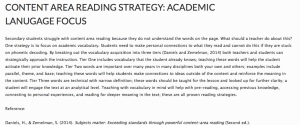
FIRST: Three Tiers of Words for Differentiated Instruction

  • Tier One includes vocabulary that the student already knows; teaching these words will help the student activate their prior knowledge.
  • Tier Two words are important over many years in many disciplines both your own and others; examples include parallel, theme, and base; teaching these words will help students make connections to ideas outside of the content and reinforce the meaning in the content.
  • Tier Three words are technical with narrow definition; these words should be taught for the lesson and looked up for further clarity; a student will engage the text at an analytical level.

SECOND: Three Levels of Reading for increased meaning and differentiated instruction

  • Level One, read for general understanding (identify words in all three tiers)
  • Level Two, making personal connections to other content areas
  • Level Three, extending the text to connect and converse with other texts

Screen Shot 2015-05-31 at 6.13.29 PM

(LINK TO POST)

Breaking the academic words into these three tiers allows both the teacher and the students to strategically approach the task of learning. By emphasizing the vocabulary early in the process of learning it can be reinforced at every step of the lesson.

In pre-reading students can identify words across tiers and note their meanings.

In connecting to personal experiences, a second stage of effective reading, students can connect their experiences of each word (especially Tier Two Words) in other classes to the text that they are examining and use the Tier One Words, words they already know, to build their knowledge and connection to the new text.

Finally as a student reads for deeper meaning, they are ready to ask bigger questions about the words and their interconnected meanings. By engaging in a process of inter-textuality, they will solidify the understanding and be able to comment on the text in relationship to other texts they have read.

Academic words in all three areas continually emerge in both Theatre Arts and English Language arts because both content areas examine texts from multiple sources with multiple narratives. I often tell my students that my class is not simply a drama class. Rather, my class is every class in the disguise of a drama class. Students must be prepared to speak about any topic that they know about. Because of this, they build their understanding of both of the first two tiers. Some common examples of these words are: inner-monologue, character development, and memorization.

The third tier words are then used most commonly through the language demand and are particular to the performance assignment. One simple example would be, blocking (the specific movement of actors on the stage).

Because of my research into the three tiers of academic language and three common phases of reading, my instruction has changed. I am more apt to point out academic words that make a connection between subjects and encourage students to read a text three times for increased clarity and deeper meaning. With each reading of the text I can guide the student by suggesting that they look for general understanding on their first time through a text, connections between the text and other subjects on their second read, and the conversation between one text and another in their third reading.

By using this three tier and three read through strategy, students are more likely to fully understand and personalize the text. Because a central practice of Theatre Arts is personalization and finding increased meaning, these strategies are invaluable to the students (and to myself). Further, different students will be reading at different levels. Knowing which level a reader is working on will allow myself to differentiate my instruction for that student.

One consequence of using this technique is lost time. It will take students three-times longer to complete any reading assignment. Because of this, reading assignments must be both shortened and be given in class time for guided completion. However, the benefits will outweigh the cost. Students will generate more connections inside of my content area and in content areas outside of my classroom.

Expect Diversity: Prologue and Epilogue

Expect Diversity in Teaching:

A Collection of Personal Stories and Reflections from Teaching that Mirror Multicultural Research

Know THYSELF, stories and reflections found here.

Know THY STUDENTS, stories and reflections found here.

Know THY SUBJECT, stories and reflections found here.

PROLOGUE

The parent of a former student of mine told me the following story. This story has had me thinking about my bias, as both a teacher and as a parent, for the past decade.

I think about this story often. How would I have reacted to the same situation? I want to raise my children without racial bias. I want to teach my children that the world is filled with good people that have a multitude of identities. I want my children to know that it is the diversity in the world that makes our world great. But, I understand that my bias (both inherited and developed) can come out in the most unexpected moments.

EPILOGUE

Returning to the story about the dinner guest, Ernie, I should tell the rest of the story because I wonder how I would have reacted. What if I was that father, standing there with my daughter? What if my friend ended the conversation there, turned and walked away in disgust? I would have ran after him and not been there for the rest of the story.

This former student of mine expected diversity. She expected Ernie to be orange. It was the bias of her father – and my bias hearing the story for the first time – that anticipated a social problem because of Ernie’s racial identity. I should expect diversity in my classroom too.

Know THYSELF, stories and reflections found here.

Know THY STUDENTS, stories and reflections found here.

Know THY SUBJECT, stories and reflections found here.

References:

Banks, C.A.M. (1996). Intellectual Leadership and the Influence of Early African American Scholars on Multicultural Education. In J.A. Banks (Ed.), Multicultural Education: Transformative Knowledge and Action (pp. 46-63). New York, NY: Teachers College Press.

Hillis, M. R. (1996). Allison Davis and the Study of Race, Social Class, and Schooling. In J.A. Banks (Ed.), Multicultural Education: Transformative Knowledge and Action (pp. 115 – 128). New York, NY: Teachers College Press.

Howard, G. (1996) Whites in Mulitcultural Education: Rethinking Our Role. In J.A. Banks (Ed.), Multicultural Education: Transformative Knowledge and Action (pp. 323 – 334). New York, NY: Teachers College Press.

McIntosh, P. (2008) White Privilege: Unpacking the Invisible Knapsack. In A.V. Kesselman, L. D. McNair, and N. Schniedewind (Ed.), Women; Images and Realities: A Multicultural Anthology (pp 388 – 392). New York: McGraw-Hill Companies.

Mvududu, N. (Director) (2015, May 1). Class Lectures. Diversity in America, Spring Quarter. Lecture conducted from Seattle Pacific University, Seattle.