How To: Writing Workshop for Performing Arts

Can a writing workshop work for any subject? Yes. Although, this assumes the liberal definition of a text, where anything with meaning, including but not limited to written words, can be composed or written. The “text” in question could be a traditional essay, a painting, or even a performance that eludes a fixed form.

The writer’s workshop allows for students work in relationship to a text by asking a strong question. For example, is Shylock, in Merchant of Venice, a hero or a villain? Students can build buy in by forming their own opinion about that question; they way they perform the text with the acting and character choices that they make will form a unique opinion that is expressed through a performance. The same is true for music. Students may be asked a question about the interpretation of a musical composition, or even be asked to compose an original score in response to an existing piece of music or in response to another piece of art. The performative interpretation becomes the student’s response.

A writing workshop depends on students setting their own goals. With a performance this is simple. The student must select artistic elements and skills that apply to the project. Individual work time is also a critical and simple step. With the given project of creating a performance in response to the question students can work on developing the selected artistic elements in their performance (such as character physicality or musical accent) by performing for each other and reflecting on the performances.

Through focused mini-lessons, derived from teacher observations, the teacher can direct the rehearsal process with a differentiated approach to the content. Further, guiding the meta-learning for the class, the teacher can introduce and model the learning target for the day as it relates to the project of answering the question. As students work, the teacher can provide one-on-one conferences with students by watching their work and asking guiding questions.

While this may not be a traditional writing workshop, it is certainly an effective adaptation for the performing arts. Likely, it would also work for Physical Education or any other skill based content that relies on a demonstration of skill rather than the presentation of knowledge in written form. I have seen it work in my class and can easily see it work in others.
Literacy Lesson: To Read or Not To Read

Using the CCSS, the following lesson was created in collaboration between theatre arts and fine arts content areas to incorporate multiple strategies in literacy instruction; the lesson incorporates strategies that are based in constructivist interpretation, visual interpretation, and performative interpretation. (Follow this link to see the evolution of this lesson from a fail to finesse)

LESSON OUTLINE: LITERACY FOCUS – MINI LESSON: TO READ OR NOT TO READ


Title TO READ OR NOT TO READ
Standard CCSS.ELA-LITERACY.RL.6.4Determine the meaning of words and phrases as they are used in a text, including figurative and connotative meanings; analyze the impact of a specific word choice on meaning and tone
Central Focus (CF) To interpret the question posed by Hamlet, “To be or not to be…” by using expressive gestural images of actors, the original text written by Shakespeare, and actor created interpretive performances.
Academic Language Interpret, Gesture, Emotion, Voice, Physicality
Learning Target (LT) To interpret Hamlet’s question “To be or not to be” by looking at images of actors, and performing one line as a group.
OVERVIEW: LESSON MAP
Lesson Part Activity description / Teacher does Students do
GOAL Introduction of learning target and pre-assessment. Self-assess on Hamlet’s Question
1A Pre-reading: Dramatic Expression in Images Students explain thoughts about images that use dramatic expression and gesture.Students complete worksheet that asks them to interpret then respond to other students’ interpretations of the gestural & emotional images supplied.
1B Informal Assessment: Presentation of scaffolded syntax sentence. Students share, respond to and invent further performed interpretations of emotions.
2A Practice: Jigsaw of Text – Interpret Meaning Students work in groups to construct meaning by combining collective knowledge of a small piece of the text.
2B Informal Assessment: Self-assessment Students share translations with the class.
3A Extended Learning: Match text to images with a performance of interpretation. Students create original performances that are matched to a section of the text by selecting voice and physical choices that correspond to the text and their interpretation.
3B Summative Assessment: Student Performances (group assessment; teacher assessment on Rubric) Students self-assess their performance on the exit ticket.


Introducing the Learning Target
GOAL Teacher Does:Write [LT] on board.
Teacher Says:FIRST: tell me now if you think you can interpret what Hamlet’s question is. Show me a fist of five.
5 – I have an excellent idea of what the question is and what it means4 – I have a good idea of what it is, but I think there is more I could know.

3 – I have a basic idea, but I’m sure there are bits I am missing

2 – I am unsure about this.

1- I’m more than unsure, I’m lost.

Students Say:

FIRST, students silently respond to both the self-evaluation “fist of five” prompt.

Pre-reading: Frontload with Images (p. 100)
INSTRUCTION (1a) 1. Teacher asks students to divide into pairs.
NOTE: Review definitions of academic language organically throughout lesson. When word comes up in discussion, pause to write the definition on the whiteboard. Interpret, Gesture, Emotion, Voice, Physicality
2. Teacher asks – what is emotion? Teacher writes 3 examples on whiteboard. Ask for one emotion example from each pair of students. Then, ask pairs to add an adjective before their emotion.
Examples: intense curiosity, overwhelming joy, life-shattering despair, mind-numbing boredom. (Anger, Fear, Confusion, Malice, Revenge, Desperation – These would fit with Hamlet really well).
3. Teacher writes examples of emotions on whiteboard.
Teacher tapes 8 images/printouts from productions of Shakespeare plays on a table in a large circle. The images should display a wide variety of emotions that occur within Shakespeare productions.
There is a worksheet attached to each image. (see attached).

  1. What emotion does the gesture in the picture convey? Give evidence to support your opinion.
  2. Do you agree with the previous comment or do you disagree? Write specifically about the gesture of the actor.
  3. If you had to perform the gesture in the printout, how would you do it? What would your body look like if you were feeling that emotion?
Students divide into pairs.Students respond with one emotion example per pair.

Students invent adjective to make their  emotion more dramatic.

Pairs choose an image and answer the first question on the worksheet.
Each pair to take a couple of minutes to write response to question number one. Pairs then move to another image and take two minutes to answer number two.The same procedure is used to answer number three.

Group Sharing
INFORMAL ASSESSMENT (1b) Teacher Says:FIRST, Secretly choose an emotion to perform from the list on the whiteboard. DON’T TELL ANY OTHER PAIRS! THIS IS A SECRET!
Now, pretend that you are an actor and are in a Shakespeare play. What kind of gesture would you use to communicate that emotion? Practice that gesture with your partner for one or two minutes. Be as dramatic as you can! Let me model this for you: Teacher models acting out a gesture.
Pairs secretly choose which emotion to perform.Pairs practice performing that gesture for the rest of the class. The class guesses which gesture that they are trying to communicate.
If the class cannot guess the emotion, a volunteer can come up, read the emotion and take a stab at performing the emotion.
Jigsaw and Sketching My Way Through the Text (p. 131)
PRACTICE ACTIVITY (2a) Teacher Does:Pass out the mini-texts (see attachment at end of lesson).
Teacher Says:Read the small segment to your group. Do two things with the segment.
FIRST, respond to the small segment by trying to translate the words from Shakespeare into words that you would use. Write out your translation under the text on your page. Pool your collective knowledge to construct an interpretation of the text.
SECOND, in three minutes or less, to brainstorm with pictures without judgement, draw an image, or series of images, that you think represents the small piece of text. This does not need to be a professional piece of art. Rather, it should express the idea of the text. Stick figures, cartoon drawings, scribbles, loose sketches, and original artistic interpretation are encouraged. Three minutes starts now!
THIRD, match the image(s) that you drew to a similar image from the first part of this lesson.Teacher Does:

Observe and work with individual groups.

Students Do:

Students collaborate to pool collective knowledge and understandings to find language that is accessible for all students.

Students quickly sketch a pictorial representation of their translation.

Students match the images

INFORMAL ASSESSMENT (2b) Teacher Does:Pass out full text to class with indicated jigsaw pieces and space to write out the translation from each group.
Teacher Says:FIRST, we will now share out our text, I am passing out the full text that the class has examined in pieces. Next to the original text, there is space for you to write down the translation.
SECOND, each group will share their translation with the class. We will go in sequence so that we can hear the text in full. I will read the original and a representative from your group will read your translation. You should write down the interpretation of each group as we go. Be sure to speak slowly so that everyone can catch every word you say.
THIRD, after the readings, we will have a quick period of time for group comments and questions about the text or translations.
FOUR, Now that we have practiced interpreting, tell me now if you think you understand what Hamlet’s question is. Show me a fist of five.
5 – I have an excellent idea of what the question is and what it means4 – I have a good idea of what it is, but I think there is more I could know.

3 – I have a basic idea, but I’m sure there are bits I am missing

2 – I am unsure about this.

1- I’m more than unsure, I’m lost.

Students do:Students share their work with the class as directed.

Students discuss.

Students self assess with a fist of five.

TEXT TO IMAGES and DRAMATIC ROLE-PLAY (110).
EXTENDED LEARNING (3a) Teacher Says:FIRST, Now that we have created a translation, you have the opportunity to perform your translations for the class. Please work as a group to speak your section of the original text. As you speak select one or more vocal choices to perform (pitch, quality, tone, prosody)
SECOND, Students will identify one or more gestures and or movements by looking at both their drawings and the images from the first part of the lesson.
THIRD, Practice presenting the text as a group. You should speak and move in unison.
Students Do:Students prepare as directed.
STUDENT PERFORMANCES
SUMMATIVE AND FORMATIVE ASSESSMENT (1b, 2b, and 3b) Teacher Says:FIRST, We will now observe group performances. After each performance, please give a clap of respect, on my cue, to each group.
SECOND, Following the performance you will complete a group-assessment, on your exit ticket, of your performance; you will also receive teacher based summative assessment. Each assessment will utilize the same rubric.
Students Do:Students observe and perform as directed.


4. Supporting Development through Language
a. Language Function: What verb appears in your learning target that represents the language function?
Language Function: To InterpretStudents will interpret the text in multiple ways. Interpretation includes a background understanding (identifying what students know), an applied understanding (accessing learning through what the students want to know), and personalizing the interpretation for individual meaning. To break the task down further, there are several sub tasks to interpreting:

  • Gather and observe associated information:

Students must closely and mindfully look at a gesture and identify the emotion associated with it; they will use images that represent what an actor may do while performing the text to understand how actor expression influences the meaning of any text.
2) Translate the text into modern language and construct meaning through group definitions:

Students must pool collective knowledge and understandings to find language that is accessible for all students. They must build a mutual understanding by defining words, discussing meanings, and brainstorming associated ideas. Doing this will enrich the experience of both watching and performing the original text.
3) Personalize the text through creating images and performances

Through performances, students can express their interpretation by using vocal (quality, tone, pitch, and prosody) and physical choices (gesture, movement, body position) that convey deeper meaning.

b. Language Demand: What learning activities or products will students write, speak, or do to represent the language demand and an opportunity to practice the language function?
This lesson uses multiple strategies for students to practice interpretation. First students will frontload with images (1a). This tactic will allow the vibrant and powerful images of actors in performance to inform what the reader might imagine or look for when interpreting the text of “To be or not to be.” This visual hook will serve as an anchor for students to use as they tackle this difficult text.
Second, students sketch their way through a portion of the text (2a). This allows them to access both multiple intelligences and avoid being caught up on the large portion of new words and, essentially, a new language for them to translate. Using the jigsaw approach, students can interact with the text in a way that remains accessible.
Lastly, students perform their understanding (3a and 3b). This dramatic role play allows students to express their understanding of the content in the way that actors would also present their understanding of the content. This is a simple performance that the students can create of a master-text. By engaging the entire class in this exercise the students are both connecting with the entire text and they are making the text personalized to their own experience.
c. Additional language demand: How will students practice content vocabulary words shown in the learning targets?
In addition to the strategies described in the previous response, throughout the lesson, students turn and talk (1a, 2a, 3a). This strategy gives students the opportunity to practice and check their understanding of the lesson content and language demand of interpreting the text. By using this strategy, students can review key elements of the lesson, identify points of personal connection, and allow multiple students to work with multiple partnerships.
d. What learning activities enable students to practice using symbols or abstract representations of information (syntax), if these are part of the lesson?
I am choosing to respond to this question by focusing on how the teacher will clearly explain the discourse rules. During (1b), the teacher will explain that the students are to stay with their pairs and secretly choose an emotion to perform. The teacher explains that the emotion does not have to be the one that they originally invented. The students are told to keep this emotion secret and to practice it for a minute or two. After the teacher models a performance, the students are then asked to perform their emotion. The class votes to choose which emotion is being performed. If the class does not correctly guess the emotion, the teacher will ask for volunteers to take a stab at acting out the emotion. This will continue until the class is able to guess correctly. The steps/rules to this discourse game will be posted on the white board as a semantic map.
e. How is discussion (discourse) structured in activities?
Discourse is structured in a variety of ways in the activities. This entire lesson can be thought of as almost all discourse between students as a large group and through working/responding/interpreting/creating in pairs. Some examples are: (1a) invention and descriptive dramatization of emotions; and completion of discourse worksheets, (1b) Creation and performance of emotional gesture; whole group (1b) – acting out gestures in front of class and class responding to whether they understand emotion being performed. Further discourse is created by the whole class guessing the emotion as well as fine tuning performances when gesture does not communicate clear emotion, written response and reflection (1a) completion of worksheet where students interpret images and respond to each other’s opinions. (2a) Students collaborate to pool collective knowledge and understandings. Discourse is also structured in a less conventional way by having the students communicate with the class through the performing of gestures to express understanding of the academic language function (interpret) and response by the rest of the class of whether that language function was achieved. Students can further the discourse by performing the emotion for the original performers (in front of the class) as a communication/model of a deeper understanding of the language function. This further builds their skills necessary to interpret Shakespeare passages.
f. What other writing or speaking activities enable students to practice vocabulary and the verb shown in the learning target?
Students are asked to invent emotions and interpret them gesturally as a way to show evidence of understanding of the academic language. Students are also asked to complete worksheet that prompts them to explain their understandings of the academic language. Students work in groups to construct meaning by combining collective knowledge of a small piece of the text. Students verbally share translations of the text with the class. Students create original performances that are matched to a section of the text by selecting voice and physical choices that correspond to the text and their interpretation. Students self-assess their performance on the exit ticket.


Personal Performances that are Developmentally Logical and Abstract, Reflection

Teachers should plan for and adapt a curriculum with a learner-centered strategy that engages students in a culturally responsive and developmentally appropriate way.

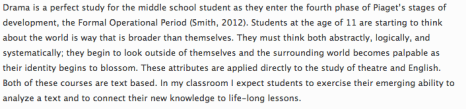
When it comes to developmentally appropriate instruction, planning can be informed by the study of the fourth phase of Piaget’s stages of development, the Formal Operational Period. As a part of this study I researched the importance of this important stage of development. As a part of coursework, I wrote, “students at the age of 11 are starting to think about the world in a way this is broader than themselves.”

Screen Shot 2015-04-28 at 10.59.23 AM
Course Research into Student Development: Piaget (https://davidoracekelly.com/2014/07/16/learning-drama-in-the-face-of-the-learner-paradox/#more-87)

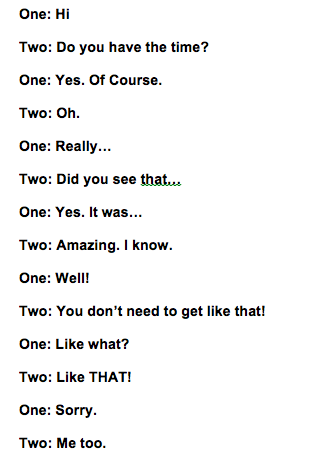
As Piaget’s fourth stage of development suggests, drama can help students to think both abstractly and logically. By studying a script they must both analyze the meaning of the text and interpret the meaning that is personally relevant. One example of this is a lesson I completed in the eighth grade. Students had to study a neutral scene and interpret the text by adding personal meaning in the performance. Students created a range of performances. By identifying the who, what, and where of the scene, students created a unique world from the abstract idea that was logically created. Student work included a daughter (One) and a mother (Two) after the daughter came home late from a party; another performance had a boyfriend (One) getting dumped by a girlfriend (Two); lastly, the most memorable performance was a rock-star (One) meeting a fan (Two) as the rock-star left a performance and unfortunately the rock-star disappoints the fan by not being everything the fan thought they were.

Picture of Neutral Scene

In this lesson, students had to imagine a situation that both logically fit the text and fit their own personal interpretation of the text. This exercise met both conditions found in Piaget’s fourth stage.

In summary, I have presented this lesson in the past. What changed this time was the insertion of personal meaning into the text. Students had to place themselves into the concepts that they were creating. The resulting performances were filled with significantly more meaning and emotional impact than I had previously seen.

Student learning in drama must include personal meaning. It is through this concept that students can personalize the work and create authentic performances. While this is typically a high-level skill that college students pursue, it is achievable in the middle school classroom through this tactic.

I propose that more of my work with text include personal meaning in performance. I will even add it to my evaluation rubric as a self-assessment component for all performances. I often talk about the symbiotic relationship between text and performer. This will bring that idea into reality; the performer must put their opinion into the text and bring it to life in a way that only they can. This key idea brought out new talent that was previously un-tapped by the students. These changes will both increase the artistry that the students produce and, more importantly, increase the student ownership of the work in drama.

You Should Champion the English Language and not Rant about Change

Every generation has cried out about the writing degradation of the next generation. Test scores are lower than ever, a critic may cry. But tests are biased ad are discriminatory to different populations depending on the content that the test asks about (Daniels, Steineke, and Zemelman, 2007).

The critic may try to expose the monumental outbreak that is assassinating the English language. “OMG” “LOL” and “BRB” are tearing apart our language. But, are they really? Language evolves with the people that use it.

What about “OK?” Historians cannot agree on the origination of the word. However, one dominant origination is from the phrase “orl korrekt” an alternate spelling of “all correct,” that was used in the U.S. during the 1830’s (for more explanation see http://www.oxforddictionaries.com/us/words/what-is-the-origin-of-the-word-ok).

From the birthplace of the English language, one of the greatest geniuses of all time, Shakespeare, made up more than 1700 words used in the common English of today (Mabillard, 2000). These words include, “exposure,” “birthplace,” “rant,” “dishearten,” “critic,” “monumental,” “outbreak,” “assassination,” and “champion.” There would not be a champion for the English language to rant about the disheartened critics, without Shakespeare.

The English language has been changing with every generation because of the way that people communicate. Perhaps today, the change is even more rapid. A teacher may say that their students hate to write; in reality the student may simply hate to write what the teacher wants (Daniels, Steineke, and Zemelman, 2007). However, students are not writing well for academic purposes (Daniels, Steineke, and Zemelman, 2007). This impacts the path of the student throughout life as they may struggle to learn advanced content in any given subject matter, as they work to meet state standards, as they seek out advanced education and take high-stakes testing such as the SAT and ACT, and as they seek out employment.

How should a teacher go about teaching writing? One strategy is Writing to Learn so that the teacher is not simply teaching “how to write;” the teacher should teach students how to learn through writing. Therefore, teachers should use writing in the following formats so that writing becomes part of the learning process: short, spontaneous, exploratory, informal, personal, one draft, unedited, and ungraded. These writing styles exist in every subject. From the quick notes that a science student makes about an experiment to the brainstorm “word cloud” that goes into writing an essay in English. The idea of ungraded work may be a novel approach in a school. But, a comprehensive correction of student writing does not and never has worked to teach writing (Daniels, Steineke, and Zemelman, 2007). Writing can be used instead to start discussions, feed small-group work, and review key ideas. From this point, the teacher can help the student act upon their writing impulses and guide the students to an academic voice in their writing.

Writing will always evolve and inform culture; if writing is also informed with an academic voice, it will change society in a way that is powerful and lasting (just as Shakespeare has done). As Gandhi said, “you must be the change you wish to see in the world.” Teachers take note and champion the change in the English Language because change will happen with or without your influence.

References:

Daniels, H., Steineke, N., & Zemelman, S. (2007). Content-area writing: Every teacher’s guide. Portsmouth, NH: Heinemann.

Mabillard, Amanda. Words Shakespeare Invented. Shakespeare Online. 20 Aug. 2000. http://www.shakespeare-online.com/biography/wordsinvented.html .

What’s the problem with American textbooks and how can this problem be overcome?

THE PROBLEM: The problem with American Textbooks is that they are often bland and outdated. The textbook replaces the standards that the teacher should use to derive original and refreshing lessons that are relevant to the student population. A textbook is a homogenous text that is made for universal appeal. With a mandated textbook, teachers are left to either follow the textbook in full (which is hardly teaching) or assemble their lessons around the required components. A textbook, when used as a primary or exclusive teaching device, is equivalent to letting another teacher (the author of the textbook) into the classroom and puts the primary teacher into a position of student management monitor.

THE SOLUTION FROM THEATRE AND ENGLISH LANGUAGE ARTS: Fortunately, both of these subjects have a broader range of choices than the average science or math class. These highly structured fields contain a set sequence of information that the student must master from one year to the next (Daniels and Zemelman, 2014). However, with English Language and Theatre Arts, the instruction has a spiral structure (Daniels and Zemelman, 2014). Students are required to build on past (and similar) learning experiences with the same structure and processes from one year to the next. In English Language Arts, students read texts (ideally in a wide array of genre) and respond to those texts through writing and other interactive activities (such as group discussions). In Theatre Arts, students study a new play each time they go through the process of performance; the text is always changing and the skills build upon the past experience of the student. Both of the subjects are focused on the personalized application and interpretation of the content.

THE QUESTION FOR EDUCATORS: Where does the information for your field live? Suggestion, take a cue from the humanities. Knowledge lives in the student; by capturing the student experience as they interact with the primary source of information, knowledge is formed. A textbook in science can be a reference tool for an educator because it contains the “required information” for the grade level. However, a textbook in Theatre Arts does not exist and a textbook for English Language Arts is seldom used. Further, students will learn and retain more information when the teaching is not exclusive to information processing (a.k.a. regurgitation). Information is retained through a personalization of the information – that is how it turns into knowledge. Lastly, this is how literacy can be build, across the subjects. Literacy must include the ability for one to personally translate, utilize, and generate information within the content. That cannot happen if the information is merely being read, memorized, tested, and forgotten.

Reference:

Daniels, H., & Zemelman, S. (2014). Subjects matter: Exceeding standards through powerful content-area reading (Second ed.).

Family Engagement Plan

Teaching is not simply a one-on-one relationship. A teacher works with the student that is influenced and informed by the families they live with, the community they work with, and the neighborhood they are active with; A teacher should involve, inform, and collaborate with the families and neighborhoods that the students live in. This involvement should inform the educational process, include student cultural identity, and be linked to student achievement and performance.

As a part of my coursework and professional development in teaching I have created a Family Engagement Plan that includes an integration of family stories and community life so that I can know my students and their families better.

Being a community-based teacher is a philosophy and a continual practice that embraced the entire student and their major influences. By following this praxis, teachers can form productive and positive relationships that validate the life of the student both outside and inside the classroom.

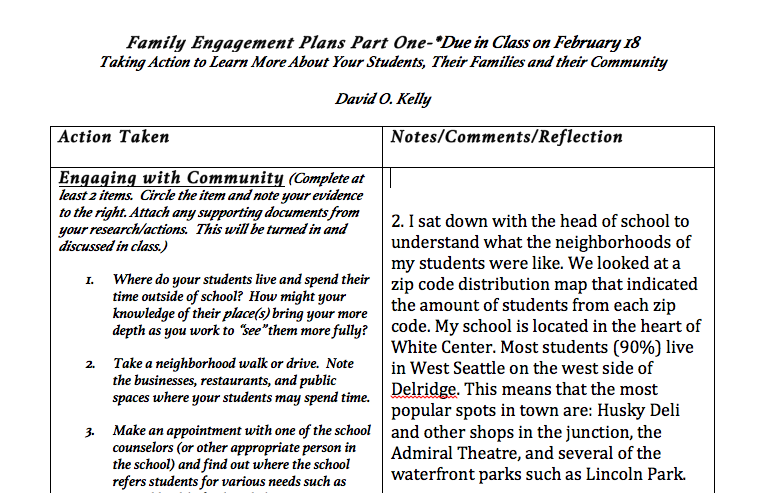
To develop my competency and understanding of my student community I met with the Head of School. In doing so, I learned that the majority of students (90%) live in the West Seattle neighborhood, west of Delridge. By interviewing students and the Head of School, I found that the most popular places for students to visit were: Husky Deli, Full Tilt Ice Cream, West Seattle Farmer’s Market, and the Admiral Theatre; other popular locations for students to visit included waterfront parks such as Lincoln Park and Alki Beach.

I took notes of my conversations and consolidated them into part one of my Family Engagement Plan.

<Screen Shot 2015-03-11 at 6.32.58 PM

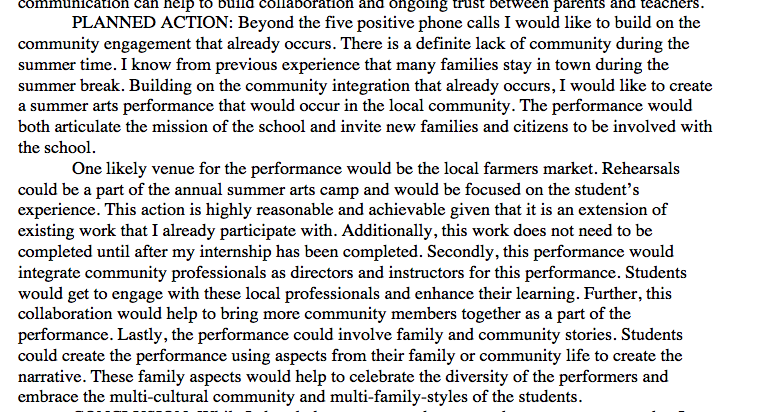
I realized and learned that I did not have a strong understanding of the student’s cultural and family identities. For part two of my plan I wanted to create a component that would embrace and include this missing aspect from my understanding. My plan, starting this summer as a part of summer camp, is to pilot a family and community story project that would have student’s bring family and community stories to the stage and integrate them into a performance that would be performed in the community. It would be my hope that the organizations that students identified with would be integrated in one aspect or another of the performance.

I presented my family engagement plan to the Head of School for a pilot program this summer. I have been approved for this work.

Screen Shot 2015-03-11 at 6.31.55 PM

It is my hope that future versions of my family engagement plan will be a part of my established curriculum. By implementing a family and community story project early in the year with sixth grade students I will be able to understand the prior history of students along with their present learning environment that they interrelate with outside of school. One last implication of this project would be my ability to integrate meaningful content, that would relate to student culture and family identity, into the remainder of the year’s academic plan.

Testing in Multiple Modalities (Course Reflection, Inquiry and Assessment)

social-media-conferencesMany people have experienced the ability to learn in different modalities. For instance, I memorize information best while I am walking. Many students in my class have demonstrated a visual preference for learning; they write and draw information to retain it. Other students in my class have shown their best growth when they talk to each other about their learning. Empirically, teachers and laypeople alike, understand that there are multiple modalities for learning. Why is it that student evaluation does not encompass the modality of learning?

Continue reading “Testing in Multiple Modalities (Course Reflection, Inquiry and Assessment)”

Classroom Philosophy

Individual Management Philosophy:


IMG_2404

My management philosophy for the classroom is student centered. With my approach I want to empower the students to not only make good choices but to also retain the ability to make good choices when I am not around. For this reason, I emphasize a principles based approach.

The classroom should remain safe for all students, especially in an arts classroom; students are asked to make creative choices that may involve taking chances and ‘putting themselves out there.’ They must feel free to take these creative risks. Because of this I have only three rules.

One, Respect yourself. Students cannot put down or belittle their own work or potential. However, they must respect their abilities in the present and make choices that stretch their learning appropriately. They must have the respect for themselves to motivate their own work and take on appropriate challenges. These are all aspects of respecting ones self.

Two, Respect Others. Students are not allowed to insult the work of another student or decide that they have something better to do when another student has the stage. Students must respect each other through a mutual engagement and appreciation for the creative process.

Three, Respect the space. This could be rephrased as “leave the classroom in better shape than when you found it.” Students are expected to clean up after themselves and their peers. This includes putting away and returning things that they did not take out in addition to things they did use in class.

Following these three rules will create the model student and help to maintain a safe environment. It is only in an environment that is safe and respectful that the students are able to learn. Students that are not able to follow these rules will be reminded of them, asked to determine an appropriate response for their actions, and may be also asked to leave the class.

Through classroom management – based in my three rules – I can create an environment that allows every student to learn at their own pace, take on challenges with the content, and interact with the ideas of theatre.

Comprehensive Theatre: Sign Four

Journal Entry from October 27, 2014 for Theatre Methods

What is…

Lazarus (2012) describes a model of Comprehensive Theatre Education. I strive to create this model in my classroom. I strive to have all students experience all aspects of theatre education. It is through the common experience of acting that I have each of my students also act, direct, design, manage, and research their productions. I also integrate other subjects into my classroom; most recently I have had collaborations with English (in the study of Shakespeare), Art (in the creation of puppets for puppet theatre), Physical Education/Health (in improvisation with Health Topics), and in Music (with creating sound scores for the annual school show). I have Comprehensive Arts Education program. The challenge is, of course, finding the curricular time to accomplish all the goals of a comprehensive program.

Comprehensive Arts Education is defined by three central ideas: a holistic arts education, an interdisciplinary education, and an integrated program. Really, this encapsulates the idea that theatre is every subject. I have told my students for years that they must be scholars if they want to be great actors. It is only through an understanding of academic knowledge of multiple fields that they can bring life to a wide range of characters.

What does this mean for the teacher of theatre arts? Does this mean that I must be an expert in every subject? I do not believe Continue reading “Comprehensive Theatre: Sign Four”

FAIR INSTRUCTION: (Classroom Management)

Classroom centered instruction, including sheltered instruction, must be connected to the communities within the classroom and the school; a teacher must have the knowledge and skills for working with multiple stakeholders within the classroom community.

After observing my mentor teacher for the past several years, I have developed an approach to classroom management that is aligned with my own teaching philosophy and comes from the best practices I have observed in my mentor teachers.

The classroom is home to many individuals; every individual is expected to perform at the same basic level. However, each individual approaches the classroom with a different set of skills, diverse backgrounds, and a wide range of attitudes to any given subject matter or class. The teacher must navigate these differences and provide fair treatment to each student. Fay and Funk (1995), promote the idea that fair is not always equal. Different students need different approaches to the content in the classroom. This concept can be integrated into the general classroom management that the teacher implements in the classroom.

One example of fair treatment is through sheltered instruction. In my classroom, there are a few students that are English Language Learners (ELL). These students require additional support within and outside of the classroom environment so that they can continue to perform at grade level expectations (GLE). Sheltered English instruction engages English Language Learners with grade level content and academic skills that are aligned with the mainstream classroom and aim to increase English proficiency. Continue reading “FAIR INSTRUCTION: (Classroom Management)”