Know Thy Subject: Expect Diversity

There is great controversy in the world of theatre when it comes to casting. Analogous to this is the classroom task of putting on a play. The philosophical question is the same. Does the actor need to match the part? In other words, do you need an actor that is black to play Martin Luther King Jr.; do you need an actor that is Italian to play Romeo; are there times when you must pay attention to the diversity that the actor brings to the part and other times that it does not and should not matter? At least in the professional theatre there is a larger pool of actors, however, the pool of actors, like the classroom, is limited to the people that show up.

With children, it is even more of a challenge. Nearly every part in mainstream plays are not for children. Many parts that they are asked to play are adults. There are not many plays written for kids; the plays that are written for kids are often lacking in content with a simplified script. The content that I want to teach, and the content that my students are ready for, does not exist in a simplified script that is written for kids.

I have developed several instructional strategies to manage this problem. I let students shape their own narrative by literally writing the script that they want to work on. This eliminates any issues of adapting outside content to my students. I encourage them to work with the stories that they know based on their own personal experience. By doing this, I get a wide range of stories. From these stories, I select an evening of varied performances. One of my favorite plays ever written by one of my students was half in English and half in Spanish. Few of my students speak Spanish. However, the play was excellent and deserved to be produced. The entire class had to learn, memorize, and personalize the text written in Spanish. When students asked the inevitable question of, “Why do we have to do this?” I responded, “because it teaches you about the world around you; this came from your colleague and from your community; not everything needs to be easy and comfortable for you.” I can have this response because I know that every student, regardless of their comfort level with the material, will still be treated with respect; also, I had my eyes opened because of a play that I had to work on with a context that was not comfortable for me.

When it comes to casting, I generally practice what is known as color-blind-casting.[1] Rarely do I have a play presented that mandates an actor with a particular trait. I always have actors that are between the ages of 10 and 14; I do not always have characters in my plays with the same age rage. Further it would be educationally irresponsible of me to cast a student, based on skills and abilities in a part that they were not ready to play or achieve in the context of the project. I have seen far too many productions that featured an actor, with an obvious diverse trait, that was not able to perform in that part.

One prominent example of this was several years ago. I was invited to watch a production of Grease. As it happens, this was for a summer camp and most of the people that had signed up for the camp were girls. The director cast one of the few boys in the production as Danny, the male lead and romantic attraction for Sandy. The girl that was cast was about 14 years old; the boy was about 8. There was agony for the entire play. Much of the plot revolves around the relationship between these two characters. The director was unwilling to reimagine the casting and make Danny female or cast a female actor in a male part. The show was a tragedy and there were plenty of female actors that could have performed in the part of Danny excellently.

Casting should be based on ability and in an educational setting that can get tricky because of our diverse society and the history that we all carry with us. However, there are plays that mandate an actor with a particular trait that cannot be faked. If I had a play that was specifically about black character, I would have to cast a black actor. Without this I would be risking community outrage or worse yet my decision would go unnoticed and another minority person would be overlooked because the homogenized white culture had absorbed them.

Lacking that black actor, I would not be able to perform the script; or, I could discuss the script with my students and identify the challenge and create dialogue about the production. But, that is about as far as it could go. Even though there are many movies where ethnicities are faked and an ethnically ambiguous actor plays a range of characters from different cultures, I do not think that I should participate in the problem. I have learned that when it comes to casting (and to teaching for that matter), I must be flexible and adapt to both the script and the classroom pool of actors that I have.

When it comes to student assessment, I can adapt to each student in the classroom. I use a rubric that is based on skills rather than student interpretation.[2] This allows the personalization of a text to come to the performance. The powerful thing about theatre is that it can, and should, change with each performance and each performer.[3] One interpretation should be different from the next.

Lastly, so that all students have a sense of belonging, I have only three rules for my content area. Respect yourself; respect others; respect the space around you. I ask students on the first day of class what these things mean. I ask them to give examples of respect. This is one value that is universal. However, the way respect is shown changes from one year to the next. Students must participate in the shaping of the classroom culture. Doing this sets the tone for everything else; teaching is a partnership between the students and the teacher, it cannot be done in a homogenous melting pot. Rather, the partnership is formed anew with each new class in a new and beautiful way.

Know THY STUDENTS, linked here.

Know THYSELF, linked here.

Back to Prologue and Epilogue, here.

[1] Color-blind-casting is term that started with the idea that any actor of any skin color should be allowed to play any part. However, the term now applies to other identifiers such as, gender, physical ability, and age.

[2] Interpretation is one of the largest areas of bias an artist can have. As one who identifies as an artist, I recognize this and allow my students to express themselves through their bias and not my own.

[3] It is interesting to note though, this idea that performances change by the day is held primarily in Western Culture. In Kabuki, a Japanese form of theater the performance is passed on exactly from one master to one apprentice. This has preserved the art form for the past 400 years so that a performance today is nearly the same as it was when the art form first started.
Know Thy Students: Expect Diversity

“Our understanding of a group remains incomplete when the perspective of either the insider or the outsider is overlooked (Banks, C.A.M., 1996, p 52).” Knowing the group is essential for anyone in teaching because teaching is a two-way relationship. Students must understand their teacher and the teacher must teach to the student understanding. How does one get to know their students? Multicultural education requires a dynamic curriculum that is derived from the interests of the teacher and the interests of their students (Mvududu, 2015). It is true that teachers must continually adapt and change their instruction. Early in my teaching career I had a challenging experience.

I was hired as an after school tutor. Previously, I had worked for a very middle-class and white population of middle and elementary school aged students in a one-on-one environment. Now, I was hired to work in a low-income and racially diverse school. I was to implement after school programming such as yard games and arts activities in addition to homework help. On paper, I was a great fit. In reality, I was not ready to do the work to form a relationship with students that saw this after school program as a holding tank that they had to stay at because their parents could not pick them up. One student in particular expressed this opinion nearly every day. Both a Pacific Islander and a musician, he loved to play a ukulele. I would frequently stop him from playing. I would tell him to put the ukulele away so that he could participate in my activities. “You can’t keep me here,” he would say as he stormed off and ran down the hall away from the gym, where he was supposed to stay. Because it was an after school program and because the school was already understaffed, I could not leave the gym. I had to call for support when this happened. The student was frequently angry. While I tried to treat the student with respect, it became difficult for me to do when he attacked my own identity. “You’re not like me, you wouldn’t understand.” I wanted to understand. But, the barrier that was between us was too difficult to overcome. I gave up and left the position as soon as a replacement could be hired.

Both of us, the student and myself, constructed a meta-narrative about each other. We both had an alien voice for each other. We both made assumptions about whom the other of us was. If we could have challenged our instinctual notions and in turn challenged the metanarrative, just as early African American Scholars did with the story of the Westward Movement (Banks, C.A.M., 1996, p 52), there could have been change; we could have told the whole story, or at least have gotten closer to a full picture of each other. But, the damage of our mutually exclusive meta-narrative was done. We needed our stories to be unpacked. I wanted to help and he wanted to be heard. Sometimes we a set back because of the metanarrative that is given to us; this is the same story that we take as the truth about the world. We must question the metanarrative and ask to hear the voices that are put down just as the voices of the Native Americans were put down and adjusted in the footnotes of history. We, teachers, cannot sideline a student because we do not understand them. This of course crosses racial lines and includes any diversity that a student may bring to the classroom. We cannot make assumptions about the metanarrative they bring to the classroom. We must work to unpack and uncover the multiple narratives that talks about both the minority and majority experience of the student.

I understand from that experience that the job of a teacher is far more than instruction and organizing activities. The job of a teacher is to connect with their students. If I could do it again, I would. I would make more of an attempt to get to know this troubled student. I would ask him open-ended questions. I would share about my own ideas and try to find points of common connection. I would have let him play his ukulele and even lead the group in song. It would have been completely appropriate for the after school program. I bet he would have changed his mind about me. I bet I would have changed my mind about him.

If a teacher constructs a meta-narrative about a student they can become pinned down to that narrative. For me, that student will always be a troubled student that I was unable to reach. If I had implemented a dynamic curriculum that was responsive to the needs and identity of my students, I would have made a positive impact. “Multicultural education, as we’ve seen, supports just that dynamic, curriculum rising in part from the interests and backgrounds of diverse kids (Mvududu, 2015).” We must teach the students that show up in our class and use their cultural assets and interests to instruct them in the content.

Discussing my successes with culturally responsive teaching would be easy. I have now developed a program in my drama classes that demands that students talk about what they know and love. By making my curriculum implicitly responsive to the student interests (by having them create the content) I am forced into a culturally responsive stance. However, I must continually improve. Another recent challenge for me rests in a student that left the school before the year was completed. This student felt alienated; I can only assume the reasons. He is Middle Eastern with a very dark complexion. He looked black to many students and was often confused for African American. He is Muslim; this is a fact I did not learn until after his departure. He was incredibly short and believed that the NBA had a spot waiting for him. He was the last of seven children. Many teachers, including myself, believed that his parents had given up on him. We would have benefited from these wise words, “all families, no matter what their income, race, education, language, or culture, want their children to do well in school – and can make an important contribution to their children’s learning (Mvududu, 2015).” We tried to work with the family; but our work was far too late in the game. I tried, for about a year, to connect with this struggling student. He declined, often, to share details about his life

We cannot reach every student. As teachers, it is impossible to know every student as well as we should. It is an unfortunate numbers game. But, I still put the blame on my plate. I could have spent more time getting to know him and less time “supporting his academics.” I saw him as a struggling student and he stayed a struggling student.

Know THYSELF, linked here.

Know THY SUBJECT, linked here.

Back to Prologue and Epilogue, here.

References:

Banks, C.A.M. (1996). Intellectual Leadership and the Influence of Early African American Scholars on Multicultural Education. In J.A. Banks (Ed.), Multicultural Education: Transformative Knowledge and Action (pp. 46-63). New York, NY: Teachers College Press.

Mvududu, N. (Director) (2015, May 1). Class Lectures. Diversity in America, Spring Quarter. Lecture conducted from Seattle Pacific University, Seattle.

Know Thyself: Expect Diversity

My daily survival does not depend on my knowledge of any minority culture. As Peggy McIntosh (2008) points out, there is a great deal of unrecognized privilege for those that are privileged. The observation on being white extends to many categories that I identify with; certainly, not every part of my identity rests in a place of privilege. However, without awareness of this, I could easily subvert these aspects of who I am. It would be easy to simply follow the majority culture and change my persona to match. Just as many teenage students of mine transform and manipulate their persona to fit in, I could easily do the same. My knowledge of minority culture would not need to be developed in any way and my daily survival would not be impacted in any way.

In fact, my teaching does not depend on my knowledge of any minority culture either. I can address the needs of the majority of my students without acknowledging the multiple narratives that students have about their cultural identity. I can teach standards and maintain a classroom with a positive relationship between every student and myself. But, I would be missing something.

The privilege of my white skin and my male identity that I enjoy sets up an unbalanced power paradigm. I do not need to adapt; without action from myself, I would be expecting my students to adapt. With every moment of this, I would be affirming the discrimination that had come before me; I would be sending it to the next generation of diverse citizens. Without self-reflection that turns to action, I have the privilege to remain ambivalent and can inactively choose to keep oppressive systems in place. As Hiam Ginott says, “I am the decisive element in the classroom.” I can and do choose to inspire my students by engaging their student voice – rather than continue their cultural torture that would exist with inaction on my part. Everyone, especially students that are developing deserve to be who they want to be and not who majority culture tells them to be.

Giving life to Howard’s idea of cognitive dissonance, where he describes being raised in a way that is different than the way he operates in his daily adult life (Howard, G. 1996, p 323), I grew up with a bland and homogenous understanding of racial equality that is different that what I know and believe today. I learned, through personal reflection that racial equality is much more than making everyone equals because the great melting pot actually erases history and makes a palatable story for the future and ignores the rich and multi-faceted narrative of a vast network of people. Instead racial equality is about honoring and giving voice to differences so that everyone can be celebrated.

The first step I must take is to understand myself. I must understand what I bring to the table in both bias and culturally responsive instincts. To start with my own identity, I grew with a very neutral definition of being white. I grew up in the white majority town of Eugene Oregon. Despite my parent’s liberal tendencies and a family history of fighting for equality, I had no significant exposure to people that needed racial equality.

I was not aware, really aware in a personal way, of the racial injustice that exists in the world on a daily basis. I was not aware of the constant cultural appropriation that I was raised on; this appropriation in my “cultural education” was what I thought was cultural appreciation. One such instance of this was my defense of a white blues singer – one who grew up with me – that had adopted a singing voice and accent imitating the voices of the Mississippi Delta despite his otherwise homogenous and white upbringing that mirrored mine.

In fact, despite my parent’s best efforts, they led a fairly stereotypical “Leave it to Beaver” lifestyle. I grew up with a father that worked for the family income and a mother that took care of her kids; they had three children, one cat, one dog, and lived behind a short white picket fence in a very average middle class neighborhood. I had one “token” black teacher growing up. The teacher ignored racial identity and instead lectured about a very textbook based European History. I even had a Philippino best friend (but he was adopted at a young age and lived another average “white” life). I thought these people were evidence of my cultural diversity. Further, this friend of mine was blind and never saw himself as different. In his ears, everyone sounded the same. In fact, my awareness of racial identity, other than my whiteness, did not develop until I went to college. I was a product of my own socialization. This concept is more fully developed by the work of Howard (1996). The question is how we take the lessons of our own socialization and turn them into positive action. Once such powerful instance in my life happened my first year in college.

As a freshman in college, I had a teacher talk about art and the world from the perspective of the “black man;” he spoke about car doors locking when he walked down the street and people pre-emptively crossing the street to avoid walking past him on the sidewalk. I remember discounting his attitude; I am also certain that I was significantly, still to this day, affected by his attitude. The class was Textual Analysis for Theatre and we studied the play “A Raisin in the Raisin in the Sun,” by Loraine Hansburry; we even performed parts of the text. There we were, a classroom full of mostly white 18-year-olds, trying to dawn the personas from this black south-side Chicago family. The conversations between classmates after school was nothing but complaints, “how can they think I can play a black man that is half my age and from half-way across the country?” However, the experience was still valuable. If anything builds empathy, it is walking in the skin of the unfamiliar with the intention of being empathetic. There was no multi-cultural content in this class. I did not feel like my identity was valued or heard; this experience was exactly what I needed to develop as a person. The culture was completely different than what I had previously experienced. As a student I was not comfortable; Hillis (1996) would say that this helped me learn; if a student is comfortable in their classroom they will have a lessened ability to learn (Hillis, M., 1996, p 125). The classroom culture had to change completely for me to grow as a person aware of diversity.

This teacher knew his students. He knew that the shock value of having to go through the exercise of empathy would change our lives – and it did. I look at the world differently from that point in time. I was primed for deeper conversations about diversity and artistic responsiveness. My training as an artist has many similarities to my training as a teacher. Both fields require a personal performance of content where information is given and received; performances and classes vary (or should) depending on the people in the room, the comments made, the adaptations made for everyone in the room, and the relationships that both the teachers and all of the students have with each other. Both teaching and bring an artist are creative, reflective, and reactive for the practitioner; both are rooted in the community and intended to serve everyone that show up to the performance. My upbringing did not give me much to show up with. Growing up in bland white culture, I had little to talk about and identify with.

I now take the lead that Howard (1996) suggests. After reflecting deeply into my past and researching my ancestors I can reclaim my cultural identity. I have, for many years now, thought of myself as American, Irish, Scotch, and French Canadian. I am lucky that there are so many identifiable parts of my past.

Know THY STUDENTS, linked here.

Know THY SUBJECT, linked here.

Back to Prologue and Epilogue, here.

References:

Hillis, M. R. (1996). Allison Davis and the Study of Race, Social Class, and Schooling. In J.A. Banks (Ed.), Multicultural Education: Transformative Knowledge and Action (pp. 115 – 128). New York, NY: Teachers College Press.

Howard, G. (1996) Whites in Mulitcultural Education: Rethinking Our Role. In J.A. Banks (Ed.), Multicultural Education: Transformative Knowledge and Action (pp. 323 – 334). New York, NY: Teachers College Press.

McIntosh, P. (2008) White Privilege: Unpacking the Invisible Knapsack. In A.V. Kesselman, L. D. McNair, and N. Schniedewind (Ed.), Women; Images and Realities: A Multicultural Anthology (pp 388 – 392). New York: McGraw-Hill Companies.

Equal Access to Academic Language and Classroom Content through Flipped Learning

Giving students the opportunity to access classroom content in multiple ways is an essential practice of an effective educator; learning content specific academic language can be difficult for both advanced English language speakers and English speakers that are still acquiring fluency, the effective educator will give students multiple opportunities to learn the same content in different ways so that students of different backgrounds can be served equally.

In theatre arts, learning the academic language associated with blocking (the physical movement on the stage that is comprised of entrances, exits, and moving about the stage) can be difficult to master. In my classroom, students are given multiple opportunities to interact with, process, and perform their understanding of the content. This can be especially effective for students that are English Language Learners, struggling readers, or struggling writers.

A primary strategy to instruction of blocking is through a flipped classroom model. First, blocking can be difficult to understand because it is comprised of a coded language that makes the process simpler if the user understands the code. Consequently, I put together a set of instructional videos that mirrored instructional lessons so that the students can take the time to comprehend the information at a pace that works for them. These videos both teach the code of blocking, the reasons for the codes, and how the student can use the blocking.

Further videos allow the students to document the blocking that will be used in the production. These videos have both auditory instructions and the blocking written out for students to copy down; most importantly, students can pause and rewind the video at any point so that they can catch all the information that they need. Students get to both see the code and listen to the fully spoken explanation of the blocking. Any questions that students have are answered in class.

The second strategy, now that students have a written record of the required blocking for the production is to process that information through performance and rehearsal. Students demonstrate their knowledge by actually doing the blocking on stage. This critical step takes the information away from the abstract representation and transforms it into a physical practice that anyone, regardless or reading or writing level, can perform.

Lastly, students explain in their own words why their character is completing the movement in the blocking. Allowing the student to personalize the information, this step makes the information memorable. Because, blocking is more than the set of codes that represent locations on the stage; blocking is the physical expression of the actor.

These multiple modalities represent three best practices in teaching content area language. Students get to learn through multiple forms of the text (recorded audio, recorded video, in person class time) at an understandable rate; students get to perform and demonstrate their understanding of the academic language; students get to personalize the information to finalize the memorization process and relevance.

This was the first year that I presented theatrical blocking through a flipped classroom. The approach is unconventional. Some of my more experienced theatre students resisted the concept. They wanted to quick coded language (ex. Bob X DSL, R O Sam, EX USR instead of Bob crosses down stage left to the right of Sam and then exits up stage right) that they could pick up on the spot. However, students that took more time to learn this content (my sixth grade class for the most part) really enjoyed the process of learning blocking through the flipped classroom because it gave them time to both understand the blocking and process their understanding in class.

The implications for student learning are significant. Presenting the blocking and academic language associated with it through an online format allows students to go back to the information at any time that they choose. I had many students comment that they enjoyed being able to reference both the primary instructional video and the actual blocking videos.

Further iterations of this project may include multiple videos of the blocking. One video would be the quick coded message version, so that more experienced students could sort through the content quickly and a second version for students that needed a more thorough explanation. This would address the concerns that my more advanced students had with the approach while maintaining the online resource for my students.

How To: Writing Workshop for Performing Arts

Can a writing workshop work for any subject? Yes. Although, this assumes the liberal definition of a text, where anything with meaning, including but not limited to written words, can be composed or written. The “text” in question could be a traditional essay, a painting, or even a performance that eludes a fixed form.

The writer’s workshop allows for students work in relationship to a text by asking a strong question. For example, is Shylock, in Merchant of Venice, a hero or a villain? Students can build buy in by forming their own opinion about that question; they way they perform the text with the acting and character choices that they make will form a unique opinion that is expressed through a performance. The same is true for music. Students may be asked a question about the interpretation of a musical composition, or even be asked to compose an original score in response to an existing piece of music or in response to another piece of art. The performative interpretation becomes the student’s response.

A writing workshop depends on students setting their own goals. With a performance this is simple. The student must select artistic elements and skills that apply to the project. Individual work time is also a critical and simple step. With the given project of creating a performance in response to the question students can work on developing the selected artistic elements in their performance (such as character physicality or musical accent) by performing for each other and reflecting on the performances.

Through focused mini-lessons, derived from teacher observations, the teacher can direct the rehearsal process with a differentiated approach to the content. Further, guiding the meta-learning for the class, the teacher can introduce and model the learning target for the day as it relates to the project of answering the question. As students work, the teacher can provide one-on-one conferences with students by watching their work and asking guiding questions.

While this may not be a traditional writing workshop, it is certainly an effective adaptation for the performing arts. Likely, it would also work for Physical Education or any other skill based content that relies on a demonstration of skill rather than the presentation of knowledge in written form. I have seen it work in my class and can easily see it work in others.

Cross Content Collaboration

Collaboration within the school community can be an effective way to reach students across content areas and to help create new and renewed engagement for students and teachers; to do this teachers must collaborate across content areas and use appropriate communication to do so.

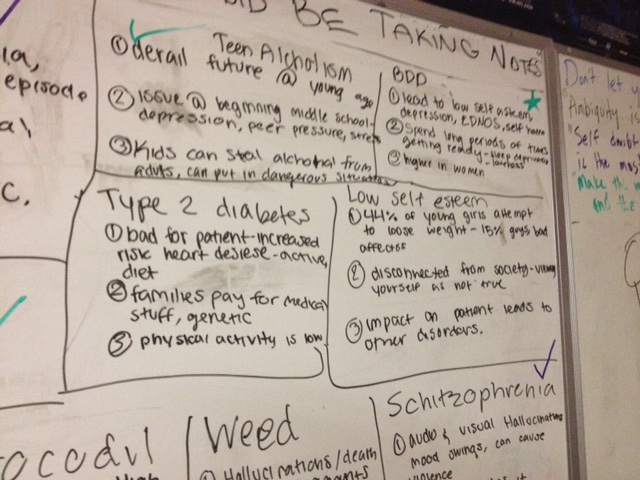
My most recent collaboration with a teacher outside of my subject area is an improvisation and health project. In the project, students must investigate and research health issues that are relevant to their lives and then use that research to build a character in drama. The characters then come together for a “community meeting” and discuss the issues of relevance in their improvised lives.

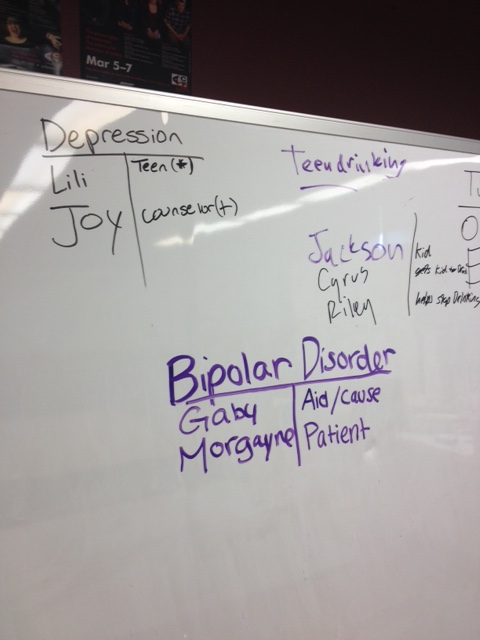
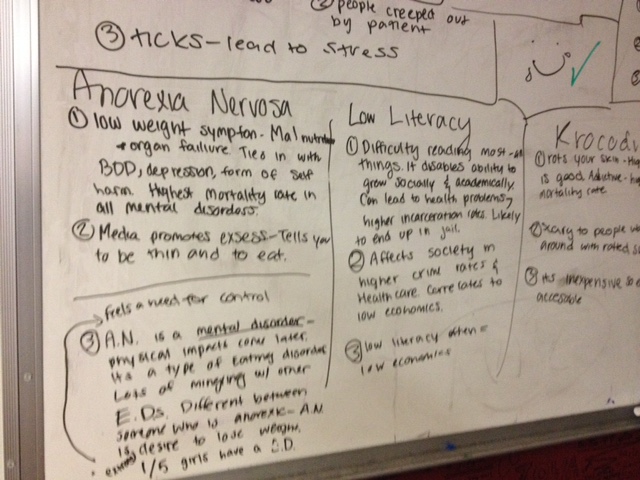
This project started with student research; this research was summed up in a inter-disciplinary meeting that shared the outcomes across content areas between drama and health. These pictures represent the research compiled by the students.

IMG_3616

IMG_3617

This information, generated by the students, was then summed up and shared with all the participating teachers so that it could be used in three ways. First, by using the foundational knowledge the health teacher is able to bring additional resources to the students so that their information that they use in drama can be more substantial.

Second, the students generate characters in an improvisational-based format that utilizes all of the research and gathered information. Based on the content from health class, students must create a back-story for their characters, character objectives and relationships, and character traits such as vocal and physical patterns.

IMG_3619

Lastly, this information, in addition to the work in class and the additional research in health class, is used to create a joint rubric. Students will receive a single summative evaluation that addresses their learning in both classes.

Every piece of written information is shared via Google drive so that both of the associated teachers can easily add and adjust content as the unit progresses.

This project exemplifies collaboration within the school because it is a unit that has and will continue to grow together. It allows students to combine their knowledge across content areas; this project further demonstrates this standard because it requires both of the collaborating teachers to communicate professionally in both written and verbal forms.

In summary, this project created a powerful effect on my students. They reported that the best aspect of the project was the integration of multiple subjects. Placing the health content in an improvisational format allowed them to explore the issues in both meaningful and personal ways. Further, this project created an excellent template (in both communication and lesson planning) for collaborations that I am sure will follow between the health teacher, other teachers, and myself.

In future iterations of this project, I will be sure to communicate with other teachers earlier in the year. While we had ample time to complete the project, the planning late in the year gave us undesirable timing when it came to the shared class time for the initial collaboration and the community meeting that the students jointly participated in.

Literacy Lesson: To Read or Not To Read

Using the CCSS, the following lesson was created in collaboration between theatre arts and fine arts content areas to incorporate multiple strategies in literacy instruction; the lesson incorporates strategies that are based in constructivist interpretation, visual interpretation, and performative interpretation. (Follow this link to see the evolution of this lesson from a fail to finesse)

LESSON OUTLINE: LITERACY FOCUS – MINI LESSON: TO READ OR NOT TO READ


Title TO READ OR NOT TO READ
Standard CCSS.ELA-LITERACY.RL.6.4Determine the meaning of words and phrases as they are used in a text, including figurative and connotative meanings; analyze the impact of a specific word choice on meaning and tone
Central Focus (CF) To interpret the question posed by Hamlet, “To be or not to be…” by using expressive gestural images of actors, the original text written by Shakespeare, and actor created interpretive performances.
Academic Language Interpret, Gesture, Emotion, Voice, Physicality
Learning Target (LT) To interpret Hamlet’s question “To be or not to be” by looking at images of actors, and performing one line as a group.
OVERVIEW: LESSON MAP
Lesson Part Activity description / Teacher does Students do
GOAL Introduction of learning target and pre-assessment. Self-assess on Hamlet’s Question
1A Pre-reading: Dramatic Expression in Images Students explain thoughts about images that use dramatic expression and gesture.Students complete worksheet that asks them to interpret then respond to other students’ interpretations of the gestural & emotional images supplied.
1B Informal Assessment: Presentation of scaffolded syntax sentence. Students share, respond to and invent further performed interpretations of emotions.
2A Practice: Jigsaw of Text – Interpret Meaning Students work in groups to construct meaning by combining collective knowledge of a small piece of the text.
2B Informal Assessment: Self-assessment Students share translations with the class.
3A Extended Learning: Match text to images with a performance of interpretation. Students create original performances that are matched to a section of the text by selecting voice and physical choices that correspond to the text and their interpretation.
3B Summative Assessment: Student Performances (group assessment; teacher assessment on Rubric) Students self-assess their performance on the exit ticket.


Introducing the Learning Target
GOAL Teacher Does:Write [LT] on board.
Teacher Says:FIRST: tell me now if you think you can interpret what Hamlet’s question is. Show me a fist of five.
5 – I have an excellent idea of what the question is and what it means4 – I have a good idea of what it is, but I think there is more I could know.

3 – I have a basic idea, but I’m sure there are bits I am missing

2 – I am unsure about this.

1- I’m more than unsure, I’m lost.

Students Say:

FIRST, students silently respond to both the self-evaluation “fist of five” prompt.

Pre-reading: Frontload with Images (p. 100)
INSTRUCTION (1a) 1. Teacher asks students to divide into pairs.
NOTE: Review definitions of academic language organically throughout lesson. When word comes up in discussion, pause to write the definition on the whiteboard. Interpret, Gesture, Emotion, Voice, Physicality
2. Teacher asks – what is emotion? Teacher writes 3 examples on whiteboard. Ask for one emotion example from each pair of students. Then, ask pairs to add an adjective before their emotion.
Examples: intense curiosity, overwhelming joy, life-shattering despair, mind-numbing boredom. (Anger, Fear, Confusion, Malice, Revenge, Desperation – These would fit with Hamlet really well).
3. Teacher writes examples of emotions on whiteboard.
Teacher tapes 8 images/printouts from productions of Shakespeare plays on a table in a large circle. The images should display a wide variety of emotions that occur within Shakespeare productions.
There is a worksheet attached to each image. (see attached).

  1. What emotion does the gesture in the picture convey? Give evidence to support your opinion.
  2. Do you agree with the previous comment or do you disagree? Write specifically about the gesture of the actor.
  3. If you had to perform the gesture in the printout, how would you do it? What would your body look like if you were feeling that emotion?
Students divide into pairs.Students respond with one emotion example per pair.

Students invent adjective to make their  emotion more dramatic.

Pairs choose an image and answer the first question on the worksheet.
Each pair to take a couple of minutes to write response to question number one. Pairs then move to another image and take two minutes to answer number two.The same procedure is used to answer number three.

Group Sharing
INFORMAL ASSESSMENT (1b) Teacher Says:FIRST, Secretly choose an emotion to perform from the list on the whiteboard. DON’T TELL ANY OTHER PAIRS! THIS IS A SECRET!
Now, pretend that you are an actor and are in a Shakespeare play. What kind of gesture would you use to communicate that emotion? Practice that gesture with your partner for one or two minutes. Be as dramatic as you can! Let me model this for you: Teacher models acting out a gesture.
Pairs secretly choose which emotion to perform.Pairs practice performing that gesture for the rest of the class. The class guesses which gesture that they are trying to communicate.
If the class cannot guess the emotion, a volunteer can come up, read the emotion and take a stab at performing the emotion.
Jigsaw and Sketching My Way Through the Text (p. 131)
PRACTICE ACTIVITY (2a) Teacher Does:Pass out the mini-texts (see attachment at end of lesson).
Teacher Says:Read the small segment to your group. Do two things with the segment.
FIRST, respond to the small segment by trying to translate the words from Shakespeare into words that you would use. Write out your translation under the text on your page. Pool your collective knowledge to construct an interpretation of the text.
SECOND, in three minutes or less, to brainstorm with pictures without judgement, draw an image, or series of images, that you think represents the small piece of text. This does not need to be a professional piece of art. Rather, it should express the idea of the text. Stick figures, cartoon drawings, scribbles, loose sketches, and original artistic interpretation are encouraged. Three minutes starts now!
THIRD, match the image(s) that you drew to a similar image from the first part of this lesson.Teacher Does:

Observe and work with individual groups.

Students Do:

Students collaborate to pool collective knowledge and understandings to find language that is accessible for all students.

Students quickly sketch a pictorial representation of their translation.

Students match the images

INFORMAL ASSESSMENT (2b) Teacher Does:Pass out full text to class with indicated jigsaw pieces and space to write out the translation from each group.
Teacher Says:FIRST, we will now share out our text, I am passing out the full text that the class has examined in pieces. Next to the original text, there is space for you to write down the translation.
SECOND, each group will share their translation with the class. We will go in sequence so that we can hear the text in full. I will read the original and a representative from your group will read your translation. You should write down the interpretation of each group as we go. Be sure to speak slowly so that everyone can catch every word you say.
THIRD, after the readings, we will have a quick period of time for group comments and questions about the text or translations.
FOUR, Now that we have practiced interpreting, tell me now if you think you understand what Hamlet’s question is. Show me a fist of five.
5 – I have an excellent idea of what the question is and what it means4 – I have a good idea of what it is, but I think there is more I could know.

3 – I have a basic idea, but I’m sure there are bits I am missing

2 – I am unsure about this.

1- I’m more than unsure, I’m lost.

Students do:Students share their work with the class as directed.

Students discuss.

Students self assess with a fist of five.

TEXT TO IMAGES and DRAMATIC ROLE-PLAY (110).
EXTENDED LEARNING (3a) Teacher Says:FIRST, Now that we have created a translation, you have the opportunity to perform your translations for the class. Please work as a group to speak your section of the original text. As you speak select one or more vocal choices to perform (pitch, quality, tone, prosody)
SECOND, Students will identify one or more gestures and or movements by looking at both their drawings and the images from the first part of the lesson.
THIRD, Practice presenting the text as a group. You should speak and move in unison.
Students Do:Students prepare as directed.
STUDENT PERFORMANCES
SUMMATIVE AND FORMATIVE ASSESSMENT (1b, 2b, and 3b) Teacher Says:FIRST, We will now observe group performances. After each performance, please give a clap of respect, on my cue, to each group.
SECOND, Following the performance you will complete a group-assessment, on your exit ticket, of your performance; you will also receive teacher based summative assessment. Each assessment will utilize the same rubric.
Students Do:Students observe and perform as directed.


4. Supporting Development through Language
a. Language Function: What verb appears in your learning target that represents the language function?
Language Function: To InterpretStudents will interpret the text in multiple ways. Interpretation includes a background understanding (identifying what students know), an applied understanding (accessing learning through what the students want to know), and personalizing the interpretation for individual meaning. To break the task down further, there are several sub tasks to interpreting:

  • Gather and observe associated information:

Students must closely and mindfully look at a gesture and identify the emotion associated with it; they will use images that represent what an actor may do while performing the text to understand how actor expression influences the meaning of any text.
2) Translate the text into modern language and construct meaning through group definitions:

Students must pool collective knowledge and understandings to find language that is accessible for all students. They must build a mutual understanding by defining words, discussing meanings, and brainstorming associated ideas. Doing this will enrich the experience of both watching and performing the original text.
3) Personalize the text through creating images and performances

Through performances, students can express their interpretation by using vocal (quality, tone, pitch, and prosody) and physical choices (gesture, movement, body position) that convey deeper meaning.

b. Language Demand: What learning activities or products will students write, speak, or do to represent the language demand and an opportunity to practice the language function?
This lesson uses multiple strategies for students to practice interpretation. First students will frontload with images (1a). This tactic will allow the vibrant and powerful images of actors in performance to inform what the reader might imagine or look for when interpreting the text of “To be or not to be.” This visual hook will serve as an anchor for students to use as they tackle this difficult text.
Second, students sketch their way through a portion of the text (2a). This allows them to access both multiple intelligences and avoid being caught up on the large portion of new words and, essentially, a new language for them to translate. Using the jigsaw approach, students can interact with the text in a way that remains accessible.
Lastly, students perform their understanding (3a and 3b). This dramatic role play allows students to express their understanding of the content in the way that actors would also present their understanding of the content. This is a simple performance that the students can create of a master-text. By engaging the entire class in this exercise the students are both connecting with the entire text and they are making the text personalized to their own experience.
c. Additional language demand: How will students practice content vocabulary words shown in the learning targets?
In addition to the strategies described in the previous response, throughout the lesson, students turn and talk (1a, 2a, 3a). This strategy gives students the opportunity to practice and check their understanding of the lesson content and language demand of interpreting the text. By using this strategy, students can review key elements of the lesson, identify points of personal connection, and allow multiple students to work with multiple partnerships.
d. What learning activities enable students to practice using symbols or abstract representations of information (syntax), if these are part of the lesson?
I am choosing to respond to this question by focusing on how the teacher will clearly explain the discourse rules. During (1b), the teacher will explain that the students are to stay with their pairs and secretly choose an emotion to perform. The teacher explains that the emotion does not have to be the one that they originally invented. The students are told to keep this emotion secret and to practice it for a minute or two. After the teacher models a performance, the students are then asked to perform their emotion. The class votes to choose which emotion is being performed. If the class does not correctly guess the emotion, the teacher will ask for volunteers to take a stab at acting out the emotion. This will continue until the class is able to guess correctly. The steps/rules to this discourse game will be posted on the white board as a semantic map.
e. How is discussion (discourse) structured in activities?
Discourse is structured in a variety of ways in the activities. This entire lesson can be thought of as almost all discourse between students as a large group and through working/responding/interpreting/creating in pairs. Some examples are: (1a) invention and descriptive dramatization of emotions; and completion of discourse worksheets, (1b) Creation and performance of emotional gesture; whole group (1b) – acting out gestures in front of class and class responding to whether they understand emotion being performed. Further discourse is created by the whole class guessing the emotion as well as fine tuning performances when gesture does not communicate clear emotion, written response and reflection (1a) completion of worksheet where students interpret images and respond to each other’s opinions. (2a) Students collaborate to pool collective knowledge and understandings. Discourse is also structured in a less conventional way by having the students communicate with the class through the performing of gestures to express understanding of the academic language function (interpret) and response by the rest of the class of whether that language function was achieved. Students can further the discourse by performing the emotion for the original performers (in front of the class) as a communication/model of a deeper understanding of the language function. This further builds their skills necessary to interpret Shakespeare passages.
f. What other writing or speaking activities enable students to practice vocabulary and the verb shown in the learning target?
Students are asked to invent emotions and interpret them gesturally as a way to show evidence of understanding of the academic language. Students are also asked to complete worksheet that prompts them to explain their understandings of the academic language. Students work in groups to construct meaning by combining collective knowledge of a small piece of the text. Students verbally share translations of the text with the class. Students create original performances that are matched to a section of the text by selecting voice and physical choices that correspond to the text and their interpretation. Students self-assess their performance on the exit ticket.


Personal Performances that are Developmentally Logical and Abstract, Reflection

Teachers should plan for and adapt a curriculum with a learner-centered strategy that engages students in a culturally responsive and developmentally appropriate way.

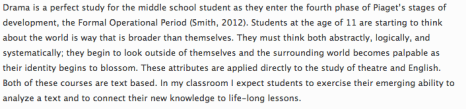
When it comes to developmentally appropriate instruction, planning can be informed by the study of the fourth phase of Piaget’s stages of development, the Formal Operational Period. As a part of this study I researched the importance of this important stage of development. As a part of coursework, I wrote, “students at the age of 11 are starting to think about the world in a way this is broader than themselves.”

Screen Shot 2015-04-28 at 10.59.23 AM
Course Research into Student Development: Piaget (https://davidoracekelly.com/2014/07/16/learning-drama-in-the-face-of-the-learner-paradox/#more-87)

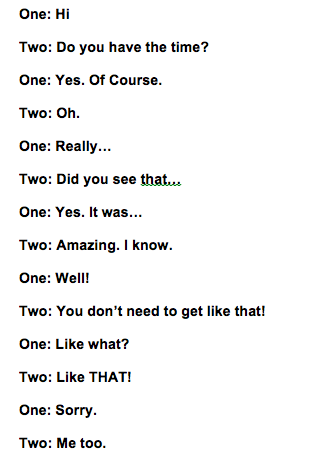
As Piaget’s fourth stage of development suggests, drama can help students to think both abstractly and logically. By studying a script they must both analyze the meaning of the text and interpret the meaning that is personally relevant. One example of this is a lesson I completed in the eighth grade. Students had to study a neutral scene and interpret the text by adding personal meaning in the performance. Students created a range of performances. By identifying the who, what, and where of the scene, students created a unique world from the abstract idea that was logically created. Student work included a daughter (One) and a mother (Two) after the daughter came home late from a party; another performance had a boyfriend (One) getting dumped by a girlfriend (Two); lastly, the most memorable performance was a rock-star (One) meeting a fan (Two) as the rock-star left a performance and unfortunately the rock-star disappoints the fan by not being everything the fan thought they were.

Picture of Neutral Scene

In this lesson, students had to imagine a situation that both logically fit the text and fit their own personal interpretation of the text. This exercise met both conditions found in Piaget’s fourth stage.

In summary, I have presented this lesson in the past. What changed this time was the insertion of personal meaning into the text. Students had to place themselves into the concepts that they were creating. The resulting performances were filled with significantly more meaning and emotional impact than I had previously seen.

Student learning in drama must include personal meaning. It is through this concept that students can personalize the work and create authentic performances. While this is typically a high-level skill that college students pursue, it is achievable in the middle school classroom through this tactic.

I propose that more of my work with text include personal meaning in performance. I will even add it to my evaluation rubric as a self-assessment component for all performances. I often talk about the symbiotic relationship between text and performer. This will bring that idea into reality; the performer must put their opinion into the text and bring it to life in a way that only they can. This key idea brought out new talent that was previously un-tapped by the students. These changes will both increase the artistry that the students produce and, more importantly, increase the student ownership of the work in drama.

You Should Champion the English Language and not Rant about Change

Every generation has cried out about the writing degradation of the next generation. Test scores are lower than ever, a critic may cry. But tests are biased ad are discriminatory to different populations depending on the content that the test asks about (Daniels, Steineke, and Zemelman, 2007).

The critic may try to expose the monumental outbreak that is assassinating the English language. “OMG” “LOL” and “BRB” are tearing apart our language. But, are they really? Language evolves with the people that use it.

What about “OK?” Historians cannot agree on the origination of the word. However, one dominant origination is from the phrase “orl korrekt” an alternate spelling of “all correct,” that was used in the U.S. during the 1830’s (for more explanation see http://www.oxforddictionaries.com/us/words/what-is-the-origin-of-the-word-ok).

From the birthplace of the English language, one of the greatest geniuses of all time, Shakespeare, made up more than 1700 words used in the common English of today (Mabillard, 2000). These words include, “exposure,” “birthplace,” “rant,” “dishearten,” “critic,” “monumental,” “outbreak,” “assassination,” and “champion.” There would not be a champion for the English language to rant about the disheartened critics, without Shakespeare.

The English language has been changing with every generation because of the way that people communicate. Perhaps today, the change is even more rapid. A teacher may say that their students hate to write; in reality the student may simply hate to write what the teacher wants (Daniels, Steineke, and Zemelman, 2007). However, students are not writing well for academic purposes (Daniels, Steineke, and Zemelman, 2007). This impacts the path of the student throughout life as they may struggle to learn advanced content in any given subject matter, as they work to meet state standards, as they seek out advanced education and take high-stakes testing such as the SAT and ACT, and as they seek out employment.

How should a teacher go about teaching writing? One strategy is Writing to Learn so that the teacher is not simply teaching “how to write;” the teacher should teach students how to learn through writing. Therefore, teachers should use writing in the following formats so that writing becomes part of the learning process: short, spontaneous, exploratory, informal, personal, one draft, unedited, and ungraded. These writing styles exist in every subject. From the quick notes that a science student makes about an experiment to the brainstorm “word cloud” that goes into writing an essay in English. The idea of ungraded work may be a novel approach in a school. But, a comprehensive correction of student writing does not and never has worked to teach writing (Daniels, Steineke, and Zemelman, 2007). Writing can be used instead to start discussions, feed small-group work, and review key ideas. From this point, the teacher can help the student act upon their writing impulses and guide the students to an academic voice in their writing.

Writing will always evolve and inform culture; if writing is also informed with an academic voice, it will change society in a way that is powerful and lasting (just as Shakespeare has done). As Gandhi said, “you must be the change you wish to see in the world.” Teachers take note and champion the change in the English Language because change will happen with or without your influence.

References:

Daniels, H., Steineke, N., & Zemelman, S. (2007). Content-area writing: Every teacher’s guide. Portsmouth, NH: Heinemann.

Mabillard, Amanda. Words Shakespeare Invented. Shakespeare Online. 20 Aug. 2000. http://www.shakespeare-online.com/biography/wordsinvented.html .

What’s the problem with American textbooks and how can this problem be overcome?

THE PROBLEM: The problem with American Textbooks is that they are often bland and outdated. The textbook replaces the standards that the teacher should use to derive original and refreshing lessons that are relevant to the student population. A textbook is a homogenous text that is made for universal appeal. With a mandated textbook, teachers are left to either follow the textbook in full (which is hardly teaching) or assemble their lessons around the required components. A textbook, when used as a primary or exclusive teaching device, is equivalent to letting another teacher (the author of the textbook) into the classroom and puts the primary teacher into a position of student management monitor.

THE SOLUTION FROM THEATRE AND ENGLISH LANGUAGE ARTS: Fortunately, both of these subjects have a broader range of choices than the average science or math class. These highly structured fields contain a set sequence of information that the student must master from one year to the next (Daniels and Zemelman, 2014). However, with English Language and Theatre Arts, the instruction has a spiral structure (Daniels and Zemelman, 2014). Students are required to build on past (and similar) learning experiences with the same structure and processes from one year to the next. In English Language Arts, students read texts (ideally in a wide array of genre) and respond to those texts through writing and other interactive activities (such as group discussions). In Theatre Arts, students study a new play each time they go through the process of performance; the text is always changing and the skills build upon the past experience of the student. Both of the subjects are focused on the personalized application and interpretation of the content.

THE QUESTION FOR EDUCATORS: Where does the information for your field live? Suggestion, take a cue from the humanities. Knowledge lives in the student; by capturing the student experience as they interact with the primary source of information, knowledge is formed. A textbook in science can be a reference tool for an educator because it contains the “required information” for the grade level. However, a textbook in Theatre Arts does not exist and a textbook for English Language Arts is seldom used. Further, students will learn and retain more information when the teaching is not exclusive to information processing (a.k.a. regurgitation). Information is retained through a personalization of the information – that is how it turns into knowledge. Lastly, this is how literacy can be build, across the subjects. Literacy must include the ability for one to personally translate, utilize, and generate information within the content. That cannot happen if the information is merely being read, memorized, tested, and forgotten.

Reference:

Daniels, H., & Zemelman, S. (2014). Subjects matter: Exceeding standards through powerful content-area reading (Second ed.).