Family Engagement Plan

Teaching is not simply a one-on-one relationship. A teacher works with the student that is influenced and informed by the families they live with, the community they work with, and the neighborhood they are active with; A teacher should involve, inform, and collaborate with the families and neighborhoods that the students live in. This involvement should inform the educational process, include student cultural identity, and be linked to student achievement and performance.

As a part of my coursework and professional development in teaching I have created a Family Engagement Plan that includes an integration of family stories and community life so that I can know my students and their families better.

Being a community-based teacher is a philosophy and a continual practice that embraced the entire student and their major influences. By following this praxis, teachers can form productive and positive relationships that validate the life of the student both outside and inside the classroom.

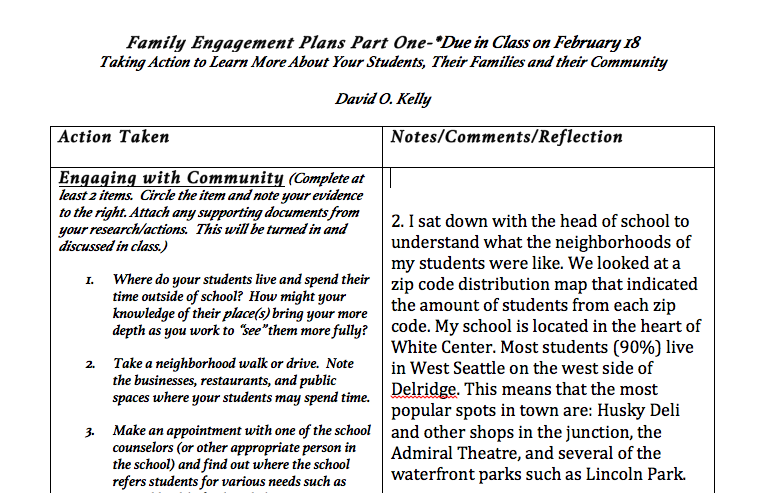
To develop my competency and understanding of my student community I met with the Head of School. In doing so, I learned that the majority of students (90%) live in the West Seattle neighborhood, west of Delridge. By interviewing students and the Head of School, I found that the most popular places for students to visit were: Husky Deli, Full Tilt Ice Cream, West Seattle Farmer’s Market, and the Admiral Theatre; other popular locations for students to visit included waterfront parks such as Lincoln Park and Alki Beach.

I took notes of my conversations and consolidated them into part one of my Family Engagement Plan.

<Screen Shot 2015-03-11 at 6.32.58 PM
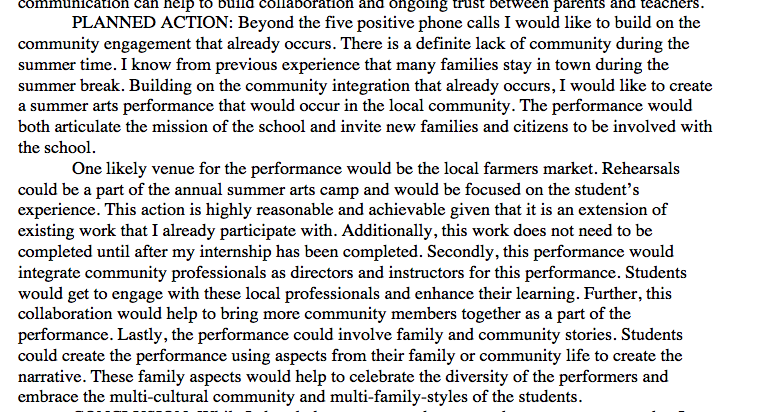
I realized and learned that I did not have a strong understanding of the student’s cultural and family identities. For part two of my plan I wanted to create a component that would embrace and include this missing aspect from my understanding. My plan, starting this summer as a part of summer camp, is to pilot a family and community story project that would have student’s bring family and community stories to the stage and integrate them into a performance that would be performed in the community. It would be my hope that the organizations that students identified with would be integrated in one aspect or another of the performance.

I presented my family engagement plan to the Head of School for a pilot program this summer. I have been approved for this work.
Screen Shot 2015-03-11 at 6.31.55 PM

It is my hope that future versions of my family engagement plan will be a part of my established curriculum. By implementing a family and community story project early in the year with sixth grade students I will be able to understand the prior history of students along with their present learning environment that they interrelate with outside of school. One last implication of this project would be my ability to integrate meaningful content, that would relate to student culture and family identity, into the remainder of the year’s academic plan.
ISTE 4: Digital Citizenship

ISTE 4 asks teachers to comprehend the social issues and responsibilities, on a local and global scale, that are involved with the ethical and legal behavior of digital culture.

Therefore, because instruction and differentiation are central to good teaching practices, and therefor part of the ethical praxis of a teacher, how can teachers address the societal issue of integrating technology within the classroom in a way that is both grounded in the broader framework of digital literacy for students and instills responsible learning habits for the students (including the understanding of basic copyright and creative commons practices, legal limitations for youth and the internet, individualized instruction and self-assessment, navigating the internet with global etiquette, and developing a cultural understanding of the world at large through the digital interface)?

In exploring this question I came across several resources, articles mostly, that can help a teacher align their priorities and educational objectives when integrating technology in the classroom.

This article (http://www.educationworld.com/a_tech/responsible-student-technology-use.shtml) written by Christopher McGilvery (2012) reviews many tech teaching concepts such as: caring for technology equipment; safe sites for learning; copyright law and creative commons; cyberbullying; digital self-image; netiquette; and other essential topics for the technology enabled classroom. McGilvery (2012) includes lesson plan boosters on Digital Literacy, thinking before hitting “send,” and the ‘Facebook’ score and Hiring Decisions.

Here, as part of a LinkedIn group, I found an article (https://www.linkedin.com/pulse/technology-sake-problem-samr-lorna-keane) that emphasizes the importance of learning. Lorna Keane (2015) describes the problem with the SAMR (Substitution, Augmentation, Modification, Redefinition) model that is often used with technology integration in schools. “Once technology integration alone becomes a goal, we’re doing something wrong (Keane, 2015).” The essence of this article emphasizes independent learning, personalization, student voice, and critical thinking as essential aspect of learning (and that these things can be assisted by technology).

So, how is a teacher to do this? One hurdle may be the digital literacy of the teacher. In this case, there are several resources online that can help a teacher to develop competency with teaching digital literacy and citizenship. DigitalLiteracy.gov (http://www.digitalliteracy.gov/content/learner) has tutorials designed for adults in multiple technology streams. These lessons include: using a computer or mobile device, software and applications, using the internet, communicating on the web, and child online protection.

My colleague Shawn Cudney, is working with an online tool that would be an excellent place for any educator to start. This teen pledge (http://www.safekids.com/teen-pledge-for-being-smart-online/) empowers students to make the right choices online while engaging with educational technology and while they are engaging with technology for personal and social pursuits.

For teachers that have experience with technology Carey (2014) provides an excellent description on how to infuse digital literacy throughout the curriculum (http://plpnetwork.com/2014/03/26/infuse-digital-literacy-curriculum/). Carey (2014) posits that evaluating online content is a research skill, engaging online is a modern communication skill, and that student projects can become digital. Teaching digital literacy does not mean that technology will take over the classroom. However, integrating technology into the curriculum, is an essential 21st Century skill for every classroom.


Resources:

Carey, J. (2014, March 26). How to Infuse Digital Literacy Throughout the Curriculum. Retrieved March 1, 2015, from http://plpnetwork.com/2014/03/26/infuse-digital-literacy-curriculum/

Keane, L. (2015, February 19). Technology for the Sake of Technology: The Problem with SAMR. Retrieved February 19, 2015, from https://www.linkedin.com/pulse/technology-sake-problem-samr-lorna-keane

McGilvery, C. (2012, January 1). Help Kids Become Responsible Digital Citizens. Retrieved February 19, 2015, from http://www.educationworld.com/a_tech/responsible-student-technology-use.shtml

PLCO: Professional Leaning Community Online

I have found a great deal of professional development and engagement through several LinkedIn Teaching Communities.

These communities have provided both the opportunity for an exchange of ideas and an opportunity to showcase my teaching credentials.

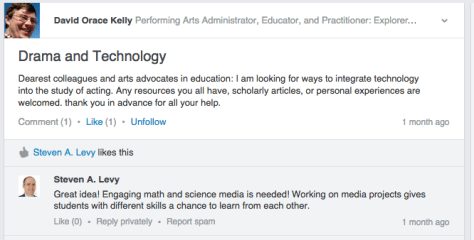
One example of my PLCO engagement was through a question I asked in the “Teacher’s Lounge,” a LinkedIn Community that is populated by educators of varied experience.

Screen Shot 2015-03-01 at 10.10.46 AM


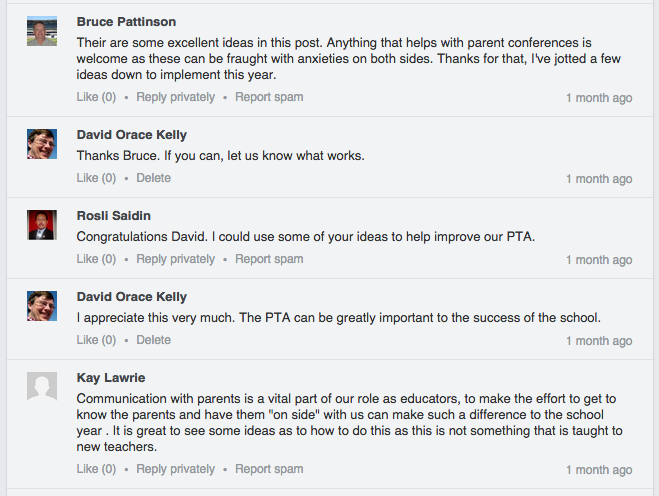
Another example of my online participation is through a presentation I created on Parent and Teacher Conferences.

Screen Shot 2015-03-01 at 10.11.12 AM


The comments were highly encouraging and demonstrated the impact of my post and the importance of my message.

Screen Shot 2015-03-01 at 10.11.31 AM


Online Professional Learning Communities are a new and highly productive way of developing as an educator; these online communities are on LinkedIn, Google+, and many other platforms. Without much effort a teacher can bring an expert, on a range of teaching topics, to their desk. An educator can also offer their work to for the benefit of the community.

Digital Citizen

Enjoy my Glog on Digital Literacy and Citizenship

GLOG
Linked here.

Digital Literacy is an essential skill for the students of today. It will enable them to achieve academically as more and more content is delivered through technology and it will enable them to succeed in the workplace of the future.

Being digitally literate means understanding the technology of today in both how to use it and the best practices surrounding it. Digital Literacy also means adapting to the technology of the future.

Every teacher, regardless of subject, should integrate technology into their classroom for these very basic reasons. Teaching digital literacy and citizenship is the essential class of today – equivalent to the civics class of the past.

Modeling Digital-Age Learning in a Participation Arts Based Classroom (ISTE 3)

ISTE Standard 3 states that teachers should exhibit knowledge, skills, and work processes that are representative of an innovative professional. My content area, theatre arts, is based in human interaction; these interactions must occur in the moment and in person. An actor must learn to act and re-act. Taking the content of theatre arts into the technological realm is equivalent to making painting class into a digital photography class. However, there is a great deal of content that can be delivered in a flipped classroom format; there are digital tools for teachers, students, and actors that are becoming increasingly common place.

Because the world is increasingly tech-enabled and tech-enhanced, how can I as a teacher of theatre arts, demonstrate technological processes that both enhance my curriculum, increase productivity, and build technological capacity in my students?

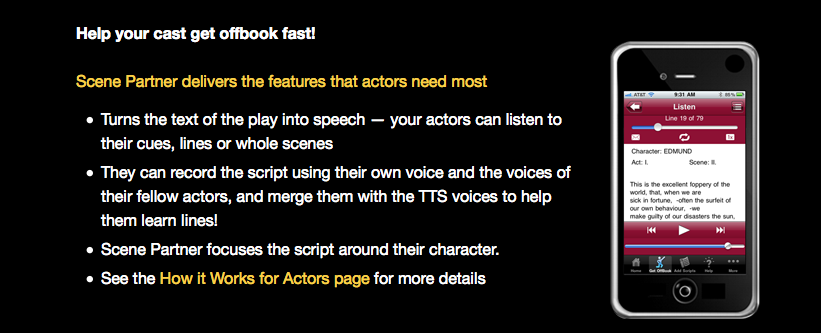
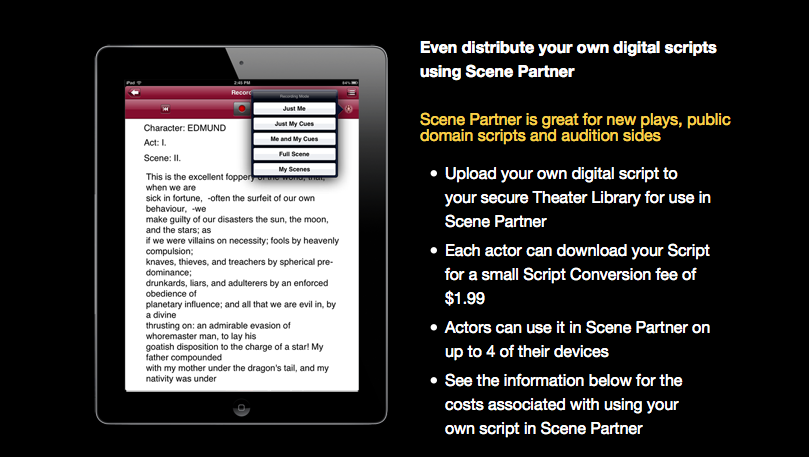
Kennedy (2009) speaks to the need for educators to rethink education and align learning environments with real world demands so that learning is flexible and can be utilized anytime and anywhere. One of the most tedious tasks of the actor is to memorize lines. One digital innovation seeks to change that. ScenePartnerApp (https://www.scenepartnerapp.com/) is one of many emerging tools for actors to use when the need to memorize their lines. Any student with an iDevice can download existing scripts or upload their own. This makes the program highly adaptable to any classroom, especially mine because much of the theatre work that my students engage with is written by the students in my classes. However, when we do get to the published works (such as Shakespeare), we can simply download the text.

Screen Shot 2015-02-14 at 1.45.46 PM Screen Shot 2015-02-14 at 1.46.16 PM Screen Shot 2015-02-14 at 1.46.38 PM

One of the greatest highlights of this app is that it allows the user to hear only their lines or only the lines of their scene partner. This ability to repeat the text and use a digital scene partner is invaluable. Without this, the technique of memorization with a partner would need to happen in class. By using this app many of my students, those with iPods and iPads, have a highly effective solution that not only saves time for my classroom, it adds digital flexibility for my students. This app is one clear example of how I can integrate emerging digital technology into a classroom based on human interaction. In fact, because of the time I save (due to students memorizing their lines outside of class) I can increase the amount of human interaction in my class.

Theatre arts is not alone when it comes to time saving digital tools. Now because of the Google Institute (shared by Lida Enche in Google+) students can save travel time and virtually visit art across the world. This too increases the human interaction because in the classroom, teachers and students can talk as much as they want. Google Institute can be found at, https://www.google.com/culturalinstitute/project/art-project. I encourage everyone to check out both of these new digital tools that help arts classes.

References:

Kennedy, K. (2009). Volume 7, Issue 2 Distance Learning 21 Cross-Reference of Online Teaching Standards and the Development of Quality Teachers for 21st Century Learning Environments. Distance Learning, 7(2), 21-28.

ISTE #2 Teaching With Technology

ISTE QUESTION 2: Given that authentic learning experiences can be powerful and lifelong, how can educators put technology into the hands of the students to personalize their knowledge and demonstrate their understanding; further, how can students use technology for self-assessment (formative or summative)?

I started my question this week with the assumption that self-assessment was valid and effective in the practice of teaching. What I found, to support that assessment was valid, was a study conducted by de la Fuente (2014); a link to the study can be found at http://web.b.ebscohost.com/ehost/command/detail?sid=cd7a458d-96f3-4e94-a3d7-2e1c3fc46da9%40sessionmgr198&vid=26&hid=125. This study compared two types of student assessment in a secondary language classroom. The scenario of students working independently to memorize words and phrases is not too different from a common scenario in the theatre arts classroom. In my work, I often give students time to work on memorizing their lines. The study placed one group of students in a position of control over their self-assessment with mobile assisted language learning (MALL). The second group surrendered all power to the instructor with an assessment that was instructor manipulated language learning (IMLL). The study observed the comprehension of the students following the assessments. Students in the MALL group demonstrated significantly higher levels of comprehension in multiple categories (de la Furente, 2014). When comprehension is the central task, self-assessment is more effective than instructor directed assessment.

Second, I attempted to answer the more difficult question of how to implement self-assessment through technology. A second study was found to answer this question (Mordis and Economides, 2012); the link is provided here http://web.b.ebscohost.com/ehost/pdfviewer/pdfviewer?vid=24&sid=cd7a458d-96f3-4e94-a3d7-2e1c3fc46da9%40sessionmgr198&hid=125. Mordis and Economides (2012) found that during a self assessment test the learner was able to reach an optimal emotional state in relationship to the learning content by giving students the reward of applause after correct responses.

Students took a multiple choice question test and the levels of anxiety were observed and measured. Results showed that male students not receiving applause have a significantly high state of anxiety after the test than female students not receiving the applause (Mordis and Economides, 2012). Further, males that received applause after correct responses were significantly less anxious than females in the same category. In other words, males need more external positive motivation to reduce their anxiety.

Mordis and Economides (2012) conclude that affective feedback during self-assessment is only one tool that can be used; this supportive feedback can have positive or negative outcomes that may fall along gender lines. Lastly, affective teaching must embed self-assessment within the educational context (Mordis and Economides, 2012).

In my classroom, I have students give a “clap of respect” to performers. The clap does not signal success or failure (as the second study did for success). However, this did highlight renewed awareness that every student reacts differently to praise.

What really interested me this week was the idea of self-assessment through technology in an arts classroom. Lida Enche, provided a reference to the tool that could combine my public presentations with technology. By utilizing a document camera, I could have students highlight their own work (e.g. notes they made on their script) and evaluate their progress for the class. The resource provided by Enche (http://www.theartofed.com/2014/09/01/15-fabulous-ways-to-utilize-a-document-camera-in-the-art-room) does not address the concept of self-assessment, however it does lead one to extend ones thinking about how to use the document camera.

References:

de la Fuente, M. J. (2014). Learners&apos; Attention to Input during Focus on Form Listening Tasks: The Role of Mobile Technology in the Second Language Classroom. Computer Assisted Language Learning, 27(3), 261-276.

Moridis, C. N., & Economides, A. A. (2012). Applause as an Achievement-Based Reward during a Computerised Self-Assessment Test. British Journal Of Educational Technology, 43(3), 489-504.

Teaching With Technology

The integration of technology in a classroom can be an effective means to instruction because it can generate creativity along side developing proficiency with technology .

In consideration of ISTE 1 and the practice of drama instruction, learning can happen online – in a flipped classroom setting. The online portion of the learning can deliver content and allow for the classroom time to be focused on the creative aspects of drama. The technology can then also be used to capture the creative expressions of the students.

For example, I can deliver a lecture online about the play format and style.

Continue reading “Teaching With Technology”

Parent-Teacher Relationships

Teachers should exemplify an understanding of the professional responsibilities of teaching and the policies of the school they teach in.

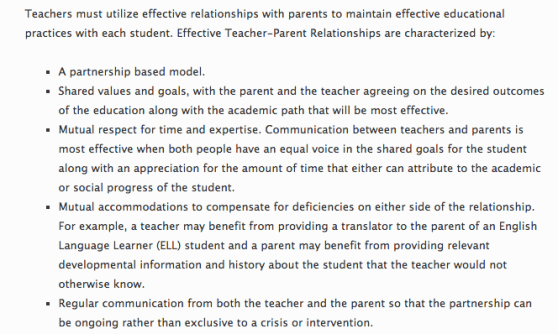
In my recent work as a teacher I have developed a nuanced understanding of effective relationships with parents. Recently I researched into the best practices of parent and teacher relationships and identified five key points for a relationship between a teacher and a parent to be effective for the education of the student in question; the relationship must be partnership based, include shared goals, be based in mutual respect, provide for accommodations on both sides of the relationship, and have regular communication that is both formal and informal.

These best practices, which I wrote about (see figure 1) and produced a video about (see below), are based in my experience as an educator and the work of Cheatham and Ostosky (2013), Guo (2010), Reyes-Blanes, Peel, et al. (1998), and Juniewicz, (2003).

Screen Shot 2014-12-01 at 10.55.45 AM
Figure 1


It is a professional responsibility and best practice of any educator to create an ongoing relationship with the parents of each student.

The first reason relationship building is important is that with the relationship the teacher develops an advocate and resource that will enhance the student’s understanding and learning outside of the classroom. An educator, at best, gets one-third of the day with each student. The parents of the students, at best, get the remaining two-thirds of the time; the parents are in an equal or better position to be influential in the academic outcomes of their student.

Secondly, each parent is a stakeholder in the community and a taxpayer (or tuition funder) that supports the development and continuation of the school. By involving parents into the process of education, teachers are acting with due diligence to their constituents, the community. Schools exist for the public good and those that fund and participate in schools deserve to know what is happening in the schools.

In completing the research, and in spite of my eight years as a teacher, I was impressed by the literature that presented educators as figures that are feared. There are parents that have little respect or appreciation for educators, or purposefully distance themselves from educators, because of their own experience with education. This increases the importance of building a positive partnership that is team-based, rather than a model of opposition or submission.

When an educator and a parent team-up with shared goals and values the student has a significantly increased chance for academic growth. Just this year I have seen an ELL student advance beyond his peers because of an intensive parental involvement in this student’s education. This involvement would not have been possible without an ongoing, weekly often and daily at times, relationship with the parents of this student.

While there are limitations on my time, I would like to increase my competency with parent-teacher relationships. One way I can do this is to focus on early and frequent positive communication about the students that I teach; this is one clear area that I can improve in. While phone calls and emails home along with ad hoc meetings after school and formal conferences have been productive, a method that I have not employed in the past has been through a message in the school bulletin. A brief statement that informs parents what we are working on in class and invites parents to contribute in ways they are comfortable would be an excellent way to establish a relationship that would allow parents to make the initial contact rather than myself making the first contact to the individual. This would also bring parents into the classroom and increase their buy-in to the program as a whole because their voices would be heard.

References:

Gregory A. Cheatham & Michaelene M. Ostrosky (2013). Goal Setting During Early Childhood Parent-Teacher Conferences: A Comparison of Three Groups of Parents, Journal of Research in Childhood Education, 27:2, 166-189

Guo, Y. (2010). Meetings Without Dialogue: A Study of ESL Parent-Teacher Interactions at Secondary School Parents’ Nights. (Undetermined). School Community Journal, 20(1), 121 – 140.

Jordan, L., Reyes-Blanes, M. E. Peel, B. B., Peel, H. A., & Lane, H. B. (1998). Developing teacher-parent partnerships across cultures:.. Intervention in School & Clinic, 33(3), 141.

Juniewicz, K. (2003). Student Portfolios with a Purpose, Clearing House, 77(2), 73-77.

Testing in Multiple Modalities (Course Reflection, Inquiry and Assessment)

social-media-conferencesMany people have experienced the ability to learn in different modalities. For instance, I memorize information best while I am walking. Many students in my class have demonstrated a visual preference for learning; they write and draw information to retain it. Other students in my class have shown their best growth when they talk to each other about their learning. Empirically, teachers and laypeople alike, understand that there are multiple modalities for learning. Why is it that student evaluation does not encompass the modality of learning?

Continue reading “Testing in Multiple Modalities (Course Reflection, Inquiry and Assessment)”