Know Thy Subject: Expect Diversity

There is great controversy in the world of theatre when it comes to casting. Analogous to this is the classroom task of putting on a play. The philosophical question is the same. Does the actor need to match the part? In other words, do you need an actor that is black to play Martin Luther King Jr.; do you need an actor that is Italian to play Romeo; are there times when you must pay attention to the diversity that the actor brings to the part and other times that it does not and should not matter? At least in the professional theatre there is a larger pool of actors, however, the pool of actors, like the classroom, is limited to the people that show up.

With children, it is even more of a challenge. Nearly every part in mainstream plays are not for children. Many parts that they are asked to play are adults. There are not many plays written for kids; the plays that are written for kids are often lacking in content with a simplified script. The content that I want to teach, and the content that my students are ready for, does not exist in a simplified script that is written for kids.

I have developed several instructional strategies to manage this problem. I let students shape their own narrative by literally writing the script that they want to work on. This eliminates any issues of adapting outside content to my students. I encourage them to work with the stories that they know based on their own personal experience. By doing this, I get a wide range of stories. From these stories, I select an evening of varied performances. One of my favorite plays ever written by one of my students was half in English and half in Spanish. Few of my students speak Spanish. However, the play was excellent and deserved to be produced. The entire class had to learn, memorize, and personalize the text written in Spanish. When students asked the inevitable question of, “Why do we have to do this?” I responded, “because it teaches you about the world around you; this came from your colleague and from your community; not everything needs to be easy and comfortable for you.” I can have this response because I know that every student, regardless of their comfort level with the material, will still be treated with respect; also, I had my eyes opened because of a play that I had to work on with a context that was not comfortable for me.

When it comes to casting, I generally practice what is known as color-blind-casting.[1] Rarely do I have a play presented that mandates an actor with a particular trait. I always have actors that are between the ages of 10 and 14; I do not always have characters in my plays with the same age rage. Further it would be educationally irresponsible of me to cast a student, based on skills and abilities in a part that they were not ready to play or achieve in the context of the project. I have seen far too many productions that featured an actor, with an obvious diverse trait, that was not able to perform in that part.

One prominent example of this was several years ago. I was invited to watch a production of Grease. As it happens, this was for a summer camp and most of the people that had signed up for the camp were girls. The director cast one of the few boys in the production as Danny, the male lead and romantic attraction for Sandy. The girl that was cast was about 14 years old; the boy was about 8. There was agony for the entire play. Much of the plot revolves around the relationship between these two characters. The director was unwilling to reimagine the casting and make Danny female or cast a female actor in a male part. The show was a tragedy and there were plenty of female actors that could have performed in the part of Danny excellently.

Casting should be based on ability and in an educational setting that can get tricky because of our diverse society and the history that we all carry with us. However, there are plays that mandate an actor with a particular trait that cannot be faked. If I had a play that was specifically about black character, I would have to cast a black actor. Without this I would be risking community outrage or worse yet my decision would go unnoticed and another minority person would be overlooked because the homogenized white culture had absorbed them.

Lacking that black actor, I would not be able to perform the script; or, I could discuss the script with my students and identify the challenge and create dialogue about the production. But, that is about as far as it could go. Even though there are many movies where ethnicities are faked and an ethnically ambiguous actor plays a range of characters from different cultures, I do not think that I should participate in the problem. I have learned that when it comes to casting (and to teaching for that matter), I must be flexible and adapt to both the script and the classroom pool of actors that I have.

When it comes to student assessment, I can adapt to each student in the classroom. I use a rubric that is based on skills rather than student interpretation.[2] This allows the personalization of a text to come to the performance. The powerful thing about theatre is that it can, and should, change with each performance and each performer.[3] One interpretation should be different from the next.

Lastly, so that all students have a sense of belonging, I have only three rules for my content area. Respect yourself; respect others; respect the space around you. I ask students on the first day of class what these things mean. I ask them to give examples of respect. This is one value that is universal. However, the way respect is shown changes from one year to the next. Students must participate in the shaping of the classroom culture. Doing this sets the tone for everything else; teaching is a partnership between the students and the teacher, it cannot be done in a homogenous melting pot. Rather, the partnership is formed anew with each new class in a new and beautiful way.

Know THY STUDENTS, linked here.

Know THYSELF, linked here.

Back to Prologue and Epilogue, here.

[1] Color-blind-casting is term that started with the idea that any actor of any skin color should be allowed to play any part. However, the term now applies to other identifiers such as, gender, physical ability, and age.

[2] Interpretation is one of the largest areas of bias an artist can have. As one who identifies as an artist, I recognize this and allow my students to express themselves through their bias and not my own.

[3] It is interesting to note though, this idea that performances change by the day is held primarily in Western Culture. In Kabuki, a Japanese form of theater the performance is passed on exactly from one master to one apprentice. This has preserved the art form for the past 400 years so that a performance today is nearly the same as it was when the art form first started.
Cross Content Collaboration

Collaboration within the school community can be an effective way to reach students across content areas and to help create new and renewed engagement for students and teachers; to do this teachers must collaborate across content areas and use appropriate communication to do so.

My most recent collaboration with a teacher outside of my subject area is an improvisation and health project. In the project, students must investigate and research health issues that are relevant to their lives and then use that research to build a character in drama. The characters then come together for a “community meeting” and discuss the issues of relevance in their improvised lives.

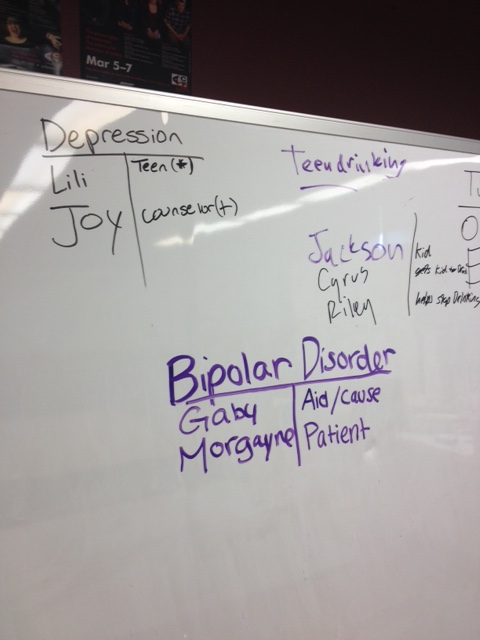
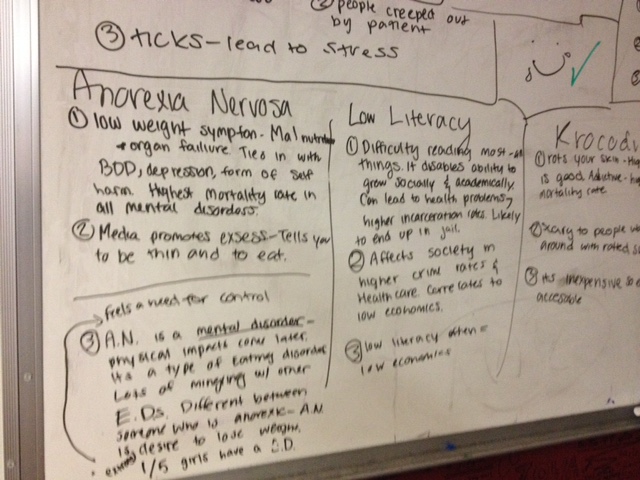
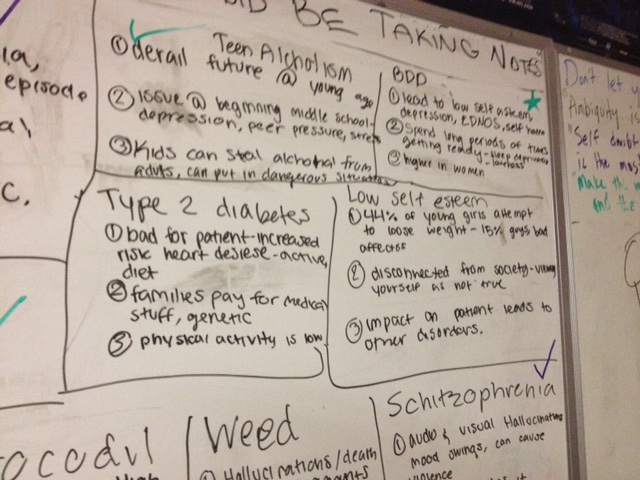
This project started with student research; this research was summed up in a inter-disciplinary meeting that shared the outcomes across content areas between drama and health. These pictures represent the research compiled by the students.

IMG_3616

IMG_3617

This information, generated by the students, was then summed up and shared with all the participating teachers so that it could be used in three ways. First, by using the foundational knowledge the health teacher is able to bring additional resources to the students so that their information that they use in drama can be more substantial.

Second, the students generate characters in an improvisational-based format that utilizes all of the research and gathered information. Based on the content from health class, students must create a back-story for their characters, character objectives and relationships, and character traits such as vocal and physical patterns.

IMG_3619

Lastly, this information, in addition to the work in class and the additional research in health class, is used to create a joint rubric. Students will receive a single summative evaluation that addresses their learning in both classes.

Every piece of written information is shared via Google drive so that both of the associated teachers can easily add and adjust content as the unit progresses.

This project exemplifies collaboration within the school because it is a unit that has and will continue to grow together. It allows students to combine their knowledge across content areas; this project further demonstrates this standard because it requires both of the collaborating teachers to communicate professionally in both written and verbal forms.

In summary, this project created a powerful effect on my students. They reported that the best aspect of the project was the integration of multiple subjects. Placing the health content in an improvisational format allowed them to explore the issues in both meaningful and personal ways. Further, this project created an excellent template (in both communication and lesson planning) for collaborations that I am sure will follow between the health teacher, other teachers, and myself.

In future iterations of this project, I will be sure to communicate with other teachers earlier in the year. While we had ample time to complete the project, the planning late in the year gave us undesirable timing when it came to the shared class time for the initial collaboration and the community meeting that the students jointly participated in.

Parent-Teacher Relationships

Teachers should exemplify an understanding of the professional responsibilities of teaching and the policies of the school they teach in.

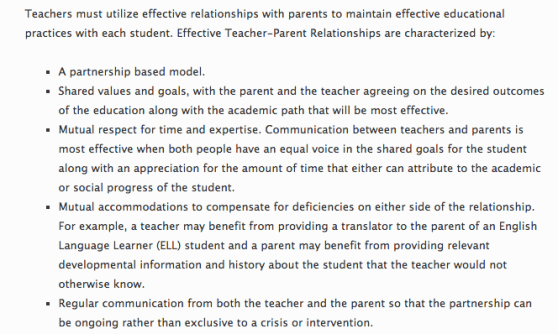
In my recent work as a teacher I have developed a nuanced understanding of effective relationships with parents. Recently I researched into the best practices of parent and teacher relationships and identified five key points for a relationship between a teacher and a parent to be effective for the education of the student in question; the relationship must be partnership based, include shared goals, be based in mutual respect, provide for accommodations on both sides of the relationship, and have regular communication that is both formal and informal.

These best practices, which I wrote about (see figure 1) and produced a video about (see below), are based in my experience as an educator and the work of Cheatham and Ostosky (2013), Guo (2010), Reyes-Blanes, Peel, et al. (1998), and Juniewicz, (2003).

Screen Shot 2014-12-01 at 10.55.45 AM
Figure 1


It is a professional responsibility and best practice of any educator to create an ongoing relationship with the parents of each student.

The first reason relationship building is important is that with the relationship the teacher develops an advocate and resource that will enhance the student’s understanding and learning outside of the classroom. An educator, at best, gets one-third of the day with each student. The parents of the students, at best, get the remaining two-thirds of the time; the parents are in an equal or better position to be influential in the academic outcomes of their student.

Secondly, each parent is a stakeholder in the community and a taxpayer (or tuition funder) that supports the development and continuation of the school. By involving parents into the process of education, teachers are acting with due diligence to their constituents, the community. Schools exist for the public good and those that fund and participate in schools deserve to know what is happening in the schools.

In completing the research, and in spite of my eight years as a teacher, I was impressed by the literature that presented educators as figures that are feared. There are parents that have little respect or appreciation for educators, or purposefully distance themselves from educators, because of their own experience with education. This increases the importance of building a positive partnership that is team-based, rather than a model of opposition or submission.

When an educator and a parent team-up with shared goals and values the student has a significantly increased chance for academic growth. Just this year I have seen an ELL student advance beyond his peers because of an intensive parental involvement in this student’s education. This involvement would not have been possible without an ongoing, weekly often and daily at times, relationship with the parents of this student.

While there are limitations on my time, I would like to increase my competency with parent-teacher relationships. One way I can do this is to focus on early and frequent positive communication about the students that I teach; this is one clear area that I can improve in. While phone calls and emails home along with ad hoc meetings after school and formal conferences have been productive, a method that I have not employed in the past has been through a message in the school bulletin. A brief statement that informs parents what we are working on in class and invites parents to contribute in ways they are comfortable would be an excellent way to establish a relationship that would allow parents to make the initial contact rather than myself making the first contact to the individual. This would also bring parents into the classroom and increase their buy-in to the program as a whole because their voices would be heard.

References:

Gregory A. Cheatham & Michaelene M. Ostrosky (2013). Goal Setting During Early Childhood Parent-Teacher Conferences: A Comparison of Three Groups of Parents, Journal of Research in Childhood Education, 27:2, 166-189

Guo, Y. (2010). Meetings Without Dialogue: A Study of ESL Parent-Teacher Interactions at Secondary School Parents’ Nights. (Undetermined). School Community Journal, 20(1), 121 – 140.

Jordan, L., Reyes-Blanes, M. E. Peel, B. B., Peel, H. A., & Lane, H. B. (1998). Developing teacher-parent partnerships across cultures:.. Intervention in School & Clinic, 33(3), 141.

Juniewicz, K. (2003). Student Portfolios with a Purpose, Clearing House, 77(2), 73-77.

Parent and Teacher Conferences for Effective Education

Teachers must utilize effective relationships with parents to maintain effective educational practices with each student. Effective Teacher-Parent Relationships are characterized by:

  • A partnership based model.
  • Shared values and goals, with the parent and the teacher agreeing on the desired outcomes of the education along with the academic path that will be most effective.
  • Mutual respect for time and expertise. Communication between teachers and parents is most effective when both people have an equal voice in the shared goals for the student along with an appreciation for the amount of time that either can attribute to the academic or social progress of the student.
  • Mutual accommodations to compensate for deficiencies on either side of the relationship. For example, a teacher may benefit from providing a translator to the parent of an English Language Learner (ELL) student and a parent may benefit from providing relevant developmental information and history about the student that the teacher would not otherwise know.
  • Regular communication from both the teacher and the parent so that the partnership can be ongoing rather than exclusive to a crisis or intervention.

Conferences with parents are an essential tool for effective communication between parents and teachers. These conferences happen in a variety of formats and are essential to developing positive relationships that are focused on the academic and social growth of the student in question. Conferences may or may not include the student. However, it is a best practice to bring the element of student voice to the conference, regardless of the student being in attendance. The two most common formats of a conference are casual and formal.

Casual Conferences occur spontaneously. Characterized by informal meetings, these conferences may occur at school, on the phone, or even in the broader community setting (Jordan, Reyes-Blanes, et. al. 1998). Research shows that frequent, early, and positive communication from teachers to parents is a consistently effective way to build productive partnerships between parents and teachers (Gregory and Ostrosky, 2013).

Formal Scheduled Conferences typically have an intended purpose. These purposes can include, but are not limited to, an academic check-in to evaluate student strengths and challenges, an academic intervention to address specific student challenges, and academic assessment of learning abilities to develop an Individualized Education Program (IEP). All three types can occur commonly. Addressing general academic strengths and challenges is a good practice for every student. Interventions are more effective when both the parents and the teachers agree on the purpose, plan, and goals of the intervention; which is why a conference can be valuable. Also, developing an IEP must include input from the parent of the student so that, like an intervention, the purpose, plan, and goals of the IEP are clear and agreed upon (Jordan, Reyes-Blanes, et. al. 1998).

When preparing for a conference the teacher must allow for ample time for the conference to occur. At a minimum conferences last 30 minutes when everyone involved has time to participate in the discussion. However, the teacher must also respect time restraints so that the conference does not last too long and create a scheduling conflict for any of the participants.

Parents can feel uncomfortable and vulnerable around teachers and other education professionals due to their own experiences in education (Jordan, Reyes-Blanes, et. al. 1998). Teachers should be advised to create a family centered environment so that families are comfortable at the school (Gregory and Ostrosky, 2013).

Parents may have their own concerns about their relationships with a teacher, in addition to the experiences of their child (Jordan, Reyes-Blanes, et. al. 1998) and may have either a positive or negative impression of teachers because teachers can be seen as self-appointed “experts” (Gregory and Ostrosky, 2013); when this occurs communication becomes a teacher monologue, rather than a dialogue between teachers and parents (Guo, 2010). One way to avoid this is to approach the meeting from a team-building perspective.

In part because of this perceived monologue effect, teachers must be aware of their potential attitudes toward parents; this is especially important when the parent comes from a different demographic (cultural, economic, geographic, etc.) than the teacher (Jordan, Reyes-Blanes, et. al. 1998).

Some of the issues that teachers may encounter, when addressing demographic differences, are:

  • The concept of family and family roles.
  • Expectations for student behavior.
  • Expectations of teacher behavior.
  • Expectations of parent involvement.
  • Socio-economic resources, especially as they apply to schoolwork that occurs outside of the home.

Of particular note are parents that speak little or no English. One of the greatest under-represented cultural demographics in school communities is that of ELL parents (Guo, 2010). These parents need to have a translator present at the meetings; the school should provide a translator as a part of creating an accessible and fair education for every student. The translator can provide a comfortable and welcoming element to the meeting in addition to explaining school specific content that is culturally contained, such as what Social Studies or Science may courses include (Guo, 2010). Without a translator the teacher risks alienating the parent and consequently eliminating any potential supports that could occur outside of school.

In a formal conference setting, the teacher must also work to ensure the physical comfort of all participants. The physical arrangement of the conference can facilitate or inhibit the progress made in addition to the relationship between parent and teacher (Jordan, Reyes-Blanes, et. al. 1998). The area must be comfortable for adult sized bodies, maintain privacy and confidentiality, include a seating arrangement that is non-hierarchical, and a seating arrangement that is focused on eye contact without physical barriers between participants (Jordan, Reyes-Blanes, et. al. 1998). One common seating arrangement is with adult sized chairs placed in a circle.

Student Portfolios in Conferences are an excellent way to exhibit student work, academic progress, and engage student voice. By integrating a student portfolio into the conference the conversation can be targeted to a qualitative and quantitative discussion (Juniewicz, 2003). Avoiding the litany of summative assessment scores, a qualitative discussion can highlight student achievement and student weaknesses in a non-confrontational way. While it does require teachers to assist in the creation of the portfolios, it can be student-centered. If implemented early in the school year, students can be held accountable for maintaining a student portfolio that is kept in the classroom. The student should be instructed to include work that features their strengths, academic growth, and academic challenges. It should be noted that parent reactions to a portfolio-based conference will vary. Some parents will assert that the qualitative description from their child is extremely helpful for their understanding of their child’s academic abilities. Other parents will complain that the conference does not allow for private communication between teacher and parent (Juniewicz, 2003).

While teacher and parent schedules are busy, it is a best practice to utilize multiple conferences throughout the year, in both formal and informal formats. In doing so, the lines of communication will not be limited to a single meeting and the relative accumulation of data will give both teachers, parents, and students a valid and reliable interpretation of the student’s academic standing. Teachers should remember that parent communication is an essential part of effective education.

REFERENCES:

Gregory A. Cheatham & Michaelene M. Ostrosky (2013). Goal Setting During Early Childhood Parent-Teacher Conferences: A Comparison of Three Groups of Parents, Journal of Research in Childhood Education, 27:2, 166-189

Guo, Y. (2010). Meetings Without Dialogue: A Study of ESL Parent-Teacher Interactions at Secondary School Parents’ Nights. (Undetermined). School Community Journal, 20(1), 121 – 140.

Jordan, L., Reyes-Blanes, M. E. Peel, B. B., Peel, H. A., & Lane, H. B. (1998). Developing teacher-parent partnerships across cultures:.. Intervention in School & Clinic, 33(3), 141.

Juniewicz, K. (2003). Student Portfolios with a Purpose, Clearing House, 77(2), 73-77.

Classroom Philosophy

Individual Management Philosophy:


IMG_2404

My management philosophy for the classroom is student centered. With my approach I want to empower the students to not only make good choices but to also retain the ability to make good choices when I am not around. For this reason, I emphasize a principles based approach.

The classroom should remain safe for all students, especially in an arts classroom; students are asked to make creative choices that may involve taking chances and ‘putting themselves out there.’ They must feel free to take these creative risks. Because of this I have only three rules.

One, Respect yourself. Students cannot put down or belittle their own work or potential. However, they must respect their abilities in the present and make choices that stretch their learning appropriately. They must have the respect for themselves to motivate their own work and take on appropriate challenges. These are all aspects of respecting ones self.

Two, Respect Others. Students are not allowed to insult the work of another student or decide that they have something better to do when another student has the stage. Students must respect each other through a mutual engagement and appreciation for the creative process.

Three, Respect the space. This could be rephrased as “leave the classroom in better shape than when you found it.” Students are expected to clean up after themselves and their peers. This includes putting away and returning things that they did not take out in addition to things they did use in class.

Following these three rules will create the model student and help to maintain a safe environment. It is only in an environment that is safe and respectful that the students are able to learn. Students that are not able to follow these rules will be reminded of them, asked to determine an appropriate response for their actions, and may be also asked to leave the class.

Through classroom management – based in my three rules – I can create an environment that allows every student to learn at their own pace, take on challenges with the content, and interact with the ideas of theatre.

Theatre of Differentiation

Over the course of teaching and teacher training, it is important to center one’s practice on areas of potential growth. To do this, one must be reflective, collaborative, and evaluative of one’s teaching practice.

From one classroom to the next and one student to the next, education is never the same. There are similar aspects and best practices that are universal. However, the reality of it is that every day educators face new situations caused by a combination of contextual issues that come with each student.

These issues include: developmental issues of nature and nurture, an integration of multiple learning styles, and a student’s Zone of Proximal Development.

Nature and Nurture: As I noted in the first class discussion, neither side is every completely correct. Continue reading “Theatre of Differentiation”