
Cross Content Collaboration

Collaboration within the school community can be an effective way to reach students across content areas and to help create new and renewed engagement for students and teachers; to do this teachers must collaborate across content areas and use appropriate communication to do so.

My most recent collaboration with a teacher outside of my subject area is an improvisation and health project. In the project, students must investigate and research health issues that are relevant to their lives and then use that research to build a character in drama. The characters then come together for a “community meeting” and discuss the issues of relevance in their improvised lives.

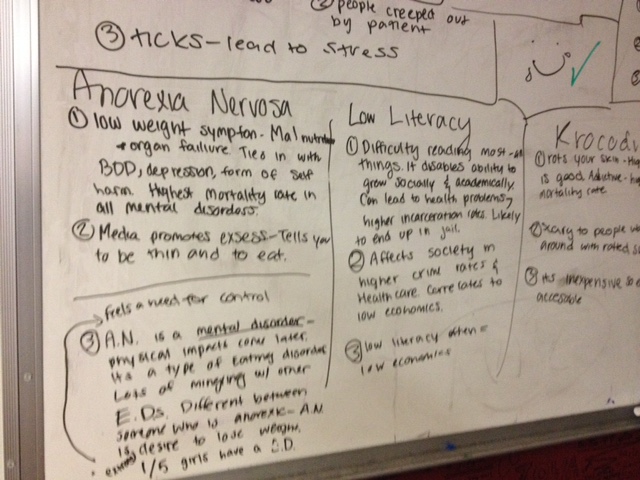
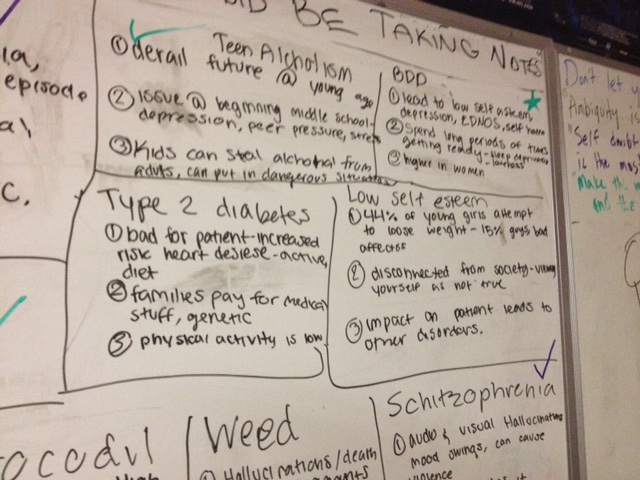
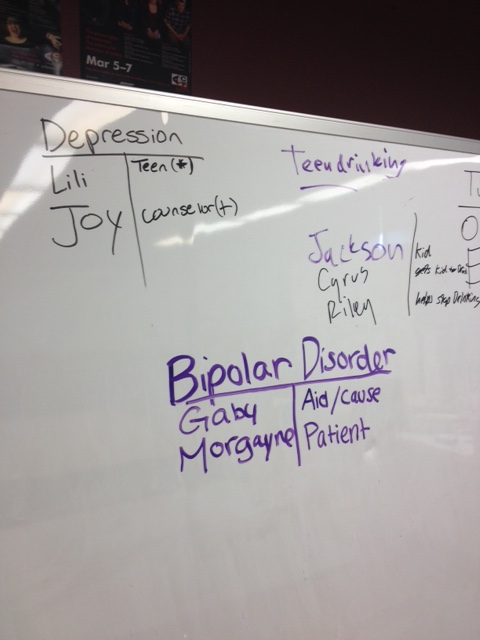
This project started with student research; this research was summed up in a inter-disciplinary meeting that shared the outcomes across content areas between drama and health. These pictures represent the research compiled by the students.
IMG_3616

IMG_3617

This information, generated by the students, was then summed up and shared with all the participating teachers so that it could be used in three ways. First, by using the foundational knowledge the health teacher is able to bring additional resources to the students so that their information that they use in drama can be more substantial.

Second, the students generate characters in an improvisational-based format that utilizes all of the research and gathered information. Based on the content from health class, students must create a back-story for their characters, character objectives and relationships, and character traits such as vocal and physical patterns.
IMG_3619

Lastly, this information, in addition to the work in class and the additional research in health class, is used to create a joint rubric. Students will receive a single summative evaluation that addresses their learning in both classes.

Every piece of written information is shared via Google drive so that both of the associated teachers can easily add and adjust content as the unit progresses.

This project exemplifies collaboration within the school because it is a unit that has and will continue to grow together. It allows students to combine their knowledge across content areas; this project further demonstrates this standard because it requires both of the collaborating teachers to communicate professionally in both written and verbal forms.

In summary, this project created a powerful effect on my students. They reported that the best aspect of the project was the integration of multiple subjects. Placing the health content in an improvisational format allowed them to explore the issues in both meaningful and personal ways. Further, this project created an excellent template (in both communication and lesson planning) for collaborations that I am sure will follow between the health teacher, other teachers, and myself.

In future iterations of this project, I will be sure to communicate with other teachers earlier in the year. While we had ample time to complete the project, the planning late in the year gave us undesirable timing when it came to the shared class time for the initial collaboration and the community meeting that the students jointly participated in.
Personal Performances that are Developmentally Logical and Abstract, Reflection

Teachers should plan for and adapt a curriculum with a learner-centered strategy that engages students in a culturally responsive and developmentally appropriate way.

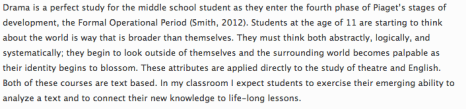
When it comes to developmentally appropriate instruction, planning can be informed by the study of the fourth phase of Piaget’s stages of development, the Formal Operational Period. As a part of this study I researched the importance of this important stage of development. As a part of coursework, I wrote, “students at the age of 11 are starting to think about the world in a way this is broader than themselves.”

Screen Shot 2015-04-28 at 10.59.23 AM
Course Research into Student Development: Piaget (https://davidoracekelly.com/2014/07/16/learning-drama-in-the-face-of-the-learner-paradox/#more-87)

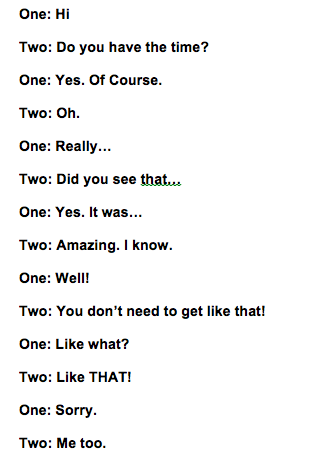
As Piaget’s fourth stage of development suggests, drama can help students to think both abstractly and logically. By studying a script they must both analyze the meaning of the text and interpret the meaning that is personally relevant. One example of this is a lesson I completed in the eighth grade. Students had to study a neutral scene and interpret the text by adding personal meaning in the performance. Students created a range of performances. By identifying the who, what, and where of the scene, students created a unique world from the abstract idea that was logically created. Student work included a daughter (One) and a mother (Two) after the daughter came home late from a party; another performance had a boyfriend (One) getting dumped by a girlfriend (Two); lastly, the most memorable performance was a rock-star (One) meeting a fan (Two) as the rock-star left a performance and unfortunately the rock-star disappoints the fan by not being everything the fan thought they were.

Picture of Neutral Scene

In this lesson, students had to imagine a situation that both logically fit the text and fit their own personal interpretation of the text. This exercise met both conditions found in Piaget’s fourth stage.

In summary, I have presented this lesson in the past. What changed this time was the insertion of personal meaning into the text. Students had to place themselves into the concepts that they were creating. The resulting performances were filled with significantly more meaning and emotional impact than I had previously seen.

Student learning in drama must include personal meaning. It is through this concept that students can personalize the work and create authentic performances. While this is typically a high-level skill that college students pursue, it is achievable in the middle school classroom through this tactic.

I propose that more of my work with text include personal meaning in performance. I will even add it to my evaluation rubric as a self-assessment component for all performances. I often talk about the symbiotic relationship between text and performer. This will bring that idea into reality; the performer must put their opinion into the text and bring it to life in a way that only they can. This key idea brought out new talent that was previously un-tapped by the students. These changes will both increase the artistry that the students produce and, more importantly, increase the student ownership of the work in drama.

You Should Champion the English Language and not Rant about Change

Every generation has cried out about the writing degradation of the next generation. Test scores are lower than ever, a critic may cry. But tests are biased ad are discriminatory to different populations depending on the content that the test asks about (Daniels, Steineke, and Zemelman, 2007).

The critic may try to expose the monumental outbreak that is assassinating the English language. “OMG” “LOL” and “BRB” are tearing apart our language. But, are they really? Language evolves with the people that use it.

What about “OK?” Historians cannot agree on the origination of the word. However, one dominant origination is from the phrase “orl korrekt” an alternate spelling of “all correct,” that was used in the U.S. during the 1830’s (for more explanation see http://www.oxforddictionaries.com/us/words/what-is-the-origin-of-the-word-ok).

From the birthplace of the English language, one of the greatest geniuses of all time, Shakespeare, made up more than 1700 words used in the common English of today (Mabillard, 2000). These words include, “exposure,” “birthplace,” “rant,” “dishearten,” “critic,” “monumental,” “outbreak,” “assassination,” and “champion.” There would not be a champion for the English language to rant about the disheartened critics, without Shakespeare.

The English language has been changing with every generation because of the way that people communicate. Perhaps today, the change is even more rapid. A teacher may say that their students hate to write; in reality the student may simply hate to write what the teacher wants (Daniels, Steineke, and Zemelman, 2007). However, students are not writing well for academic purposes (Daniels, Steineke, and Zemelman, 2007). This impacts the path of the student throughout life as they may struggle to learn advanced content in any given subject matter, as they work to meet state standards, as they seek out advanced education and take high-stakes testing such as the SAT and ACT, and as they seek out employment.

How should a teacher go about teaching writing? One strategy is Writing to Learn so that the teacher is not simply teaching “how to write;” the teacher should teach students how to learn through writing. Therefore, teachers should use writing in the following formats so that writing becomes part of the learning process: short, spontaneous, exploratory, informal, personal, one draft, unedited, and ungraded. These writing styles exist in every subject. From the quick notes that a science student makes about an experiment to the brainstorm “word cloud” that goes into writing an essay in English. The idea of ungraded work may be a novel approach in a school. But, a comprehensive correction of student writing does not and never has worked to teach writing (Daniels, Steineke, and Zemelman, 2007). Writing can be used instead to start discussions, feed small-group work, and review key ideas. From this point, the teacher can help the student act upon their writing impulses and guide the students to an academic voice in their writing.

Writing will always evolve and inform culture; if writing is also informed with an academic voice, it will change society in a way that is powerful and lasting (just as Shakespeare has done). As Gandhi said, “you must be the change you wish to see in the world.” Teachers take note and champion the change in the English Language because change will happen with or without your influence.

References:

Daniels, H., Steineke, N., & Zemelman, S. (2007). Content-area writing: Every teacher’s guide. Portsmouth, NH: Heinemann.

Mabillard, Amanda. Words Shakespeare Invented. Shakespeare Online. 20 Aug. 2000. http://www.shakespeare-online.com/biography/wordsinvented.html .

Content Area Reading Strategy: Academic Lanugage Focus

Secondary students struggle with content area reading because they do not understand the words on the page. What should a teacher do about this? One strategy is to focus on academic vocabulary. Students need to make personal connections to what they read and cannot do this if they are stuck on phonetic decoding. By breaking out the vocabulary acquisition into three tiers (Daniels and Zemelman, 2014) both teachers and students can strategically approach the instruction. Tier One includes vocabulary that the student already knows; teaching these words will help the student activate their prior knowledge. Tier Two words are important over many years in many disciplines both your own and others; examples include parallel, theme, and base; teaching these words will help students make connections to ideas outside of the content and reinforce the meaning in the content. Tier Three words are technical with narrow definition; these words should be taught for the lesson and looked up for further clarity; a student will engage the text at an analytical level. Teaching with vocabulary in mind will help with pre-reading, accessing previous knowledge, connecting to personal experiences, and reading for deeper meaning in the text; these are all proven reading strategies.

Reference:

Daniels, H., & Zemelman, S. (2014). Subjects matter: Exceeding standards through powerful content-area reading (Second ed.).

ISTE5: Arts Teachers Connected By Technology

ISTE Standard 5 states that educators should always improve their teaching through lifelong learning, participating in global learning communities, and reflect on the learning of their students through applications of technology.

How can one demonstrate a continual development and improvement in one’s teaching practice, model lifelong learning, and exhibit leadership in you’re the school and professional community through the effective use of digital tools and resources?

What resources and tools exist for arts professionals to connect through digital networks so that they can participate in local and global learning opportunities and exhibit leadership in an arts curriculum that integrates technology?

There are many groups geared toward teachers of the arts. Many of these groups can be found on Google+ Communities (Arts Education and Google Art Projects are two such groups). There are also arts education discussion boards on LinkedIn that have proven to be highly valuable (Arts in Technology is one such group). However, arts teachers are not known for their technological resources. The arts are more about human and in-person connections. Teachers in the arts must re-train how they connect with each other. One resource to do just that is Learn North Carolina (http://www.learnnc.org/lp/pages/7012). This page takes the user, step-by-step, from the in-person conference meeting to building an online PLC. It is not exclusive to teachers in the arts. This resource is valuable for any educator that wants to build a PLC from scratch. Teachers that have been in the field for many years or who have been reluctant to adapt new ways of connecting with other educators may need to receive professional development just to embark into the world of digital networking. Social media and networks can be an essential part in todays workforce to provide educators with the tools they need to succeed in the classroom of today (Transforming American Education, 2010).

Another potential resource is Edutopia. Heather German posited that Edutopia.edu can provide discipline specific resources and connect educators from across the globe. This is a valuable resource for educators in marginalized disciplines such as the arts.

Resource:

Transforming American Education: Learning Powered by Technology. (2010, January 1). Retrieved March 11, 2015, fromhttp://www.ed.gov/sites/default/files/netp2010.pdf