
Assessment Cycle Formative to Summative

Responding to the learning progress of every student is a crucial step of successful teaching and can improve instruction in multiple ways; teachers must use standards based assessment that can be used for both formative and summative outcomes; students should use these same standards for self-assessment (P3).

My eighth grade drama class is currently working on scenes from “Merchant of Venice.” In the previous year, they passed the eighth grade Essential Academic Learning Requirements (EALR) standards, dictated by the Office of Superintendent of Public Instruction (OSPI). This year, they are working towards basic high school proficiency (9th and 10th grade EALR levels). To do this they must pass a series of Grade Level Expectations and OSPI Assessments. These assessments cover areas of character physicality and speech. Both of these components are tested in a summative rubric used at the end of the 10-week long unit. This summative rubric is derived from the EALR standards at the desired grade level.

Prior to this year the student skill level was assessed qualitatively, in comparison to state EALR, without the OSPI Assessments. This year, the rubric is completely derived from these assessments. In doing so, I improve the reliability of the student outcomes.

Continue reading “Assessment Cycle Formative to Summative”

Student Empowerment: Sign Two

Journal Entry from October 12, 2014 for Theatre Methods

When I consider the voices in my classroom – the voices that are shared with the performance space, my first thought is that of the playwright. I believe that the actor, in training or professional, has a duty to the words; the actor must bring the text to life. My second thought, as a teacher, is that the voices of my students must be heard. It is their learning experience; if a student can own the work – put their own name on it, there is an incentive to the student for increased ‘buy-in’ to the process. It is exactly this engagement that brings the words of the playwright to life in new ways. My students have the freedom to approach a text with a fresh and empowered perspective. That is why I am in theatre arts – I relish the empowered perspective of a student that demands full participation of each student. This was certainly true of my education; I received a high school theatre training that emphasized my full participation.

Reflecting, specifically on my high school theater experience, my teacher (much beloved) had a style that emphasized projects – often projects that he did not do much or any teaching for. The teaching in his class came after two weeks of practice. Students would present their scene and he would critique for twenty minutes after each scene. Sitting from the back of the theatre, in his bully pulpit, he lectured on the merits and faults of what we presented. He offered little in the way of technique. What he did offer was a drive for his approval. As far as I was concerned, my theatre teacher was the guru of art. For an angst-ridden teen this was exactly what drove my passion for theatre. Getting the approval of my theatre teacher was more valuable than gold.

Screen Shot 2014-10-09 at 7.57.01 PM
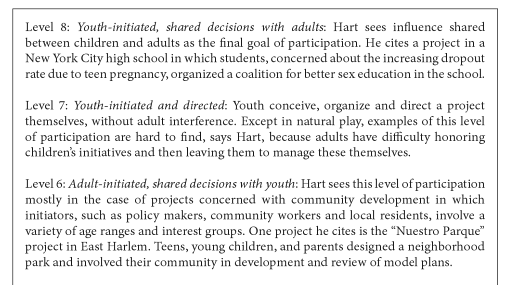
Level 8 (Lazarus, 2012)

Nearly, two decades later, how does this experience reflect and resonate in my classroom? Now that I have been teaching for several years, I have developed a style that is very hands on; my style is almost the opposite of my high school theater teacher. For example, I often base a lesson in a specific learning target that includes a specific acting or performance skill. I Continue reading “Student Empowerment: Sign Two”

Theatre Changes: Sign One

Journal Entry from October 5, 2014 for Theatre Methods

IMG_2406On the theme of reflection and change, Lazarus (2012) proposes a series of questions to engage with Appreciative Inquiry. The first question: what is it that has changed in the last year of my teaching; what has stayed the same? The simplest of my answers, I have enrolled in graduate school, MAT and certification. After seven years of developing my middle school drama program and ten years of teaching youth theatre, I have chosen to take this climactic step so that I can change my practice of teaching: in doing so it is my hope to become a better teacher with increased efficacy, increased student impact, and increased knowledge regarding the implementation of best practices.

This does not mean that I have lacked impact over my teaching career. I have had Continue reading “Theatre Changes: Sign One”

STEM v. ARTS?

A teacher is a practitioner of education. Because of this, their understanding and contextual information continues to grow. To nurture this growth, they must collaborate with colleagues, reflect on their experiences, and evaluate their progress based on the feedback from their collaborations and reflections.

One deep aspect of reflection that I engage with continually is the relevance of arts education. Continue reading “STEM v. ARTS?”

Theatre of Differentiation

Over the course of teaching and teacher training, it is important to center one’s practice on areas of potential growth. To do this, one must be reflective, collaborative, and evaluative of one’s teaching practice.

From one classroom to the next and one student to the next, education is never the same. There are similar aspects and best practices that are universal. However, the reality of it is that every day educators face new situations caused by a combination of contextual issues that come with each student.

These issues include: developmental issues of nature and nurture, an integration of multiple learning styles, and a student’s Zone of Proximal Development.

Nature and Nurture: As I noted in the first class discussion, neither side is every completely correct. Continue reading “Theatre of Differentiation”

Essential Theatre Standards in Washington State

Context: In 2002, the arts were identified as a core academic subject in the State of Washington by the Elementary and Secondary Education Act (ESEA); this act defined the arts as consisting of four distinct disciplines: dance, music, theatre, and visual arts (Dorn, Joseph, Vavrus, 2011). ESEA essentially established that the arts were equally important to all other subjects because only a well-rounded education can increase the academic development of every student. Because of this, standards were created for each of the arts (O1).

The learning standards for the arts, including Theatre, can be found on the website for Office of Superintendent of Public Instruction (OSPI). They can be viewed online or downloaded as a PDF or Word document.

Searching for standards is easy, providing that there is an existing knowledge of the Essential Academic Learning Requirements (EALR) for the arts. The first EALR is centered on student understanding of arts knowledge, the second focuses on the student artistic process of creation, the third emphasizes student communication through the arts, and the fourth demands that students make connections across the arts and other disciplines (Dorn, et. al, 2011). A comprehensive chart of the four EALR can be found at the conclusion of this document (see Figure One). Continue reading “Essential Theatre Standards in Washington State”

Students in a Plural World

Students deserve an education they can easily access. It should be of the highest possible quality, developmentally appropriate, and stretch the learning into proximal development. Student learning happens best across language barriers and ability levels.

John Medina writes on the value of Multimedia presentations. In the book, “Brain Rules (2008)” he cites five rules for multi-media teaching. These rules offer a memory boost to students because they engage the student across language land earning abilities. Their application to Theatre Arts or English Language Arts is immediate and necessary.

Rule One, Multimedia Principle. Application: Have students create maps of their learning. Students learn from words and pictures together. Students should map their knowledge. When they do this they are creating a framework for present knowledge and future knowledge organized into nodes of learning.

Rule Two, Temporal Contiguity Principle. Application: present a concept map or picture that has text integrated into the image. For drama or ELA, this can be done with a storyboard. The storyboard can pre-view the chapter or entire story. The storyboard can include images of major characters and places that they go along with character relationships, such as family relationships.

Rule Three, Spatial Contiguity Principle. Application: Words need to be presented near the image. For a theatre classroom, all the equipment, costumes, and props, can have labels that both help to organize the room and instruct students about what they are as they passively observe the room.

Continue reading “Students in a Plural World”

Three-in-one Approach to Teaching Drama

I teach Drama; this class can be a great equalizer when it comes to student success because it is malleable to a variety of skill sets. Every student can find success in drama because it works with many different facets of learning. This is my teaching philosophy when it comes to student learning: I must provide a variety of venues for each student to learn in a way that suits them best and to find success in the class. To do this, we often read plays; we analyze them; we perform them. In this praxis, students are expected to master a variety of skills that are best learned through a utilization of three theories of knowledge, Information Processing, Sociocultural Learning, and Constructivism (H2, O2, P2).

At the start of any project the best theory of knowledge that reaches toward my teaching philosophy is Information Processing. Students must turn their minds into computers. They are asked to memorize and encode the information of the play as they study their lines and seek to understand the sequence of events in the context of the character motivations. This is a simple input and output scenario. Several methods are utilized to memorize the text; regardless of the method it is mechanical and generally reliable. Students are able to retain the information so that they can proceed to the next step. Continue reading “Three-in-one Approach to Teaching Drama”

Learning Drama in the Face of the Learner Paradox

IMG_1976Drama is a perfect study for the middle school student as they enter the fourth phase of Piaget’s stages of development, the Formal Operational Period (Smith, 2012). Students at the age of 11 are starting to think about the world is way that is broader than themselves. They must think both abstractly, logically, and systematically; they begin to look outside of themselves and the surrounding world becomes palpable as their identity begins to blossom. These attributes are applied directly to the study of theatre and English. Both of these courses are text based. In my classroom I expect students to exercise their emerging ability to analyze a text and to connect their new knowledge to life-long lessons.
There are several important factors that the middle school educator must consider for their students. First, teachers must operate in a classroom that is filled with individuals. Each individual has been influenced by elements of nature and nurture as well as their gender (both internal and external). Second, teachers must operate in a classroom that is standardized. Each student must meet the objectives of the course, pass specific tests, and memorize the same material. The learner paradox that the teacher faces is inherent. Students must be simultaneously treated as both individuals and as a collective. This paradox can be accounted for as I create a classroom of differentiation. State learning standards are written with a degree of interpretation that I can take advantage of as a teacher. Because of this, students are able to work towards the standards in different ways; each student can build their path to knowledge and achievement. The practice solidifies my belief in a constructivist approach to learning. I intend to continue to use constructivism as a central modality for all my classes.

There are two central camps in the child development debate, The Nature Camp and the Nurture Camp. Those on the side of nature argue that all of development is pre-determined and the outcomes of character are set at birth. Those in favor of nurture posit that the outcome of a person’s character is primarily from the forces that one experiences as they go through life. However, this relationship is far too binary. There are traits that people are born with, sexual orientation for example, and traits that develop over time, acting with confidence on a stage for example. As Pressley and McCormick (2007) point out, the potential development of a person is subject to both genetics and environmental factors.

Continue reading “Learning Drama in the Face of the Learner Paradox”