Student State Testing Results (course reflection Inquiry and Assessment)

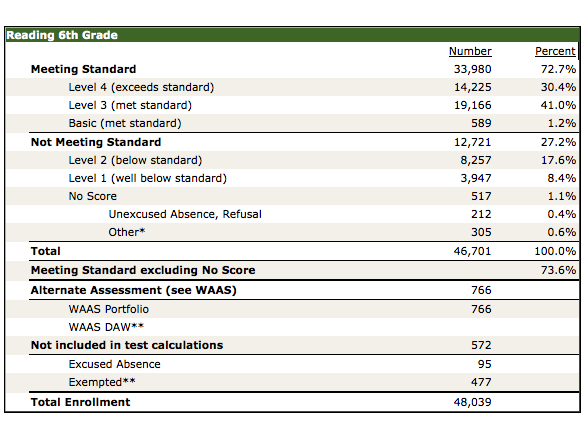
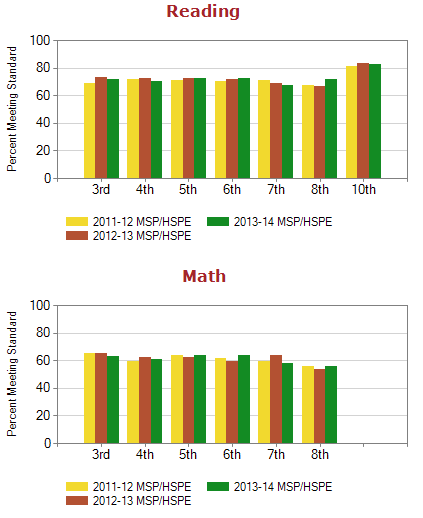
Screen Shot 2014-11-09 at 12.27.21 PMThe 2013-14 Washington Office of the Superintendent for Public Instruction test for Sixth Grade Reading Scores indicate that 30% of students exceed the standards (level 4) and 41% of students met the standard (level 3). This means that approximately one third of all sixth grade students are not meeting grade level standards. On the same test the Math Scores for sixth grade indicate that 28% of students exceeded standards (level 4) and 34% of students met standards. Again approximately one third of all students did not meet the standards. In 2013-14 there were approximately 48,000 students taking these tests and these scores, across each grade level stay at approximately the same rate of passing and failure.

GEN TEST MTH GEN. TEST READ

Across demographic categories, girls marginally outperform boys in reading and math. Above the group average, more than 80% of Asian students (10% of respondents) pass both tests and Hispanic students (20% of respondents) have an aproximate 50% passing rate on both tests, below the full group results.

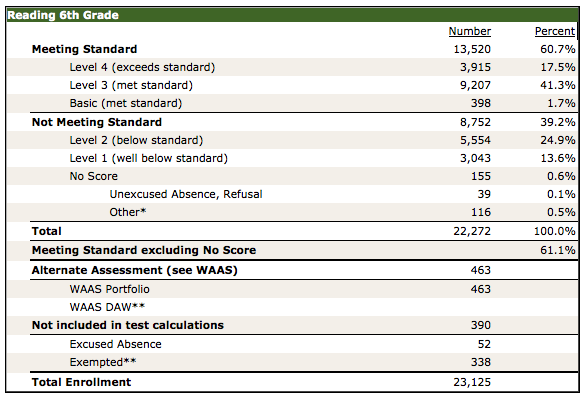
Approximately half of all of students (23,000 in total) taking these tests are low income; one third of students in this category did not pass the reading assessment and half did not pass the math assessment.

LOW INC. MTH LOW INC. READ

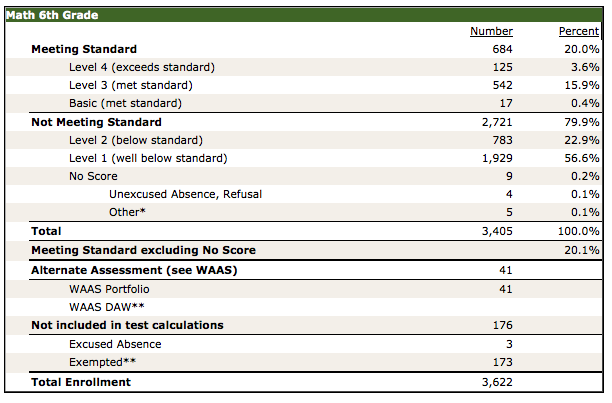
Just under 10% of students taking this test have low English abilities. Approximately only 20% of students in this category pass in either category.

LOW ENG. MTH LOW ENG. READ

Testing Does Not Measure Teacher Effectiveness 

test-taking-tipsTeacher evaluation is necessary; it is a needed part of overall education reform. But – teacher testing is not the solution to improve schools. The current model of evaluating teachers, students, and schools, based on a snapshot test, results in counter-intuitive results, counter-productive teaching, and damaging practices to the entire school system. There are better ways to improve teaching outcomes and evaluate teacher performance. Continue reading “Testing Does Not Measure Teacher Effectiveness “

ONLINE SURVEY and KWL

Using the KWL model (Know, Want to know, and Learning accomplished) is an effective tool for educators to assess student progress and gauge engagement with the content. A teacher must understand the previous knowledge of each student’s abilities; they must activate the students desire for knowledge based on what the students want to know; the must assess what students have learned. Assessing student knowledge can be cumbersome. With multiple tests, exit tickets, and paper surveys, it can build up on a teacher’s desk and quickly end up in the recycling. Instead, a teacher can effectively integrate technology into the classroom through online surveys; in doing so, students are introduced to the technology that will make their education more simple and efficient (P4).

This year, I started using Google Forms for all of my classes. It is an effective method of collecting (and keeping) student

Continue reading “ONLINE SURVEY and KWL”

ONLINE SURVEY and KWL

Using the KWL model (Know, Want to know, and Learning accomplished) is an effective tool for educators to assess student progress and evaluate engagement with the content. A teacher must understand the previous knowledge of each student’s abilities; they must activate the students desire for knowledge based on what the students want to know; they must assess what students have learned. Assessing student knowledge can be cumbersome. With multiple tests, exit tickets, and paper surveys, it can build up on a teacher’s desk and quickly end up in the recycling. Instead, a teacher can effectively integrate technology into the classroom through online surveys; in doing so, students are introduced to the technology that will make their education more simple and efficient.

This year, I started using Google Forms for all of my classes. It is an effective method of collecting (and keeping) student information. These surveys can serve as pre-assessment tools, formative assessments, and summative tests. Through Google Forms, I can customize the experience. By adding navigation functions from one question to the next, I can send a survey link to every grade level and the survey will sort out the questions that the respondent needs to answer based on their previous responses. This was most helpful when I designed a survey for all students as they prepared for their student conferences. I am also able to limit the number of responses to one per respondent; this means that students cannot retake a test.

With Google forms, I can quickly gather student data on the relevant topic. More importantly, I can access that data anywhere I have an Internet connection. I can easily send out a survey to an entire class, including students that are sick or absent for the day. Now, I no longer need to track down a student that has not completed a survey. I can simply send them an email reminder to complete the work online.

PRE-ASSESSMENT: At the start of the semester, I wanted to know what my eighth grade students knew about Shakespeare. Before we started the unit, I had them take this quick “quiz.”

https://drive.google.com/open?id=1QDW4v-2B0M2iRcUSwqPKpoAGTg8esIhgQen4nF_86KA&authuser=0

I was able to use the results to gage my lessons. At the end of the unit, students will take the same quiz and I will be able to compare the results and assess learning for all students as individuals and as a class.

FORMATIVE WORK: Discovering what the students KNOW and what they WANT to know, I implemented a survey that assessed student progress to date. In the seventh grade, so that I could quickly evaluate each students progress with their playwriting project, I implemented a survey. I used the student laptops so that I could demonstrate the process in class. Each student was able to fill out the form during class time during this first round while I was available to answer any technology questions.

https://drive.google.com/open?id=14hndDn2MEJTz4miOcWkbU4uWXHD56jsij1DhgpH4CfU&authuser=0

In answering the survey, I was able to find what the students wanted to write about (what they wanted to know). I was also able to assess how well they knew the format that I wanted them to use (what the knew).

SUMMATIVE WORK: Here I used the survey tool as a summative assessment. This is the third portion to a state standards test for Drama in Pantomime (what they learned). Students had to respond to a performance they presented in class the day prior.

https://drive.google.com/open?id=1xNAAo4gTekec3z5Bby_dM1FZYFor2RNWoI-oxrlUFB4&authuser=1

One may have a concern about the ‘take-home-test.’ However, in this case, there is no information that the student can look up on the Internet that will help them. There are no notes that they may have that will give them the answers to the questions and students must use their class materials to complete the test. When the take-home-test is an option, the survey format is excellent.

In summary, I have seen a great deal of benefit in efficiency and student buy in with the online survey. Students see it as “cool” that they get to do homework online and I am able to keep all the responses without any additional paperwork. I aim to further my pursuits in online survey work.

There were a small handful of students that do not have Internet access at their homes. However, students are able to access their email accounts at school. Because of this, I allow multiple days for the completion of the survey so that students can access the form from school.

In future versions of the online form, I will be sure to make the directions clear in the answer (e.g. select two answers). In one form I created, many students gave me the feedback that the form was confusing due to one question where the requirement to select two answers was unclear.

Because of the success of Google forms and Google docs, I aim to integrate Google Presentations into my classroom next. I envision a project that requires multiple students to collaborate into a single presentation.

Multiple Choice Tests: All of the Above

When addressing the validity of multiple-choice tests, there are many things to be concerned about. Multiple choice testing can be many things to many students.

  • Multiple Choice Testing (MCT) is a means to conformity
  • MCT can cover a great amount of material in a single test
  • MCT can also lead to student confusion with poorly constructed prompts
  • MCT can also be “beaten” by the experienced student
  • MCT does not address complex understanding of the given topic
  • All of the above.

1) A MEANS TO CONFORMITY: Every child will take at least one high stakes standardized test in his or her life. From the S.A.T. to state standardized testing, MCT is unavoidable in the current education system. Therefore, regardless of the content, there is an educational benefit to a teacher offering MCT in everyday curriculum. Students must learn to take this type of test. While conformity is not always desired, it does allow schools across the country to assess the abilities of one student against the next in an equal and uniform way.

Continue reading “Multiple Choice Tests: All of the Above”

Standards in Education are Good

A Standards based education is essentially a good thing under the following conditions:

  • Standards are applied equally to all grade levels and content areas
  • Standards take into account student differences (learning abilities especially)
  • Standards are used diagnostically for improvement in both teachers and students
  • Student history is integrated into any standards based assessment

Condition One: Equal Application

Currently the Common Core State Standards are not applied to the arts or social sciences. I applaud the national application of standards that allow states to bring every student to the same level. However, the focus on writing and math is very, “old-school.” Students must engage in topics that expand beyond the “R’s” for a high-quality education, something that No Child Left Behind aimed to do for every student in the country.

Condition Two: Student Differences

Not every student is made equally. Students may have disabilities or superior talents. If a standards based approach is to work it should function more like Karate Levels than grade levels. Standards should be comprehensive and thorough. When a student passes one level they should be expected to have mastered a dependable amount of the material in that level for a given subject. This means a revolution in the school system. A student can be at level X in one subject and level Y in another. This happens to some degree with advanced placement courses. However, it should happen throughout education. Students advance at different paces and have different learning abilities. There should be no reason that a student should take algebra simply because they are in ninth grade. A student should take algebra because they have mastered the content that supports algebra.

Condition Three: Focus on Improvement

Students and teachers can both benefit from the feedback that standard based assessment can offer. Standards can highlight the strengths and weaknesses of the learning process. A good teacher and a good student can respond to the diagnostic standard test and use the feedback to greater effect in their learning. However, students and teachers should be allowed to not pass a standard in curriculum content. When the pressure to pass is removed, students and teachers can have the freedom to assess their abilities and strengthen their weaknesses.

Condition Four: Student Chronology

Just as standards should be used to evaluate the matriculation of a student from one level to the next, the past experiences and testing of a student should be weighted along with current student performance. A student may have a history of difficulty in a given subject. This historical information must be used when creating an individualized education plan for that student in that subject. The student should not be allowed to continually fail. If they are placed in a course designed around their leaning abilities they are more likely to succeed. This is both a pro-active and retroactive approach to teaching. The most specialized teachers should be diagnosticians that can bring the students abilities to light and prescribe the treatment appropriate to the individual.

Proposed Changes: Revolution

The changes that I propose here are not entirely simple to administer. They would require a revolution in the education industry for the United States. More teachers would be needed to provide an approach to teaching that embraces differentiation and individualization. Classrooms would need to adapt to a level based education instead of a grade-based education. Teachers would need to design coursework that was appropriate for multiple age levels. These adaptations would need to account for student development as well so that content could also be adapted to chronological maturity. Students would need to focus directly on the learning of the content and ignore the passing of the time from August to June. Lastly, the nation would need to agree on a system of content specific standards that are aligned to ability not chronology and further agree on the meaning of a high-school diploma.

Classroom Philosophy

Individual Management Philosophy:


IMG_2404

My management philosophy for the classroom is student centered. With my approach I want to empower the students to not only make good choices but to also retain the ability to make good choices when I am not around. For this reason, I emphasize a principles based approach.

The classroom should remain safe for all students, especially in an arts classroom; students are asked to make creative choices that may involve taking chances and ‘putting themselves out there.’ They must feel free to take these creative risks. Because of this I have only three rules.

One, Respect yourself. Students cannot put down or belittle their own work or potential. However, they must respect their abilities in the present and make choices that stretch their learning appropriately. They must have the respect for themselves to motivate their own work and take on appropriate challenges. These are all aspects of respecting ones self.

Two, Respect Others. Students are not allowed to insult the work of another student or decide that they have something better to do when another student has the stage. Students must respect each other through a mutual engagement and appreciation for the creative process.

Three, Respect the space. This could be rephrased as “leave the classroom in better shape than when you found it.” Students are expected to clean up after themselves and their peers. This includes putting away and returning things that they did not take out in addition to things they did use in class.

Following these three rules will create the model student and help to maintain a safe environment. It is only in an environment that is safe and respectful that the students are able to learn. Students that are not able to follow these rules will be reminded of them, asked to determine an appropriate response for their actions, and may be also asked to leave the class.

Through classroom management – based in my three rules – I can create an environment that allows every student to learn at their own pace, take on challenges with the content, and interact with the ideas of theatre.

THE ALL POWERFUL RUBRIC

Standards Based Education is an essential component to effective teaching practice; teachers must use learning targets that are connected to the standards and effectively measure student progress toward those standards.

I have come to embrace the rubric as an essential standards based teaching tool. Used correctly, the rubric can:

  • Guide student learning throughout the lesson.
  • Support student self-assessment.
  • Proved feedback for future student improvement.
  • Direct teacher assessment that is qualitatively and quantitatively equal from one student to the next.
  • Align to standards and measure desired outcomes.

In teaching my introductory monologue unit for sixth grade drama, I utilize a rubric that is effective in all four areas. The rubric provides simple statements that describe student achievement across five essential areas of acting. I expect that all five of these areas will continue to progress across the three year sequence; consequently, I do not expect students to achieve a perfect score in their initial performances.

Screen Shot 2014-10-26 at 10.59.48 AMMany teachers will use a rubric at the end of a unit to grade a project. While this is an effective use of the rubric, there is often a missed opportunity to use the rubric throughout the lesson. In my sixth grade drama class I use the rubric to guide student learning. Students that pre-view the levels of achievement in the rubric have the opportunity to stretch their learning into the desired category. I purposefully include levels of achievement that are beyond typical sixth grade achievement. I introduce the rubric as “level based” and not point based. Using the metaphor of Karate Belts, students can conceptualize the idea that different students will be achieving at different levels. Pre-viewing the rubric will also give students an understanding of the entire project in advance of starting any work. This pre-view will help students make connections from one area of assessment to another and plan accordingly.

A well-designed rubric can be easily read and understood by each student. I take the time to explain the content in my rubric for this unit and ask that students explain it back to me. The student voice component here is an essential element of assessing the student achievement in relationship to the learning target aligned to the lesson. The rubric also includes the content of each learning target that is included in the unit. Because of this, a rubric will also help students to self-assess their progress throughout the lesson or unit. Students that work from the rubric can see where they are fully completing the task and where they need to continue to work (O2).

During the process of the project, the teacher can use the rubric as a quick method of assessment and feedback for the student. They can ask the student where they believe they are at any given level, reflect to the student on their observations, and use the rubric as a common language. The teacher can also point to work on the rubric that would take the student to the next level. If the rubric is organized for learning, each step should follow a logical progression of skills.

Regarding formative and summative assessment, the teacher can use the rubric for assessment. This assessment will clearly have a quantitative value where points are assigned across a number of categories. However, the categories can also be viewed with qualitative assessment in mind. I can use the rubric to describe the academic journey of the student.

Lastly the rubric includes the content that the learning targets support. If students work with the learning targets in each lesson and demonstrate developing or basic mastery of each learning target, they will easily score in the mid to high range of the rubric.

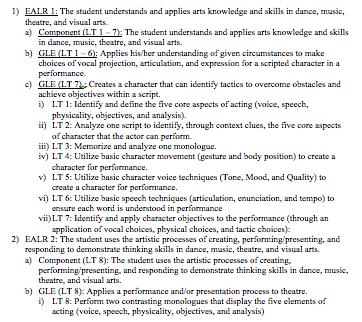
Screen Shot 2014-10-26 at 12.32.03 PMIn future editions of the rubric, I plan to increase the effectiveness and include the actual learning targets for the unit within the rubric. This will increase the connection for each student form the individual lessons to the culminating project of performing a monologue. It will also assist students to assess their daily progress in relationship to the rubric and the learning targets simultaneously.

Comprehensive Theatre: Sign Four

Journal Entry from October 27, 2014 for Theatre Methods

What is…

Lazarus (2012) describes a model of Comprehensive Theatre Education. I strive to create this model in my classroom. I strive to have all students experience all aspects of theatre education. It is through the common experience of acting that I have each of my students also act, direct, design, manage, and research their productions. I also integrate other subjects into my classroom; most recently I have had collaborations with English (in the study of Shakespeare), Art (in the creation of puppets for puppet theatre), Physical Education/Health (in improvisation with Health Topics), and in Music (with creating sound scores for the annual school show). I have Comprehensive Arts Education program. The challenge is, of course, finding the curricular time to accomplish all the goals of a comprehensive program.

Comprehensive Arts Education is defined by three central ideas: a holistic arts education, an interdisciplinary education, and an integrated program. Really, this encapsulates the idea that theatre is every subject. I have told my students for years that they must be scholars if they want to be great actors. It is only through an understanding of academic knowledge of multiple fields that they can bring life to a wide range of characters.

What does this mean for the teacher of theatre arts? Does this mean that I must be an expert in every subject? I do not believe Continue reading “Comprehensive Theatre: Sign Four”

Socially Responsible Practices of Theatre Education: Sign Three

Journal Entry from October 20, 2014 for Theatre Methods

 What is…

At this point I have a decade of experience under my belt in youth theatre. I have a firm grasp on “what is” in my program. This grasp has been continually transforming over the years and has certainly shifted from a more idealistic to a more realistic perspective on what is possible and achievable. Some of the most cumbersome constraints include administrative oversight and school policy, student interests, and limited instructional time.

In my class, as I often describe, I try to create an atmosphere of respect. One benefit of this is that it serves as a backbone for socially responsible actions. We, society, must respect the identities of the people we interact with. We, each individual, must also respect our own history and identity. Too often in theatre, we take licenses to transgress boundaries that are present in society. Sometimes it is very appropriate; it can provoke discussions that allow society to progress. Sometimes, in middle school, the students are not ready to take on those discussions; to cast Romeo and Juliet with two boys, for example, may provoke content that students are not comfortable discussing.

IMG_2248 Continue reading “Socially Responsible Practices of Theatre Education: Sign Three”