
Standards Based Education is an essential component to effective teaching practice; teachers must use learning targets that are connected to the standards and effectively measure student progress toward those standards.
I have come to embrace the rubric as an essential standards based teaching tool. Used correctly, the rubric can:
- Guide student learning throughout the lesson.
- Support student self-assessment.
- Proved feedback for future student improvement.
- Direct teacher assessment that is qualitatively and quantitatively equal from one student to the next.
- Align to standards and measure desired outcomes.
In teaching my introductory monologue unit for sixth grade drama, I utilize a rubric that is effective in all four areas. The rubric provides simple statements that describe student achievement across five essential areas of acting. I expect that all five of these areas will continue to progress across the three year sequence; consequently, I do not expect students to achieve a perfect score in their initial performances.
 Many teachers will use a rubric at the end of a unit to grade a project. While this is an effective use of the rubric, there is often a missed opportunity to use the rubric throughout the lesson. In my sixth grade drama class I use the rubric to guide student learning. Students that pre-view the levels of achievement in the rubric have the opportunity to stretch their learning into the desired category. I purposefully include levels of achievement that are beyond typical sixth grade achievement. I introduce the rubric as “level based” and not point based. Using the metaphor of Karate Belts, students can conceptualize the idea that different students will be achieving at different levels. Pre-viewing the rubric will also give students an understanding of the entire project in advance of starting any work. This pre-view will help students make connections from one area of assessment to another and plan accordingly.
A well-designed rubric can be easily read and understood by each student. I take the time to explain the content in my rubric for this unit and ask that students explain it back to me. The student voice component here is an essential element of assessing the student achievement in relationship to the learning target aligned to the lesson. The rubric also includes the content of each learning target that is included in the unit. Because of this, a rubric will also help students to self-assess their progress throughout the lesson or unit. Students that work from the rubric can see where they are fully completing the task and where they need to continue to work (O2).
During the process of the project, the teacher can use the rubric as a quick method of assessment and feedback for the student. They can ask the student where they believe they are at any given level, reflect to the student on their observations, and use the rubric as a common language. The teacher can also point to work on the rubric that would take the student to the next level. If the rubric is organized for learning, each step should follow a logical progression of skills.
Regarding formative and summative assessment, the teacher can use the rubric for assessment. This assessment will clearly have a quantitative value where points are assigned across a number of categories. However, the categories can also be viewed with qualitative assessment in mind. I can use the rubric to describe the academic journey of the student.
Lastly the rubric includes the content that the learning targets support. If students work with the learning targets in each lesson and demonstrate developing or basic mastery of each learning target, they will easily score in the mid to high range of the rubric.
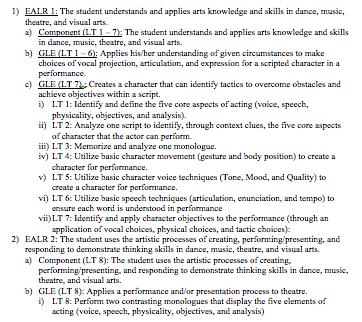 In future editions of the rubric, I plan to increase the effectiveness and include the actual learning targets for the unit within the rubric. This will increase the connection for each student form the individual lessons to the culminating project of performing a monologue. It will also assist students to assess their daily progress in relationship to the rubric and the learning targets simultaneously.
 David Orace Kelly