The lessons learned from years of teaching are rarely all put together into one lesson. Here is one example of many best practices for teaching literacy inside of just one lesson – watch to see why any teacher needs to know about them.
Using the CCSS, the following lesson was created in collaboration between theatre arts and fine arts content areas to incorporate multiple strategies in literacy instruction; the lesson incorporates strategies that are based in constructivist interpretation, visual interpretation, and performative interpretation. (Follow this link to see the evolution of this lesson from a fail to finesse)
LESSON OUTLINE: LITERACY FOCUS – MINI LESSON: TO READ OR NOT TO READ
Title
TO READ OR NOT TO READ
Standard
CCSS.ELA-LITERACY.RL.6.4Determine the meaning of words and phrases as they are used in a text, including figurative and connotative meanings; analyze the impact of a specific word choice on meaning and tone
Central Focus (CF)
To interpret the question posed by Hamlet, “To be or not to be…” by using expressive gestural images of actors, the original text written by Shakespeare, and actor created interpretive performances.
Academic Language
Interpret, Gesture, Emotion, Voice, Physicality
Learning Target (LT)
To interpret Hamlet’s question “To be or not to be” by looking at images of actors, and performing one line as a group.
OVERVIEW: LESSON MAP
Lesson Part
Activity description / Teacher does
Students do
GOAL
Introduction of learning target and pre-assessment.
Self-assess on Hamlet’s Question
1A
Pre-reading: Dramatic Expression in Images
Students explain thoughts about images that use dramatic expression and gesture.Students complete worksheet that asks them to interpret then respond to other students’ interpretations of the gestural & emotional images supplied.
1B
Informal Assessment: Presentation of scaffolded syntax sentence.
Students share, respond to and invent further performed interpretations of emotions.
2A
Practice: Jigsaw of Text – Interpret Meaning
Students work in groups to construct meaning by combining collective knowledge of a small piece of the text.
2B
Informal Assessment: Self-assessment
Students share translations with the class.
3A
Extended Learning: Match text to images with a performance of interpretation.
Students create original performances that are matched to a section of the text by selecting voice and physical choices that correspond to the text and their interpretation.
3B
Summative Assessment: Student Performances (group assessment; teacher assessment on Rubric)
Students self-assess their performance on the exit ticket.
Introducing the Learning Target
GOAL
Teacher Does:Write [LT] on board.
Teacher Says:FIRST: tell me now if you think you can interpret what Hamlet’s question is. Show me a fist of five.
5 – I have an excellent idea of what the question is and what it means4 – I have a good idea of what it is, but I think there is more I could know.
3 – I have a basic idea, but I’m sure there are bits I am missing
2 – I am unsure about this.
1- I’m more than unsure, I’m lost.
Students Say:
FIRST, students silently respond to both the self-evaluation “fist of five” prompt.
Pre-reading: Frontload with Images (p. 100)
INSTRUCTION (1a)
1. Teacher asks students to divide into pairs.
NOTE: Review definitions of academic language organically throughout lesson. When word comes up in discussion, pause to write the definition on the whiteboard. Interpret, Gesture, Emotion, Voice, Physicality
2. Teacher asks – what is emotion? Teacher writes 3 examples on whiteboard. Ask for one emotion example from each pair of students. Then, ask pairs to add an adjective before their emotion.
Examples: intense curiosity, overwhelming joy, life-shattering despair, mind-numbing boredom. (Anger, Fear, Confusion, Malice, Revenge, Desperation – These would fit with Hamlet really well).
3. Teacher writes examples of emotions on whiteboard.
Teacher tapes 8 images/printouts from productions of Shakespeare plays on a table in a large circle. The images should display a wide variety of emotions that occur within Shakespeare productions.
There is a worksheet attached to each image. (see attached).
What emotion does the gesture in the picture convey? Give evidence to support your opinion.
Do you agree with the previous comment or do you disagree? Write specifically about the gesture of the actor.
If you had to perform the gesture in the printout, how would you do it? What would your body look like if you were feeling that emotion?
Students divide into pairs.Students respond with one emotion example per pair.
Students invent adjective to make their emotion more dramatic.
Pairs choose an image and answer the first question on the worksheet.
Each pair to take a couple of minutes to write response to question number one. Pairs then move to another image and take two minutes to answer number two.The same procedure is used to answer number three.
Group Sharing
INFORMAL ASSESSMENT (1b)
Teacher Says:FIRST, Secretly choose an emotion to perform from the list on the whiteboard. DON’T TELL ANY OTHER PAIRS! THIS IS A SECRET!
Now, pretend that you are an actor and are in a Shakespeare play. What kind of gesture would you use to communicate that emotion? Practice that gesture with your partner for one or two minutes. Be as dramatic as you can! Let me model this for you: Teacher models acting out a gesture.
Pairs secretly choose which emotion to perform.Pairs practice performing that gesture for the rest of the class. The class guesses which gesture that they are trying to communicate.
If the class cannot guess the emotion, a volunteer can come up, read the emotion and take a stab at performing the emotion.
Jigsaw and Sketching My Way Through the Text (p. 131)
PRACTICE ACTIVITY (2a)
Teacher Does:Pass out the mini-texts (see attachment at end of lesson).
Teacher Says:Read the small segment to your group. Do two things with the segment.
FIRST, respond to the small segment by trying to translate the words from Shakespeare into words that you would use. Write out your translation under the text on your page. Pool your collective knowledge to construct an interpretation of the text.
SECOND, in three minutes or less, to brainstorm with pictures without judgement, draw an image, or series of images, that you think represents the small piece of text. This does not need to be a professional piece of art. Rather, it should express the idea of the text. Stick figures, cartoon drawings, scribbles, loose sketches, and original artistic interpretation are encouraged. Three minutes starts now!
THIRD, match the image(s) that you drew to a similar image from the first part of this lesson.Teacher Does:
Observe and work with individual groups.
Students Do:
Students collaborate to pool collective knowledge and understandings to find language that is accessible for all students.
Students quickly sketch a pictorial representation of their translation.
Students match the images
INFORMAL ASSESSMENT (2b)
Teacher Does:Pass out full text to class with indicated jigsaw pieces and space to write out the translation from each group.
Teacher Says:FIRST, we will now share out our text, I am passing out the full text that the class has examined in pieces. Next to the original text, there is space for you to write down the translation.
SECOND, each group will share their translation with the class. We will go in sequence so that we can hear the text in full. I will read the original and a representative from your group will read your translation. You should write down the interpretation of each group as we go. Be sure to speak slowly so that everyone can catch every word you say.
THIRD, after the readings, we will have a quick period of time for group comments and questions about the text or translations.
FOUR, Now that we have practiced interpreting, tell me now if you think you understand what Hamlet’s question is. Show me a fist of five.
5 – I have an excellent idea of what the question is and what it means4 – I have a good idea of what it is, but I think there is more I could know.
3 – I have a basic idea, but I’m sure there are bits I am missing
2 – I am unsure about this.
1- I’m more than unsure, I’m lost.
Students do:Students share their work with the class as directed.
Students discuss.
Students self assess with a fist of five.
TEXT TO IMAGES and DRAMATIC ROLE-PLAY (110).
EXTENDED LEARNING (3a)
Teacher Says:FIRST, Now that we have created a translation, you have the opportunity to perform your translations for the class. Please work as a group to speak your section of the original text. As you speak select one or more vocal choices to perform (pitch, quality, tone, prosody)
SECOND, Students will identify one or more gestures and or movements by looking at both their drawings and the images from the first part of the lesson.
THIRD, Practice presenting the text as a group. You should speak and move in unison.
Students Do:Students prepare as directed.
STUDENT PERFORMANCES
SUMMATIVE AND FORMATIVE ASSESSMENT (1b, 2b, and 3b)
Teacher Says:FIRST, We will now observe group performances. After each performance, please give a clap of respect, on my cue, to each group.
SECOND, Following the performance you will complete a group-assessment, on your exit ticket, of your performance; you will also receive teacher based summative assessment. Each assessment will utilize the same rubric.
Students Do:Students observe and perform as directed.
4. Supporting Development through Language
a. Language Function: What verb appears in your learning target that represents the language function?
Language Function: To InterpretStudents will interpret the text in multiple ways. Interpretation includes a background understanding (identifying what students know), an applied understanding (accessing learning through what the students want to know), and personalizing the interpretation for individual meaning. To break the task down further, there are several sub tasks to interpreting:
Gather and observe associated information:
Students must closely and mindfully look at a gesture and identify the emotion associated with it; they will use images that represent what an actor may do while performing the text to understand how actor expression influences the meaning of any text. 2) Translate the text into modern language and construct meaning through group definitions:
Students must pool collective knowledge and understandings to find language that is accessible for all students. They must build a mutual understanding by defining words, discussing meanings, and brainstorming associated ideas. Doing this will enrich the experience of both watching and performing the original text. 3) Personalize the text through creating images and performances
Through performances, students can express their interpretation by using vocal (quality, tone, pitch, and prosody) and physical choices (gesture, movement, body position) that convey deeper meaning.
b. Language Demand: What learning activities or products will students write, speak, or do to represent the language demand and an opportunity to practice the language function?
This lesson uses multiple strategies for students to practice interpretation. First students will frontload with images (1a). This tactic will allow the vibrant and powerful images of actors in performance to inform what the reader might imagine or look for when interpreting the text of “To be or not to be.” This visual hook will serve as an anchor for students to use as they tackle this difficult text. Second, students sketch their way through a portion of the text (2a). This allows them to access both multiple intelligences and avoid being caught up on the large portion of new words and, essentially, a new language for them to translate. Using the jigsaw approach, students can interact with the text in a way that remains accessible. Lastly, students perform their understanding (3a and 3b). This dramatic role play allows students to express their understanding of the content in the way that actors would also present their understanding of the content. This is a simple performance that the students can create of a master-text. By engaging the entire class in this exercise the students are both connecting with the entire text and they are making the text personalized to their own experience.
c. Additional language demand: How will students practice content vocabulary words shown in the learning targets?
In addition to the strategies described in the previous response, throughout the lesson, students turn and talk (1a, 2a, 3a). This strategy gives students the opportunity to practice and check their understanding of the lesson content and language demand of interpreting the text. By using this strategy, students can review key elements of the lesson, identify points of personal connection, and allow multiple students to work with multiple partnerships.
d. What learning activities enable students to practice using symbols or abstract representations of information (syntax), if these are part of the lesson?
I am choosing to respond to this question by focusing on how the teacher will clearly explain the discourse rules. During (1b), the teacher will explain that the students are to stay with their pairs and secretly choose an emotion to perform. The teacher explains that the emotion does not have to be the one that they originally invented. The students are told to keep this emotion secret and to practice it for a minute or two. After the teacher models a performance, the students are then asked to perform their emotion. The class votes to choose which emotion is being performed. If the class does not correctly guess the emotion, the teacher will ask for volunteers to take a stab at acting out the emotion. This will continue until the class is able to guess correctly. The steps/rules to this discourse game will be posted on the white board as a semantic map.
e. How is discussion (discourse) structured in activities?
Discourse is structured in a variety of ways in the activities. This entire lesson can be thought of as almost all discourse between students as a large group and through working/responding/interpreting/creating in pairs. Some examples are: (1a) invention and descriptive dramatization of emotions; and completion of discourse worksheets, (1b) Creation and performance of emotional gesture; whole group (1b) – acting out gestures in front of class and class responding to whether they understand emotion being performed. Further discourse is created by the whole class guessing the emotion as well as fine tuning performances when gesture does not communicate clear emotion, written response and reflection (1a) completion of worksheet where students interpret images and respond to each other’s opinions. (2a) Students collaborate to pool collective knowledge and understandings. Discourse is also structured in a less conventional way by having the students communicate with the class through the performing of gestures to express understanding of the academic language function (interpret) and response by the rest of the class of whether that language function was achieved. Students can further the discourse by performing the emotion for the original performers (in front of the class) as a communication/model of a deeper understanding of the language function. This further builds their skills necessary to interpret Shakespeare passages.
f. What other writing or speaking activities enable students to practice vocabulary and the verb shown in the learning target?
Students are asked to invent emotions and interpret them gesturally as a way to show evidence of understanding of the academic language. Students are also asked to complete worksheet that prompts them to explain their understandings of the academic language. Students work in groups to construct meaning by combining collective knowledge of a small piece of the text. Students verbally share translations of the text with the class. Students create original performances that are matched to a section of the text by selecting voice and physical choices that correspond to the text and their interpretation. Students self-assess their performance on the exit ticket.
Technology is becoming ubiquitous with everyday life. Students and teachers should use technology in a way that is effectively integrated into the classroom so that learners and teachers are technologically proficient.
Through an investigation of the ISTE standards I have brought multiple avenues of potential development to my classroom. Integrating the arts and technology together in education is a difficult thing to do. Many other subjects have pre-loaded content, websites, and platforms that are dedicated to the education of students through technology. However, the arts do not have parody with these resources.
My existing work with technology in teaching supersedes the work that many of my colleagues are doing. One example of this is my development of a flipped classroom. This approach allows me to deliver lecture, collect survey/test data, and support class content through a use of my website, screen casts, and the Google Platform (including Google Docs, Google Forms, and other associated Google Apps).
Linked to ISTE1 Blog Post
Given that I already deliver tests and assessments online, I wanted to verify the validity of self-administered testing and self-assessments through technology. I found that testing through technology provided valid and reliable data; surprisingly I also found that self-assessment through technology provided increased learning. I intend to engaged this approach in my future teaching be integrating more self-assessments through my web site.
Linked to ISTE 2 Blog Post
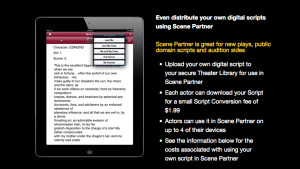
For ISTE 3 I was able to find an app, ScenePartnerApp, that would assist me in modeling digital age learning in my classroom and content area. Students using this app will be able to upload their script and use the text reader as a scene partner when memorizing their lines. This technology provided the discipline specific resource I needed to teach with technology.
Linked to Blog Post on ISTE 3
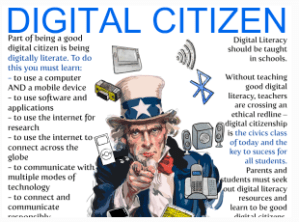
Given the lack of resources that I found that are discipline specific I leave my research with two action points that I intend to pursue. First, I will continue to integrate screen casts and self-produced material in my classroom. It has proven to be, and I believe will continue to be, an effective pedagogical tool. One new aspect of this will be teaching students about digital citizenship.
Linked to Digital Citizen Post
Second, I will use online communities (such as LinkedIn) to connect with teachers from across the globe. I have already started to do this through LinkedIn; the results of this outreach have been effective. Not only have I been able to ask questions of teachers in multiple disciplines, including theatre, but I have been able to present my research to these groups and offer my expertise to other teachers.
Linked to ISTE5 Post
By using technology in my classroom I am providing the needed tools to my students so that they can participate in a digital future. Teaching digital literacy and citizenship is the civics class of today and a needed part of every classroom.
Lastly, I plan to create a theatre curriculum that is entirely supported online. I would like to pilot a remote learning theatre program that will allow students from across the globe to connect through theatre performance. This would go a long way towards providing the resources – to other educators – that I struggled to find for myself.
Standards Based Education is an essential component to effective teaching practice; teachers must use learning targets that are connected to the standards and effectively measure student progress toward those standards.
I have come to embrace the rubric as an essential standards based teaching tool. Used correctly, the rubric can:
Guide student learning throughout the lesson.
Support student self-assessment.
Proved feedback for future student improvement.
Direct teacher assessment that is qualitatively and quantitatively equal from one student to the next.
Align to standards and measure desired outcomes.
In teaching my introductory monologue unit for sixth grade drama, I utilize a rubric that is effective in all four areas. The rubric provides simple statements that describe student achievement across five essential areas of acting. I expect that all five of these areas will continue to progress across the three year sequence; consequently, I do not expect students to achieve a perfect score in their initial performances.
Many teachers will use a rubric at the end of a unit to grade a project. While this is an effective use of the rubric, there is often a missed opportunity to use the rubric throughout the lesson. In my sixth grade drama class I use the rubric to guide student learning. Students that pre-view the levels of achievement in the rubric have the opportunity to stretch their learning into the desired category. I purposefully include levels of achievement that are beyond typical sixth grade achievement. I introduce the rubric as “level based” and not point based. Using the metaphor of Karate Belts, students can conceptualize the idea that different students will be achieving at different levels. Pre-viewing the rubric will also give students an understanding of the entire project in advance of starting any work. This pre-view will help students make connections from one area of assessment to another and plan accordingly.
A well-designed rubric can be easily read and understood by each student. I take the time to explain the content in my rubric for this unit and ask that students explain it back to me. The student voice component here is an essential element of assessing the student achievement in relationship to the learning target aligned to the lesson. The rubric also includes the content of each learning target that is included in the unit. Because of this, a rubric will also help students to self-assess their progress throughout the lesson or unit. Students that work from the rubric can see where they are fully completing the task and where they need to continue to work (O2).
During the process of the project, the teacher can use the rubric as a quick method of assessment and feedback for the student. They can ask the student where they believe they are at any given level, reflect to the student on their observations, and use the rubric as a common language. The teacher can also point to work on the rubric that would take the student to the next level. If the rubric is organized for learning, each step should follow a logical progression of skills.
Regarding formative and summative assessment, the teacher can use the rubric for assessment. This assessment will clearly have a quantitative value where points are assigned across a number of categories. However, the categories can also be viewed with qualitative assessment in mind. I can use the rubric to describe the academic journey of the student.
Lastly the rubric includes the content that the learning targets support. If students work with the learning targets in each lesson and demonstrate developing or basic mastery of each learning target, they will easily score in the mid to high range of the rubric.
In future editions of the rubric, I plan to increase the effectiveness and include the actual learning targets for the unit within the rubric. This will increase the connection for each student form the individual lessons to the culminating project of performing a monologue. It will also assist students to assess their daily progress in relationship to the rubric and the learning targets simultaneously.
Journal Entry from October 27, 2014 for Theatre Methods
What is…
Lazarus (2012) describes a model of Comprehensive Theatre Education. I strive to create this model in my classroom. I strive to have all students experience all aspects of theatre education. It is through the common experience of acting that I have each of my students also act, direct, design, manage, and research their productions. I also integrate other subjects into my classroom; most recently I have had collaborations with English (in the study of Shakespeare), Art (in the creation of puppets for puppet theatre), Physical Education/Health (in improvisation with Health Topics), and in Music (with creating sound scores for the annual school show). I have Comprehensive Arts Education program. The challenge is, of course, finding the curricular time to accomplish all the goals of a comprehensive program.
Comprehensive Arts Education is defined by three central ideas: a holistic arts education, an interdisciplinary education, and an integrated program. Really, this encapsulates the idea that theatre is every subject. I have told my students for years that they must be scholars if they want to be great actors. It is only through an understanding of academic knowledge of multiple fields that they can bring life to a wide range of characters.
Responding to the learning progress of every student is a crucial step of successful teaching and can improve instruction in multiple ways; teachers must use standards based assessment that can be used for both formative and summative outcomes; students should use these same standards for self-assessment (P3).
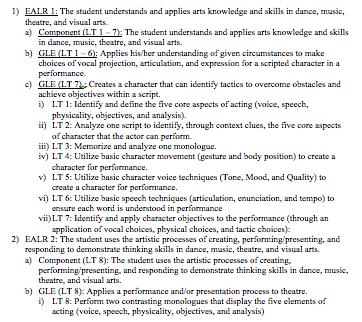
My eighth grade drama class is currently working on scenes from “Merchant of Venice.” In the previous year, they passed the eighth grade Essential Academic Learning Requirements (EALR) standards, dictated by the Office of Superintendent of Public Instruction (OSPI). This year, they are working towards basic high school proficiency (9th and 10th grade EALR levels). To do this they must pass a series of Grade Level Expectations and OSPI Assessments. These assessments cover areas of character physicality and speech. Both of these components are tested in a summative rubric used at the end of the 10-week long unit. This summative rubric is derived from the EALR standards at the desired grade level.
Prior to this year the student skill level was assessed qualitatively, in comparison to state EALR, without the OSPI Assessments. This year, the rubric is completely derived from these assessments. In doing so, I improve the reliability of the student outcomes.
To improve as a teacher, one must reflect upon their progress, plan for future instruction, and adapt standards that are uniform across classes while allowing for the diverse needs of each student (P1). I have and will continue to do this in my teaching practice (E1).
It is interesting to think about teaching as a practice. It is never something that is perfected – it is practiced. Like medicine or an instrument it must be a continual activity where the practitioner improves and changes over time.
At the beginning of the summer, I made very general comments about lesson plans as I reflected on my past experience in the classroom. I stated, “At a basic level, lesson plans are a guide for the class. Lesson plans help to prepare for and to teach a class. A clear plan will help students understand the purpose, learning goals, and content.” I still stand by what I said. Continue reading “Planning for Instruction”




 David Orace Kelly