
Tag: Learning Standards
Testing in Multiple Modalities (Course Reflection, Inquiry and Assessment)
 Many people have experienced the ability to learn in different modalities. For instance, I memorize information best while I am walking. Many students in my class have demonstrated a visual preference for learning; they write and draw information to retain it. Other students in my class have shown their best growth when they talk to each other about their learning. Empirically, teachers and laypeople alike, understand that there are multiple modalities for learning. Why is it that student evaluation does not encompass the modality of learning?
Continue reading “Testing in Multiple Modalities (Course Reflection, Inquiry and Assessment)”
Student State Testing Results (course reflection Inquiry and Assessment)
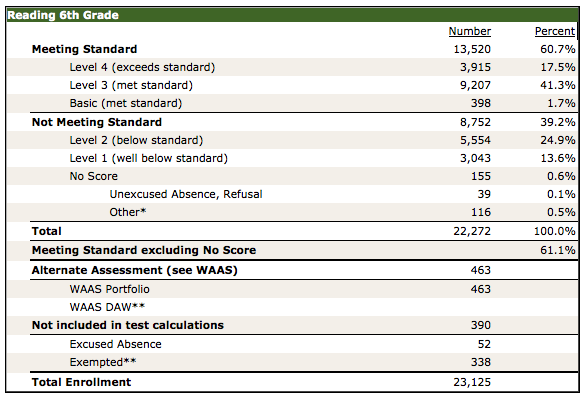
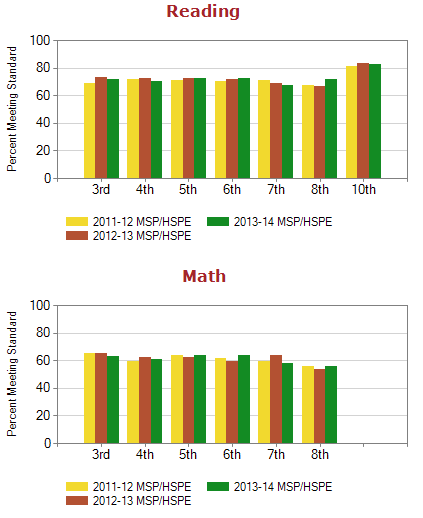 The 2013-14 Washington Office of the Superintendent for Public Instruction test for Sixth Grade Reading Scores indicate that 30% of students exceed the standards (level 4) and 41% of students met the standard (level 3). This means that approximately one third of all sixth grade students are not meeting grade level standards. On the same test the Math Scores for sixth grade indicate that 28% of students exceeded standards (level 4) and 34% of students met standards. Again approximately one third of all students did not meet the standards. In 2013-14 there were approximately 48,000 students taking these tests and these scores, across each grade level stay at approximately the same rate of passing and failure.

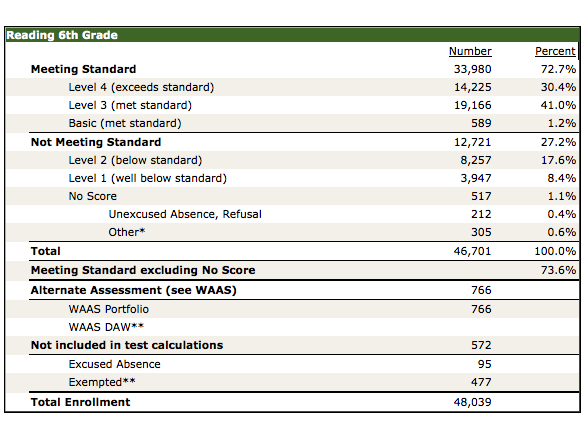
Across demographic categories, girls marginally outperform boys in reading and math. Above the group average, more than 80% of Asian students (10% of respondents) pass both tests and Hispanic students (20% of respondents) have an aproximate 50% passing rate on both tests, below the full group results.
Approximately half of all of students (23,000 in total) taking these tests are low income; one third of students in this category did not pass the reading assessment and half did not pass the math assessment.

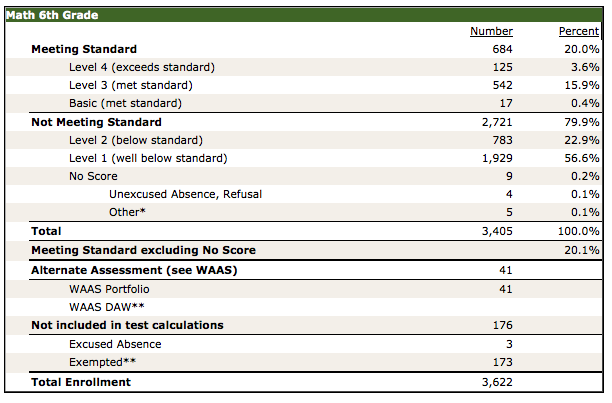
Just under 10% of students taking this test have low English abilities. Approximately only 20% of students in this category pass in either category.

Testing Does Not Measure Teacher Effectiveness
 Teacher evaluation is necessary; it is a needed part of overall education reform. But – teacher testing is not the solution to improve schools. The current model of evaluating teachers, students, and schools, based on a snapshot test, results in counter-intuitive results, counter-productive teaching, and damaging practices to the entire school system. There are better ways to improve teaching outcomes and evaluate teacher performance. Continue reading “Testing Does Not Measure Teacher Effectiveness “
Standards in Education are Good
A Standards based education is essentially a good thing under the following conditions:
- Standards are applied equally to all grade levels and content areas
- Standards take into account student differences (learning abilities especially)
- Standards are used diagnostically for improvement in both teachers and students
- Student history is integrated into any standards based assessment
Condition One: Equal Application
Currently the Common Core State Standards are not applied to the arts or social sciences. I applaud the national application of standards that allow states to bring every student to the same level. However, the focus on writing and math is very, “old-school.” Students must engage in topics that expand beyond the “R’s” for a high-quality education, something that No Child Left Behind aimed to do for every student in the country.
Condition Two: Student Differences
Not every student is made equally. Students may have disabilities or superior talents. If a standards based approach is to work it should function more like Karate Levels than grade levels. Standards should be comprehensive and thorough. When a student passes one level they should be expected to have mastered a dependable amount of the material in that level for a given subject. This means a revolution in the school system. A student can be at level X in one subject and level Y in another. This happens to some degree with advanced placement courses. However, it should happen throughout education. Students advance at different paces and have different learning abilities. There should be no reason that a student should take algebra simply because they are in ninth grade. A student should take algebra because they have mastered the content that supports algebra.
Condition Three: Focus on Improvement
Students and teachers can both benefit from the feedback that standard based assessment can offer. Standards can highlight the strengths and weaknesses of the learning process. A good teacher and a good student can respond to the diagnostic standard test and use the feedback to greater effect in their learning. However, students and teachers should be allowed to not pass a standard in curriculum content. When the pressure to pass is removed, students and teachers can have the freedom to assess their abilities and strengthen their weaknesses.
Condition Four: Student Chronology
Just as standards should be used to evaluate the matriculation of a student from one level to the next, the past experiences and testing of a student should be weighted along with current student performance. A student may have a history of difficulty in a given subject. This historical information must be used when creating an individualized education plan for that student in that subject. The student should not be allowed to continually fail. If they are placed in a course designed around their leaning abilities they are more likely to succeed. This is both a pro-active and retroactive approach to teaching. The most specialized teachers should be diagnosticians that can bring the students abilities to light and prescribe the treatment appropriate to the individual.
Proposed Changes: Revolution
The changes that I propose here are not entirely simple to administer. They would require a revolution in the education industry for the United States. More teachers would be needed to provide an approach to teaching that embraces differentiation and individualization. Classrooms would need to adapt to a level based education instead of a grade-based education. Teachers would need to design coursework that was appropriate for multiple age levels. These adaptations would need to account for student development as well so that content could also be adapted to chronological maturity. Students would need to focus directly on the learning of the content and ignore the passing of the time from August to June. Lastly, the nation would need to agree on a system of content specific standards that are aligned to ability not chronology and further agree on the meaning of a high-school diploma.
 David Orace Kelly