Parent and Teacher Conferences for Effective Education

Teachers must utilize effective relationships with parents to maintain effective educational practices with each student. Effective Teacher-Parent Relationships are characterized by:

  • A partnership based model.
  • Shared values and goals, with the parent and the teacher agreeing on the desired outcomes of the education along with the academic path that will be most effective.
  • Mutual respect for time and expertise. Communication between teachers and parents is most effective when both people have an equal voice in the shared goals for the student along with an appreciation for the amount of time that either can attribute to the academic or social progress of the student.
  • Mutual accommodations to compensate for deficiencies on either side of the relationship. For example, a teacher may benefit from providing a translator to the parent of an English Language Learner (ELL) student and a parent may benefit from providing relevant developmental information and history about the student that the teacher would not otherwise know.
  • Regular communication from both the teacher and the parent so that the partnership can be ongoing rather than exclusive to a crisis or intervention.

Conferences with parents are an essential tool for effective communication between parents and teachers. These conferences happen in a variety of formats and are essential to developing positive relationships that are focused on the academic and social growth of the student in question. Conferences may or may not include the student. However, it is a best practice to bring the element of student voice to the conference, regardless of the student being in attendance. The two most common formats of a conference are casual and formal.

Casual Conferences occur spontaneously. Characterized by informal meetings, these conferences may occur at school, on the phone, or even in the broader community setting (Jordan, Reyes-Blanes, et. al. 1998). Research shows that frequent, early, and positive communication from teachers to parents is a consistently effective way to build productive partnerships between parents and teachers (Gregory and Ostrosky, 2013).

Formal Scheduled Conferences typically have an intended purpose. These purposes can include, but are not limited to, an academic check-in to evaluate student strengths and challenges, an academic intervention to address specific student challenges, and academic assessment of learning abilities to develop an Individualized Education Program (IEP). All three types can occur commonly. Addressing general academic strengths and challenges is a good practice for every student. Interventions are more effective when both the parents and the teachers agree on the purpose, plan, and goals of the intervention; which is why a conference can be valuable. Also, developing an IEP must include input from the parent of the student so that, like an intervention, the purpose, plan, and goals of the IEP are clear and agreed upon (Jordan, Reyes-Blanes, et. al. 1998).

When preparing for a conference the teacher must allow for ample time for the conference to occur. At a minimum conferences last 30 minutes when everyone involved has time to participate in the discussion. However, the teacher must also respect time restraints so that the conference does not last too long and create a scheduling conflict for any of the participants.

Parents can feel uncomfortable and vulnerable around teachers and other education professionals due to their own experiences in education (Jordan, Reyes-Blanes, et. al. 1998). Teachers should be advised to create a family centered environment so that families are comfortable at the school (Gregory and Ostrosky, 2013).

Parents may have their own concerns about their relationships with a teacher, in addition to the experiences of their child (Jordan, Reyes-Blanes, et. al. 1998) and may have either a positive or negative impression of teachers because teachers can be seen as self-appointed “experts” (Gregory and Ostrosky, 2013); when this occurs communication becomes a teacher monologue, rather than a dialogue between teachers and parents (Guo, 2010). One way to avoid this is to approach the meeting from a team-building perspective.

In part because of this perceived monologue effect, teachers must be aware of their potential attitudes toward parents; this is especially important when the parent comes from a different demographic (cultural, economic, geographic, etc.) than the teacher (Jordan, Reyes-Blanes, et. al. 1998).

Some of the issues that teachers may encounter, when addressing demographic differences, are:

  • The concept of family and family roles.
  • Expectations for student behavior.
  • Expectations of teacher behavior.
  • Expectations of parent involvement.
  • Socio-economic resources, especially as they apply to schoolwork that occurs outside of the home.

Of particular note are parents that speak little or no English. One of the greatest under-represented cultural demographics in school communities is that of ELL parents (Guo, 2010). These parents need to have a translator present at the meetings; the school should provide a translator as a part of creating an accessible and fair education for every student. The translator can provide a comfortable and welcoming element to the meeting in addition to explaining school specific content that is culturally contained, such as what Social Studies or Science may courses include (Guo, 2010). Without a translator the teacher risks alienating the parent and consequently eliminating any potential supports that could occur outside of school.

In a formal conference setting, the teacher must also work to ensure the physical comfort of all participants. The physical arrangement of the conference can facilitate or inhibit the progress made in addition to the relationship between parent and teacher (Jordan, Reyes-Blanes, et. al. 1998). The area must be comfortable for adult sized bodies, maintain privacy and confidentiality, include a seating arrangement that is non-hierarchical, and a seating arrangement that is focused on eye contact without physical barriers between participants (Jordan, Reyes-Blanes, et. al. 1998). One common seating arrangement is with adult sized chairs placed in a circle.

Student Portfolios in Conferences are an excellent way to exhibit student work, academic progress, and engage student voice. By integrating a student portfolio into the conference the conversation can be targeted to a qualitative and quantitative discussion (Juniewicz, 2003). Avoiding the litany of summative assessment scores, a qualitative discussion can highlight student achievement and student weaknesses in a non-confrontational way. While it does require teachers to assist in the creation of the portfolios, it can be student-centered. If implemented early in the school year, students can be held accountable for maintaining a student portfolio that is kept in the classroom. The student should be instructed to include work that features their strengths, academic growth, and academic challenges. It should be noted that parent reactions to a portfolio-based conference will vary. Some parents will assert that the qualitative description from their child is extremely helpful for their understanding of their child’s academic abilities. Other parents will complain that the conference does not allow for private communication between teacher and parent (Juniewicz, 2003).

While teacher and parent schedules are busy, it is a best practice to utilize multiple conferences throughout the year, in both formal and informal formats. In doing so, the lines of communication will not be limited to a single meeting and the relative accumulation of data will give both teachers, parents, and students a valid and reliable interpretation of the student’s academic standing. Teachers should remember that parent communication is an essential part of effective education.

REFERENCES:

Gregory A. Cheatham & Michaelene M. Ostrosky (2013). Goal Setting During Early Childhood Parent-Teacher Conferences: A Comparison of Three Groups of Parents, Journal of Research in Childhood Education, 27:2, 166-189

Guo, Y. (2010). Meetings Without Dialogue: A Study of ESL Parent-Teacher Interactions at Secondary School Parents’ Nights. (Undetermined). School Community Journal, 20(1), 121 – 140.

Jordan, L., Reyes-Blanes, M. E. Peel, B. B., Peel, H. A., & Lane, H. B. (1998). Developing teacher-parent partnerships across cultures:.. Intervention in School & Clinic, 33(3), 141.

Juniewicz, K. (2003). Student Portfolios with a Purpose, Clearing House, 77(2), 73-77.
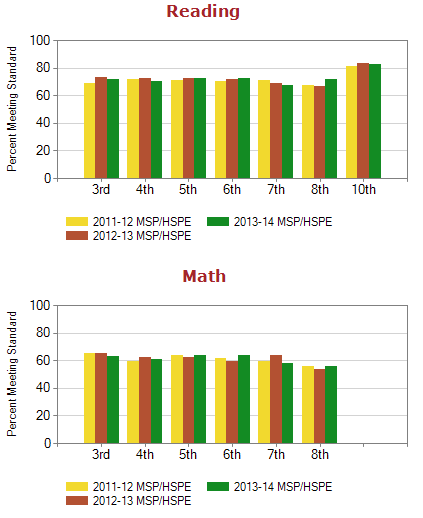
Student State Testing Results (course reflection Inquiry and Assessment)

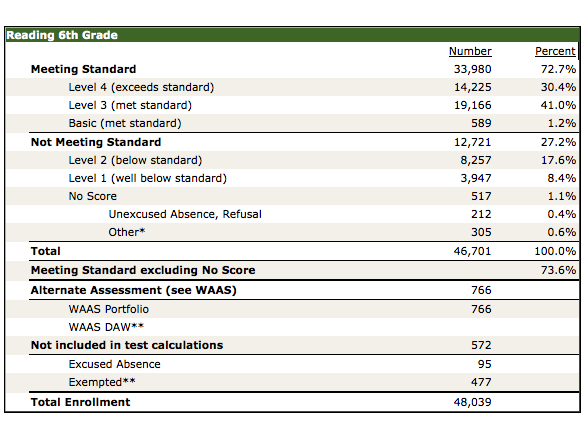
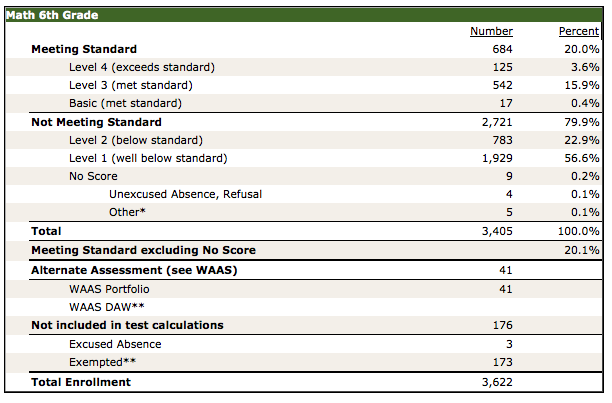
Screen Shot 2014-11-09 at 12.27.21 PMThe 2013-14 Washington Office of the Superintendent for Public Instruction test for Sixth Grade Reading Scores indicate that 30% of students exceed the standards (level 4) and 41% of students met the standard (level 3). This means that approximately one third of all sixth grade students are not meeting grade level standards. On the same test the Math Scores for sixth grade indicate that 28% of students exceeded standards (level 4) and 34% of students met standards. Again approximately one third of all students did not meet the standards. In 2013-14 there were approximately 48,000 students taking these tests and these scores, across each grade level stay at approximately the same rate of passing and failure.

GEN TEST MTH GEN. TEST READ

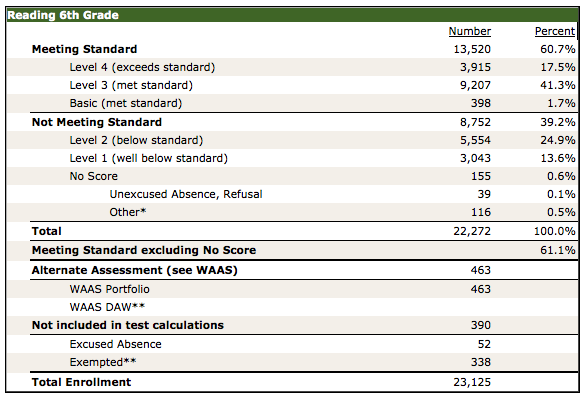
Across demographic categories, girls marginally outperform boys in reading and math. Above the group average, more than 80% of Asian students (10% of respondents) pass both tests and Hispanic students (20% of respondents) have an aproximate 50% passing rate on both tests, below the full group results.

Approximately half of all of students (23,000 in total) taking these tests are low income; one third of students in this category did not pass the reading assessment and half did not pass the math assessment.

LOW INC. MTH LOW INC. READ

Just under 10% of students taking this test have low English abilities. Approximately only 20% of students in this category pass in either category.

LOW ENG. MTH LOW ENG. READ

Testing Does Not Measure Teacher Effectiveness 

test-taking-tipsTeacher evaluation is necessary; it is a needed part of overall education reform. But – teacher testing is not the solution to improve schools. The current model of evaluating teachers, students, and schools, based on a snapshot test, results in counter-intuitive results, counter-productive teaching, and damaging practices to the entire school system. There are better ways to improve teaching outcomes and evaluate teacher performance. Continue reading “Testing Does Not Measure Teacher Effectiveness “

ONLINE SURVEY and KWL

Using the KWL model (Know, Want to know, and Learning accomplished) is an effective tool for educators to assess student progress and gauge engagement with the content. A teacher must understand the previous knowledge of each student’s abilities; they must activate the students desire for knowledge based on what the students want to know; the must assess what students have learned. Assessing student knowledge can be cumbersome. With multiple tests, exit tickets, and paper surveys, it can build up on a teacher’s desk and quickly end up in the recycling. Instead, a teacher can effectively integrate technology into the classroom through online surveys; in doing so, students are introduced to the technology that will make their education more simple and efficient (P4).

This year, I started using Google Forms for all of my classes. It is an effective method of collecting (and keeping) student

Continue reading “ONLINE SURVEY and KWL”

ONLINE SURVEY and KWL

Using the KWL model (Know, Want to know, and Learning accomplished) is an effective tool for educators to assess student progress and evaluate engagement with the content. A teacher must understand the previous knowledge of each student’s abilities; they must activate the students desire for knowledge based on what the students want to know; they must assess what students have learned. Assessing student knowledge can be cumbersome. With multiple tests, exit tickets, and paper surveys, it can build up on a teacher’s desk and quickly end up in the recycling. Instead, a teacher can effectively integrate technology into the classroom through online surveys; in doing so, students are introduced to the technology that will make their education more simple and efficient.

This year, I started using Google Forms for all of my classes. It is an effective method of collecting (and keeping) student information. These surveys can serve as pre-assessment tools, formative assessments, and summative tests. Through Google Forms, I can customize the experience. By adding navigation functions from one question to the next, I can send a survey link to every grade level and the survey will sort out the questions that the respondent needs to answer based on their previous responses. This was most helpful when I designed a survey for all students as they prepared for their student conferences. I am also able to limit the number of responses to one per respondent; this means that students cannot retake a test.

With Google forms, I can quickly gather student data on the relevant topic. More importantly, I can access that data anywhere I have an Internet connection. I can easily send out a survey to an entire class, including students that are sick or absent for the day. Now, I no longer need to track down a student that has not completed a survey. I can simply send them an email reminder to complete the work online.

PRE-ASSESSMENT: At the start of the semester, I wanted to know what my eighth grade students knew about Shakespeare. Before we started the unit, I had them take this quick “quiz.”

https://drive.google.com/open?id=1QDW4v-2B0M2iRcUSwqPKpoAGTg8esIhgQen4nF_86KA&authuser=0

I was able to use the results to gage my lessons. At the end of the unit, students will take the same quiz and I will be able to compare the results and assess learning for all students as individuals and as a class.

FORMATIVE WORK: Discovering what the students KNOW and what they WANT to know, I implemented a survey that assessed student progress to date. In the seventh grade, so that I could quickly evaluate each students progress with their playwriting project, I implemented a survey. I used the student laptops so that I could demonstrate the process in class. Each student was able to fill out the form during class time during this first round while I was available to answer any technology questions.

https://drive.google.com/open?id=14hndDn2MEJTz4miOcWkbU4uWXHD56jsij1DhgpH4CfU&authuser=0

In answering the survey, I was able to find what the students wanted to write about (what they wanted to know). I was also able to assess how well they knew the format that I wanted them to use (what the knew).

SUMMATIVE WORK: Here I used the survey tool as a summative assessment. This is the third portion to a state standards test for Drama in Pantomime (what they learned). Students had to respond to a performance they presented in class the day prior.

https://drive.google.com/open?id=1xNAAo4gTekec3z5Bby_dM1FZYFor2RNWoI-oxrlUFB4&authuser=1

One may have a concern about the ‘take-home-test.’ However, in this case, there is no information that the student can look up on the Internet that will help them. There are no notes that they may have that will give them the answers to the questions and students must use their class materials to complete the test. When the take-home-test is an option, the survey format is excellent.

In summary, I have seen a great deal of benefit in efficiency and student buy in with the online survey. Students see it as “cool” that they get to do homework online and I am able to keep all the responses without any additional paperwork. I aim to further my pursuits in online survey work.

There were a small handful of students that do not have Internet access at their homes. However, students are able to access their email accounts at school. Because of this, I allow multiple days for the completion of the survey so that students can access the form from school.

In future versions of the online form, I will be sure to make the directions clear in the answer (e.g. select two answers). In one form I created, many students gave me the feedback that the form was confusing due to one question where the requirement to select two answers was unclear.

Because of the success of Google forms and Google docs, I aim to integrate Google Presentations into my classroom next. I envision a project that requires multiple students to collaborate into a single presentation.

Multiple Choice Tests: All of the Above

When addressing the validity of multiple-choice tests, there are many things to be concerned about. Multiple choice testing can be many things to many students.

  • Multiple Choice Testing (MCT) is a means to conformity
  • MCT can cover a great amount of material in a single test
  • MCT can also lead to student confusion with poorly constructed prompts
  • MCT can also be “beaten” by the experienced student
  • MCT does not address complex understanding of the given topic
  • All of the above.

1) A MEANS TO CONFORMITY: Every child will take at least one high stakes standardized test in his or her life. From the S.A.T. to state standardized testing, MCT is unavoidable in the current education system. Therefore, regardless of the content, there is an educational benefit to a teacher offering MCT in everyday curriculum. Students must learn to take this type of test. While conformity is not always desired, it does allow schools across the country to assess the abilities of one student against the next in an equal and uniform way.

Continue reading “Multiple Choice Tests: All of the Above”

THE ALL POWERFUL RUBRIC

Standards Based Education is an essential component to effective teaching practice; teachers must use learning targets that are connected to the standards and effectively measure student progress toward those standards.

I have come to embrace the rubric as an essential standards based teaching tool. Used correctly, the rubric can:

  • Guide student learning throughout the lesson.
  • Support student self-assessment.
  • Proved feedback for future student improvement.
  • Direct teacher assessment that is qualitatively and quantitatively equal from one student to the next.
  • Align to standards and measure desired outcomes.

In teaching my introductory monologue unit for sixth grade drama, I utilize a rubric that is effective in all four areas. The rubric provides simple statements that describe student achievement across five essential areas of acting. I expect that all five of these areas will continue to progress across the three year sequence; consequently, I do not expect students to achieve a perfect score in their initial performances.

Screen Shot 2014-10-26 at 10.59.48 AMMany teachers will use a rubric at the end of a unit to grade a project. While this is an effective use of the rubric, there is often a missed opportunity to use the rubric throughout the lesson. In my sixth grade drama class I use the rubric to guide student learning. Students that pre-view the levels of achievement in the rubric have the opportunity to stretch their learning into the desired category. I purposefully include levels of achievement that are beyond typical sixth grade achievement. I introduce the rubric as “level based” and not point based. Using the metaphor of Karate Belts, students can conceptualize the idea that different students will be achieving at different levels. Pre-viewing the rubric will also give students an understanding of the entire project in advance of starting any work. This pre-view will help students make connections from one area of assessment to another and plan accordingly.

A well-designed rubric can be easily read and understood by each student. I take the time to explain the content in my rubric for this unit and ask that students explain it back to me. The student voice component here is an essential element of assessing the student achievement in relationship to the learning target aligned to the lesson. The rubric also includes the content of each learning target that is included in the unit. Because of this, a rubric will also help students to self-assess their progress throughout the lesson or unit. Students that work from the rubric can see where they are fully completing the task and where they need to continue to work (O2).

During the process of the project, the teacher can use the rubric as a quick method of assessment and feedback for the student. They can ask the student where they believe they are at any given level, reflect to the student on their observations, and use the rubric as a common language. The teacher can also point to work on the rubric that would take the student to the next level. If the rubric is organized for learning, each step should follow a logical progression of skills.

Regarding formative and summative assessment, the teacher can use the rubric for assessment. This assessment will clearly have a quantitative value where points are assigned across a number of categories. However, the categories can also be viewed with qualitative assessment in mind. I can use the rubric to describe the academic journey of the student.

Lastly the rubric includes the content that the learning targets support. If students work with the learning targets in each lesson and demonstrate developing or basic mastery of each learning target, they will easily score in the mid to high range of the rubric.

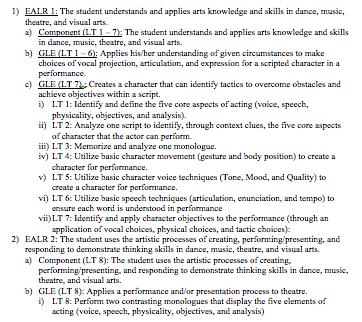
Screen Shot 2014-10-26 at 12.32.03 PMIn future editions of the rubric, I plan to increase the effectiveness and include the actual learning targets for the unit within the rubric. This will increase the connection for each student form the individual lessons to the culminating project of performing a monologue. It will also assist students to assess their daily progress in relationship to the rubric and the learning targets simultaneously.

FAIR INSTRUCTION: (Classroom Management)

Classroom centered instruction, including sheltered instruction, must be connected to the communities within the classroom and the school; a teacher must have the knowledge and skills for working with multiple stakeholders within the classroom community.

After observing my mentor teacher for the past several years, I have developed an approach to classroom management that is aligned with my own teaching philosophy and comes from the best practices I have observed in my mentor teachers.

The classroom is home to many individuals; every individual is expected to perform at the same basic level. However, each individual approaches the classroom with a different set of skills, diverse backgrounds, and a wide range of attitudes to any given subject matter or class. The teacher must navigate these differences and provide fair treatment to each student. Fay and Funk (1995), promote the idea that fair is not always equal. Different students need different approaches to the content in the classroom. This concept can be integrated into the general classroom management that the teacher implements in the classroom.

One example of fair treatment is through sheltered instruction. In my classroom, there are a few students that are English Language Learners (ELL). These students require additional support within and outside of the classroom environment so that they can continue to perform at grade level expectations (GLE). Sheltered English instruction engages English Language Learners with grade level content and academic skills that are aligned with the mainstream classroom and aim to increase English proficiency. Continue reading “FAIR INSTRUCTION: (Classroom Management)”

Assessment Cycle Formative to Summative

Responding to the learning progress of every student is a crucial step of successful teaching and can improve instruction in multiple ways; teachers must use standards based assessment that can be used for both formative and summative outcomes; students should use these same standards for self-assessment (P3).

My eighth grade drama class is currently working on scenes from “Merchant of Venice.” In the previous year, they passed the eighth grade Essential Academic Learning Requirements (EALR) standards, dictated by the Office of Superintendent of Public Instruction (OSPI). This year, they are working towards basic high school proficiency (9th and 10th grade EALR levels). To do this they must pass a series of Grade Level Expectations and OSPI Assessments. These assessments cover areas of character physicality and speech. Both of these components are tested in a summative rubric used at the end of the 10-week long unit. This summative rubric is derived from the EALR standards at the desired grade level.

Prior to this year the student skill level was assessed qualitatively, in comparison to state EALR, without the OSPI Assessments. This year, the rubric is completely derived from these assessments. In doing so, I improve the reliability of the student outcomes.

Continue reading “Assessment Cycle Formative to Summative”

Chapter Tests Bloom in Taxonomy

One of the most sophisticated things a teacher can do is to offer appropriate challenge in the content area; curricula must be both standards driven and allow students to develop their competencies using multiple skill areas (e.g. reading, writing, oral communication, and technology).

Teaching social studies in the sixth grade breaks down into two central categories: ancient civilizations and academic writing. Both are based on state or national standards. Every unit, organized around one or both of these pillars, combines all the skills of Blooms Taxonomy.

The application of Blooms Taxonomy into lesson planning, along side learning standards, follows a natural progression that assists in the development of the student (P3); the use of different question types to provoke learning and assess progress is highly effective. When it comes to the end of the unit, students should be able to demonstrate their mastery across all of Blooms six categories: knowledge, comprehension, application, analysis, Evaluation, and Synthesis.

Students often start with a hook into the knowledge. For the unit on Mesopotamia we may watch a quick introduction video, in this case Bugs Bunny on Mesopotamia.

Continue reading “Chapter Tests Bloom in Taxonomy”