Portfolio

FAIR INSTRUCTION: (Classroom Management)

Classroom centered instruction, including sheltered instruction, must be connected to the communities within the classroom and the school; a teacher must have the knowledge and skills for working with multiple stakeholders within the classroom community.

After observing my mentor teacher for the past several years, I have developed an approach to classroom management that is aligned with my own teaching philosophy and comes from the best practices I have observed in my mentor teachers.

The classroom is home to many individuals; every individual is expected to perform at the same basic level. However, each individual approaches the classroom with a different set of skills, diverse backgrounds, and a wide range of attitudes to any given subject matter or class. The teacher must navigate these differences and provide fair treatment to each student. Fay and Funk (1995), promote the idea that fair is not always equal. Different students need different approaches to the content in the classroom. This concept can be integrated into the general classroom management that the teacher implements in the classroom.

One example of fair treatment is through sheltered instruction. In my classroom, there are a few students that are English Language Learners (ELL). These students require additional support within and outside of the classroom environment so that they can continue to perform at grade level expectations (GLE). Sheltered English instruction engages English Language Learners with grade level content and academic skills that are aligned with the mainstream classroom and aim to increase English proficiency. Continue reading “FAIR INSTRUCTION: (Classroom Management)”
Assessment Cycle Formative to Summative

Responding to the learning progress of every student is a crucial step of successful teaching and can improve instruction in multiple ways; teachers must use standards based assessment that can be used for both formative and summative outcomes; students should use these same standards for self-assessment (P3).

My eighth grade drama class is currently working on scenes from “Merchant of Venice.” In the previous year, they passed the eighth grade Essential Academic Learning Requirements (EALR) standards, dictated by the Office of Superintendent of Public Instruction (OSPI). This year, they are working towards basic high school proficiency (9th and 10th grade EALR levels). To do this they must pass a series of Grade Level Expectations and OSPI Assessments. These assessments cover areas of character physicality and speech. Both of these components are tested in a summative rubric used at the end of the 10-week long unit. This summative rubric is derived from the EALR standards at the desired grade level.

Prior to this year the student skill level was assessed qualitatively, in comparison to state EALR, without the OSPI Assessments. This year, the rubric is completely derived from these assessments. In doing so, I improve the reliability of the student outcomes.

Continue reading “Assessment Cycle Formative to Summative”

Chapter Tests Bloom in Taxonomy

One of the most sophisticated things a teacher can do is to offer appropriate challenge in the content area; curricula must be both standards driven and allow students to develop their competencies using multiple skill areas (e.g. reading, writing, oral communication, and technology).

Teaching social studies in the sixth grade breaks down into two central categories: ancient civilizations and academic writing. Both are based on state or national standards. Every unit, organized around one or both of these pillars, combines all the skills of Blooms Taxonomy.

The application of Blooms Taxonomy into lesson planning, along side learning standards, follows a natural progression that assists in the development of the student (P3); the use of different question types to provoke learning and assess progress is highly effective. When it comes to the end of the unit, students should be able to demonstrate their mastery across all of Blooms six categories: knowledge, comprehension, application, analysis, Evaluation, and Synthesis.

Students often start with a hook into the knowledge. For the unit on Mesopotamia we may watch a quick introduction video, in this case Bugs Bunny on Mesopotamia.

Continue reading “Chapter Tests Bloom in Taxonomy”

Student Empowerment: Sign Two

Journal Entry from October 12, 2014 for Theatre Methods

When I consider the voices in my classroom – the voices that are shared with the performance space, my first thought is that of the playwright. I believe that the actor, in training or professional, has a duty to the words; the actor must bring the text to life. My second thought, as a teacher, is that the voices of my students must be heard. It is their learning experience; if a student can own the work – put their own name on it, there is an incentive to the student for increased ‘buy-in’ to the process. It is exactly this engagement that brings the words of the playwright to life in new ways. My students have the freedom to approach a text with a fresh and empowered perspective. That is why I am in theatre arts – I relish the empowered perspective of a student that demands full participation of each student. This was certainly true of my education; I received a high school theatre training that emphasized my full participation.

Reflecting, specifically on my high school theater experience, my teacher (much beloved) had a style that emphasized projects – often projects that he did not do much or any teaching for. The teaching in his class came after two weeks of practice. Students would present their scene and he would critique for twenty minutes after each scene. Sitting from the back of the theatre, in his bully pulpit, he lectured on the merits and faults of what we presented. He offered little in the way of technique. What he did offer was a drive for his approval. As far as I was concerned, my theatre teacher was the guru of art. For an angst-ridden teen this was exactly what drove my passion for theatre. Getting the approval of my theatre teacher was more valuable than gold.

Screen Shot 2014-10-09 at 7.57.01 PM
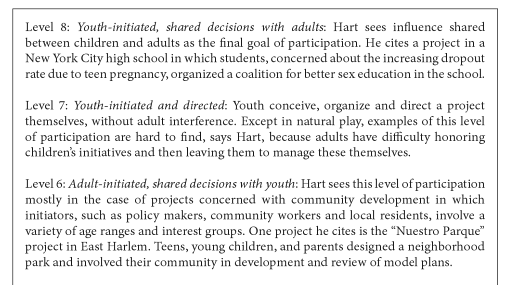
Level 8 (Lazarus, 2012)

Nearly, two decades later, how does this experience reflect and resonate in my classroom? Now that I have been teaching for several years, I have developed a style that is very hands on; my style is almost the opposite of my high school theater teacher. For example, I often base a lesson in a specific learning target that includes a specific acting or performance skill. I Continue reading “Student Empowerment: Sign Two”

Theatre Changes: Sign One

Journal Entry from October 5, 2014 for Theatre Methods

IMG_2406On the theme of reflection and change, Lazarus (2012) proposes a series of questions to engage with Appreciative Inquiry. The first question: what is it that has changed in the last year of my teaching; what has stayed the same? The simplest of my answers, I have enrolled in graduate school, MAT and certification. After seven years of developing my middle school drama program and ten years of teaching youth theatre, I have chosen to take this climactic step so that I can change my practice of teaching: in doing so it is my hope to become a better teacher with increased efficacy, increased student impact, and increased knowledge regarding the implementation of best practices.

This does not mean that I have lacked impact over my teaching career. I have had Continue reading “Theatre Changes: Sign One”

STEM v. ARTS?

A teacher is a practitioner of education. Because of this, their understanding and contextual information continues to grow. To nurture this growth, they must collaborate with colleagues, reflect on their experiences, and evaluate their progress based on the feedback from their collaborations and reflections.

One deep aspect of reflection that I engage with continually is the relevance of arts education. Continue reading “STEM v. ARTS?”

Theatre of Differentiation

Over the course of teaching and teacher training, it is important to center one’s practice on areas of potential growth. To do this, one must be reflective, collaborative, and evaluative of one’s teaching practice.

From one classroom to the next and one student to the next, education is never the same. There are similar aspects and best practices that are universal. However, the reality of it is that every day educators face new situations caused by a combination of contextual issues that come with each student.

These issues include: developmental issues of nature and nurture, an integration of multiple learning styles, and a student’s Zone of Proximal Development.

Nature and Nurture: As I noted in the first class discussion, neither side is every completely correct. Continue reading “Theatre of Differentiation”

Teaching Values: Choices, Influences, Future Choices

IMG_1784My Values: There are malleable values that collectively change over time; as Aristotle (Keuss, 2014) posited, the community has shared values derived from the city-state. Most of the values I have adopted from my city-state come from human rights movements, religious freedom, feminism, anti-slavery, workers rights, LGBTQ rights, etc. In general the majority of the human population has agreed (more so with some than others) that these values represented in these movements have cemented principles of right and wrong. In doing so, the historical context has given a code of morals and ethics that I share with my community. Additionally, like Augustine (Keuss, 2014), I have developed my own morals, values, and ethics through inward reflection and my own sense of what is virtuous. Though, this second framework has developed much more significantly in my adult life. Abstract thought and self-reflection are not skills found in children. These are skills that are developed over time.

Following the definition given by Pojman (2014), and given these two aspects in my development as an ethical person, I would put myself into the Pluralist Nonhedonist Camp. There is good in all things. This good is pleasurable. However, pleasure can become self-indulgent and one can seek “higher” virtues such as freedom, community belonging, and love. It seems that my formulation of right and wrong has been established in a nature and nurture relationship. My inner nature both initiates and harmonizes with values that evolve into my moral construct. At the same time, my praxis of ethics and morals comes from my community; my actions are affirmed by their approval.

The Influence of Values on Teaching: A teacher is an agent of the government and must represent the laws of the state and country; neutrality is crucial. Teachers should be fair, cover as many religions as possible, speak from experience, allow students to speak from their personal experience, and stay away from any prescriptions of how to be or what to do. These things should provide fairness to religion and non-religion alike. As Glenn Tinder (2014) suggests in the article “Can We Be Good Without God?” personal dignity disappears when “liberty for all human beings and equality under the law—becomes indefensible.” The classroom is an excellent place for dignity for all, religious and non-religious alike, because ultimately we live in a society with many different viewpoints and I, for one, would like my students to engage the world with respect and liberty. Tinder may call this agape. I call it common sense (E3). Continue reading “Teaching Values: Choices, Influences, Future Choices”

Essential Theatre Standards in Washington State

Context: In 2002, the arts were identified as a core academic subject in the State of Washington by the Elementary and Secondary Education Act (ESEA); this act defined the arts as consisting of four distinct disciplines: dance, music, theatre, and visual arts (Dorn, Joseph, Vavrus, 2011). ESEA essentially established that the arts were equally important to all other subjects because only a well-rounded education can increase the academic development of every student. Because of this, standards were created for each of the arts (O1).

The learning standards for the arts, including Theatre, can be found on the website for Office of Superintendent of Public Instruction (OSPI). They can be viewed online or downloaded as a PDF or Word document.

Searching for standards is easy, providing that there is an existing knowledge of the Essential Academic Learning Requirements (EALR) for the arts. The first EALR is centered on student understanding of arts knowledge, the second focuses on the student artistic process of creation, the third emphasizes student communication through the arts, and the fourth demands that students make connections across the arts and other disciplines (Dorn, et. al, 2011). A comprehensive chart of the four EALR can be found at the conclusion of this document (see Figure One). Continue reading “Essential Theatre Standards in Washington State”

Planning for Instruction

To improve as a teacher, one must reflect upon their progress, plan for future instruction, and adapt standards that are uniform across classes while allowing for the diverse needs of each student (P1). I have and will continue to do this in my teaching practice (E1).

It is interesting to think about teaching as a practice. It is never something that is perfected – it is practiced. Like medicine or an instrument it must be a continual activity where the practitioner improves and changes over time.

At the beginning of the summer, I made very general comments about lesson plans as I reflected on my past experience in the classroom. I stated, “At a basic level, lesson plans are a guide for the class. Lesson plans help to prepare for and to teach a class. A clear plan will help students understand the purpose, learning goals, and content.” I still stand by what I said. Continue reading “Planning for Instruction”