
Teachers should exemplify an understanding of the professional responsibilities of teaching and the policies of the school they teach in.
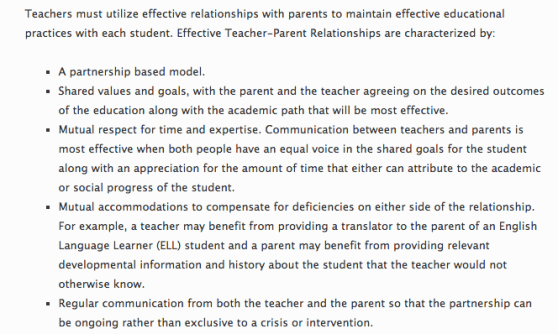
In my recent work as a teacher I have developed a nuanced understanding of effective relationships with parents. Recently I researched into the best practices of parent and teacher relationships and identified five key points for a relationship between a teacher and a parent to be effective for the education of the student in question; the relationship must be partnership based, include shared goals, be based in mutual respect, provide for accommodations on both sides of the relationship, and have regular communication that is both formal and informal.
These best practices, which I wrote about (see figure 1) and produced a video about (see below), are based in my experience as an educator and the work of Cheatham and Ostosky (2013), Guo (2010), Reyes-Blanes, Peel, et al. (1998), and Juniewicz, (2003).
It is a professional responsibility and best practice of any educator to create an ongoing relationship with the parents of each student.
The first reason relationship building is important is that with the relationship the teacher develops an advocate and resource that will enhance the student’s understanding and learning outside of the classroom. An educator, at best, gets one-third of the day with each student. The parents of the students, at best, get the remaining two-thirds of the time; the parents are in an equal or better position to be influential in the academic outcomes of their student.
Secondly, each parent is a stakeholder in the community and a taxpayer (or tuition funder) that supports the development and continuation of the school. By involving parents into the process of education, teachers are acting with due diligence to their constituents, the community. Schools exist for the public good and those that fund and participate in schools deserve to know what is happening in the schools.
In completing the research, and in spite of my eight years as a teacher, I was impressed by the literature that presented educators as figures that are feared. There are parents that have little respect or appreciation for educators, or purposefully distance themselves from educators, because of their own experience with education. This increases the importance of building a positive partnership that is team-based, rather than a model of opposition or submission.
When an educator and a parent team-up with shared goals and values the student has a significantly increased chance for academic growth. Just this year I have seen an ELL student advance beyond his peers because of an intensive parental involvement in this student’s education. This involvement would not have been possible without an ongoing, weekly often and daily at times, relationship with the parents of this student.
While there are limitations on my time, I would like to increase my competency with parent-teacher relationships. One way I can do this is to focus on early and frequent positive communication about the students that I teach; this is one clear area that I can improve in. While phone calls and emails home along with ad hoc meetings after school and formal conferences have been productive, a method that I have not employed in the past has been through a message in the school bulletin. A brief statement that informs parents what we are working on in class and invites parents to contribute in ways they are comfortable would be an excellent way to establish a relationship that would allow parents to make the initial contact rather than myself making the first contact to the individual. This would also bring parents into the classroom and increase their buy-in to the program as a whole because their voices would be heard.
References:
Gregory A. Cheatham & Michaelene M. Ostrosky (2013). Goal Setting During Early Childhood Parent-Teacher Conferences: A Comparison of Three Groups of Parents, Journal of Research in Childhood Education, 27:2, 166-189
Guo, Y. (2010). Meetings Without Dialogue: A Study of ESL Parent-Teacher Interactions at Secondary School Parents’ Nights. (Undetermined). School Community Journal, 20(1), 121 – 140.
Jordan, L., Reyes-Blanes, M. E. Peel, B. B., Peel, H. A., & Lane, H. B. (1998). Developing teacher-parent partnerships across cultures:.. Intervention in School & Clinic, 33(3), 141.
Juniewicz, K. (2003). Student Portfolios with a Purpose, Clearing House, 77(2), 73-77.

 David Orace Kelly